Researchers found that starfish (Asterias rubens) move across complex surfaces without a brain by adjusting contact behavior in each tube foot. Using refractive glass imaging, the team mapped footprints and discovered that crawling speed depends on how long feet stay attached rather than on how many feet touch the ground. Weighted backpacks (25%–50% body weight) and inverted trials confirmed that tube feet lengthen adhesion under greater load, revealing a robust, decentralized locomotion strategy.
How Starfish Walk Hundreds of Feet Without a Brain — The Clever Science of Tube Feet
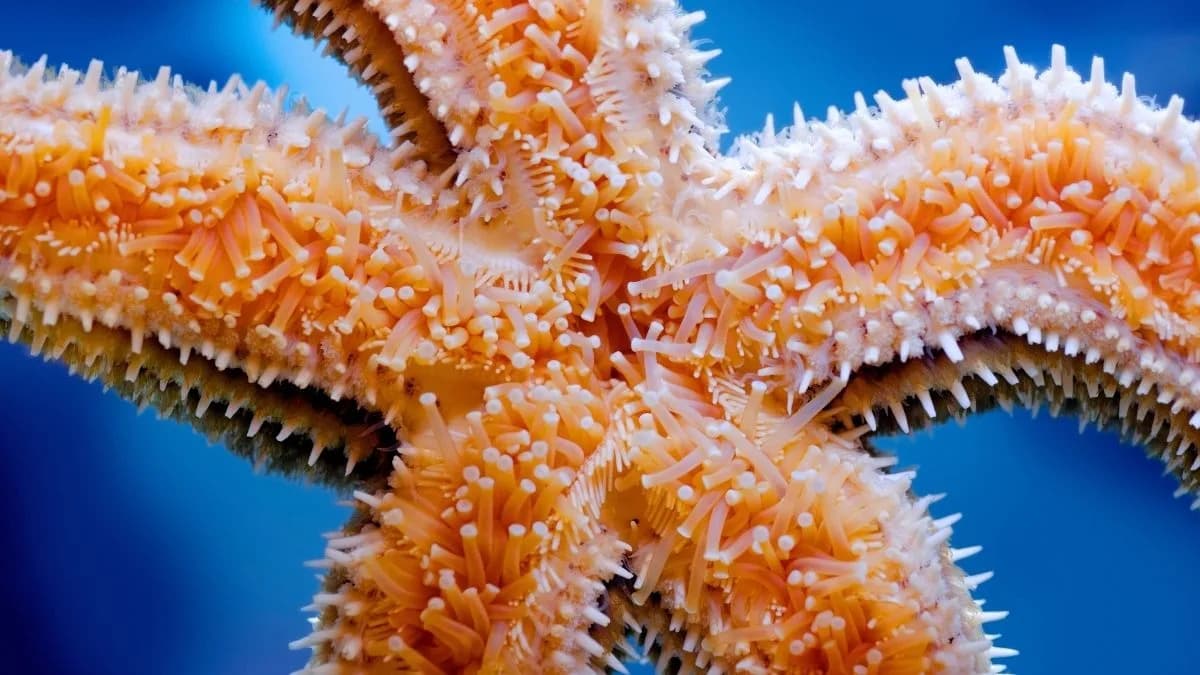
underside of a common starfish, showing its many pale orange tube feet, on a blue background
Starfish (sea stars) are expert climbers. These many-armed invertebrates traverse vertical faces, flat expanses and even inverted surfaces — no substrate seems too rocky, slimy, sandy or glassy — and they do it without a centralized brain or nervous system.
An international team of biologists and engineers recently published a paper in the Proceedings of the National Academy of Sciences showing that starfish locomotion is surprisingly sophisticated. Rather than relying on central control, starfish adapt their movement using local, load-sensitive adjustments in each tube foot.
What Are Tube Feet? On the underside of each arm are rows of hydraulic appendages called tube feet (podia). Each tube foot has a flexible muscular stem that pumps fluid through the water vascular system to produce motion and a flattened adhesive disk at the tip that secretes protein-rich slime to stick to surfaces — and likely secretes a different substance to release when detachment is needed.
The common starfish Asterias rubens carries four rows of tube feet per arm. Coordinating hundreds of such appendages might seem to require centralized control, but the new experiments reveal a different strategy: decentralized, mechanically driven coordination.

Audition now for ScienceAlert's Casting Call
To map which feet were active at any moment, researchers recorded starfish crawling on illuminated, highly refractive glass. Each contact changed the way light refracted through the glass, producing bright dots that marked footprints. That imaging approach has been used previously to study contact patterns in insects, other animals and human feet.
Surprisingly, the animals' crawling speed stayed roughly constant regardless of how many tube feet were in contact with the substrate. Instead, the critical variable was adhesion duration: when each tube foot stayed attached longer, overall crawling slowed. This pattern suggests that individual tube feet adjust their contact time in response to local mechanical load rather than following commands from a central nervous system.
To test that idea, the team added small weighted 'backpacks' equal to 25% or 50% of each starfish's body weight. As predicted, extra load produced longer adhesion times for tube feet and correspondingly slower crawling. The researchers also studied inverted locomotion (starfish moving along the 'ceiling') using experiments and computer simulations; tube feet changed their contact behavior when the animal was upside down relative to gravity.
"Together, our findings demonstrate that sea stars adapt their locomotion to changing mechanical demands by modulating tube foot–substrate interactions, revealing a robust, decentralized strategy for navigating diverse and challenging terrains," the authors write.
These insights not only deepen our understanding of how animals without centralized brains control complex behaviors, they also suggest design principles for soft robots and distributed control systems that must adapt locally to variable loads and surfaces.
Help us improve.