Microscopic organisms outperform humans when performance is scaled by body length: researchers use body lengths per second to compare diverse microbes. Champions include Magnetococcus marinus (~500 BL/s) and Candidatus Ovobacter propellens (~200 BL/s). Other extremes include Spirostomum ambiguum (contracts in ~5 ms and endures ~15 g), Pyrocystis noctiluca (inflates sixfold to manage buoyancy) and Anncaliia algerae (fires a 100 μm polar tube to infect hosts). These feats reveal new biological strategies with potential technological and biomedical applications.
Microbial Olympians: The One‑Celled Champions of Speed, Force and Ingenuity

Human athletes deliver impressive numbers — lugers exceed 90 mph, hockey pucks can travel near 100 mph and elite figure skaters rotate hundreds of times per minute. Yet when movement is scaled to body size, microscopic life outclasses us. Tiny organisms sprint, lunge, eject structures and reshape themselves under forces and speeds that challenge our intuition.
At microscopic scales, viscous forces dominate: swimming is like trying to move through syrup. That environmental constraint, paired with relentless evolutionary pressure, has driven microbes to evolve extreme mechanical solutions. “The small world is not a very kind world,” says Manu Prakash, a bioengineer and oceanographer at Stanford University. “Either you are running away from something, or you are chasing something.”
How Scientists Compare Microbial Performance
Because drag and inertia scale differently with size, researchers compare locomotion using body lengths per second (BL/s). That metric lets a one‑micrometer bacterium be fairly compared with a millimeter‑scale protozoan.
Speed Champions
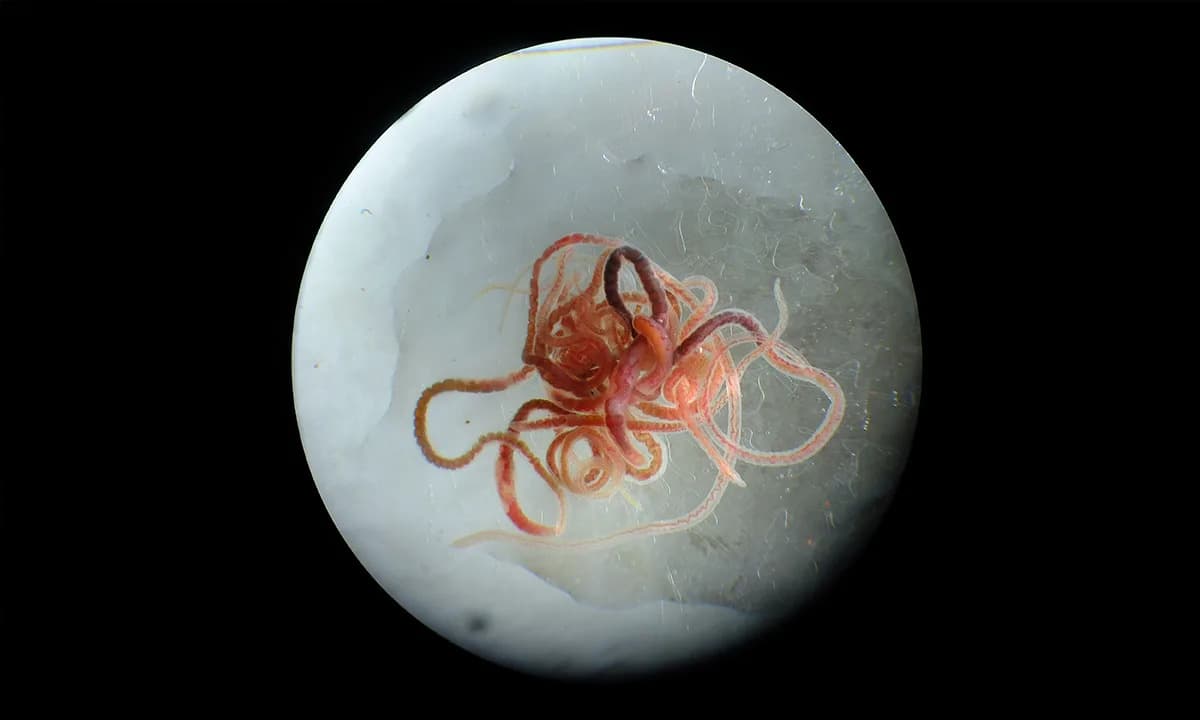
Candidatus Ovobacter propellens (provisionally named) is an egg‑shaped bacterium found about 0.5 m beneath coastal sands off Denmark. Propelled by roughly 400 flagella, it can swim up to ~1 mm/s — about 200 body lengths per second for its ~4–5 μm length.
Magnetococcus marinus is a much smaller, near‑spherical bacterium (~1–2 μm) that has been measured at up to ~500 body lengths per second. A specimen from a Rhode Island estuary tumbled so quickly that researchers first struggled to trace it; switching microscopes revealed a helical, corkscrew trajectory driven by two rotating bundles of seven flagella (one anterior, one posterior). When the corkscrew path is accounted for, its total travelled distance — and effective speed — is dramatically higher than a straight‑line estimate.
Its genus name reflects an internal chain of magnetite crystals that works like a compass, guiding the cell toward low‑oxygen zones. That magnetic trait has been exploited experimentally: researchers attached many drug‑filled vesicles to populations of M. marinus, injected them into mice and used external magnets to steer the bacteria near tumors; the cells’ preference for low oxygen then drew more than half of them into tumor interiors, suggesting potential for targeted delivery.
Archaea Can Be Speedy, Too
Archaea are a separate domain of life. A 2012 analysis identified Methanocaldococcus villosus, recovered from a hydrothermal vent north of Iceland, as a rapid swimmer: roughly 468 body lengths per second. This roughly spherical, heat‑loving archaeon uses more than 50 flagella both for swimming and for attaching to surfaces such as hydrothermal chimneys.
Explosive Movements and Shock Absorption
The protozoan Spirostomum ambiguum is millimeter‑scale (1–4 mm) but can contract to less than half its length in about 5 milliseconds. The contraction expels toxins to deter predators and produces a fluid vortex that signals neighboring cells; each responding cell amplifies the wave, producing a colony‑level alarm that propagates far faster than any single cell can swim. During such contractions, S. ambiguum can experience accelerations up to ~15 g, yet it avoids structural damage thanks to a meshwork of internal membranes that act as a biological shock absorber.
Inflation, Buoyancy and the Microbial Slingshot
The bioluminescent dinoflagellate Pyrocystis noctiluca can inflate to roughly six times its starting size in under ten minutes. These plankton migrate vertically over tens of meters: near the surface they photosynthesize, then sink to nutrient‑rich depths to divide. If newborn cells sink too deep, they perform a ‘‘slingshot’’ by taking in fresher, lower‑density water to reduce their own effective density and float back up like buoys.
Microbial Harpoons
Anncaliia algerae, a microsporidium and obligate parasite, exists as a dormant spore ~4 μm long harboring a tightly coiled infective filament called the polar tube (~100 μm long). When triggered in a suitable environment (for example, an animal intestine), the spore fires that polar tube at speeds on the order of ~300 μm/s, piercing host barriers. Remarkably, infectious material — at least multiple copies of fungal DNA and possibly larger cellular components — traverses the tube, which is only ~100 nm across. Given that nuclei are roughly seven times larger in diameter, how they pass through remains an open question; structural biologists suggest the tube may evert (turn inside‑out) as it deploys.
Why These Extremes Matter
Studying microbial extremes expands our understanding of life’s physical limits and reveals clever solutions to mechanical and fluid‑dynamic problems at small scales. Those insights can inspire engineering and biomedical innovations — for example, magnetically guided bacteria for targeted drug delivery or design principles for shock‑absorption systems scaled up from S. ambiguum.
“In the extreme,” Prakash says, “always lies a gem.”
This article is based on reporting and reviews of ultrafast microbes and microbial mechanics; it preserves key experimental observations and retains quotes from cited researchers.
Help us improve.