The study demonstrates that male Andrea cuttlefish use birefringent arm tissues to rotate incoming horizontally polarized light by nearly 90°, creating alternating bands of horizontal and vertical polarization as a courtship signal. Researchers filmed wild pairs under controlled, ocean-like polarized lighting and found the polarization pattern appears only during courtship. The arm's cylindrical shape enhances the effect, acting like a biological waveplate. Findings were published in PNAS and point to a hidden channel of animal communication invisible to human eyes.
Cuttlefish Twist Light to Woo Mates: Males Rotate Polarization With Birefringent Arms
Cuttlefish Literally Twist Light to Attract a Mate, Study Finds
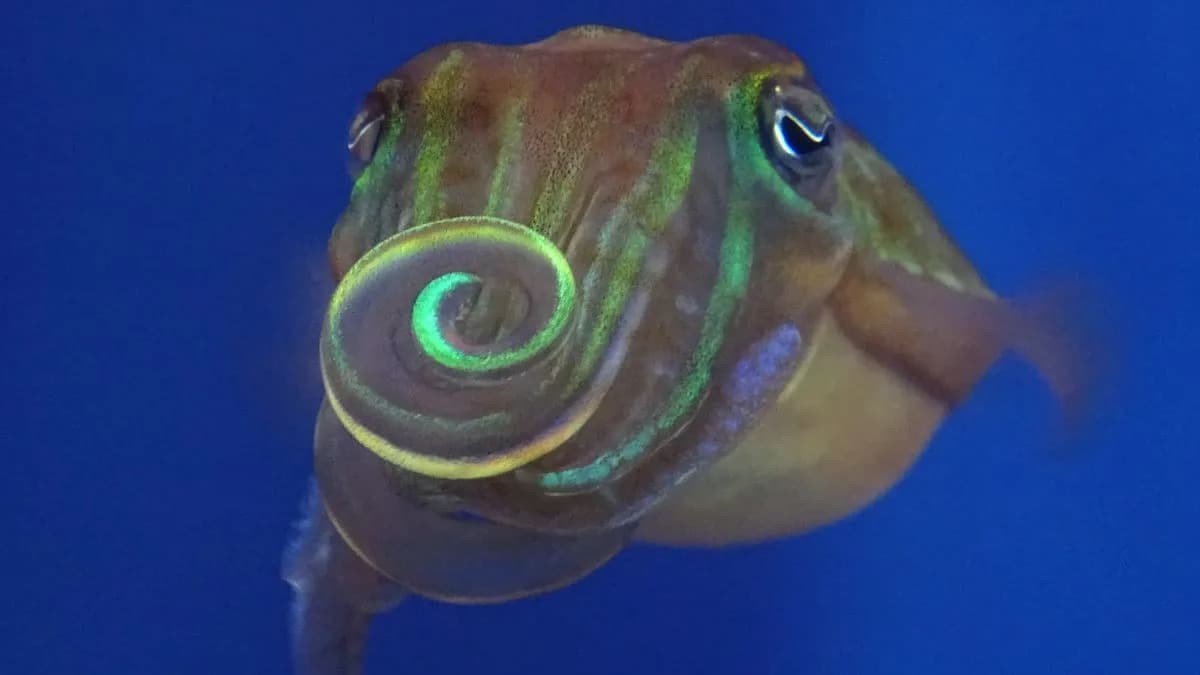
Male Andrea cuttlefish (Doratosepion andreanum) perform a striking optical trick during courtship: they physically twist the polarization of light with specialized arm tissues to create a highly conspicuous signal tailored to other cuttlefish.
How the Signal Works
Cuttlefish eyes are unusual: they have W-shaped pupils and — despite likely being colorblind — can detect the orientation of light waves, a property called polarization. Researchers led by Arata Nakayama at the University of Tokyo show that these animals not only perceive polarization but actively manipulate it as part of their signaling repertoire.

Audition now for ScienceAlert's Casting Call
When horizontally polarized sunlight passes through the translucent, birefringent muscle of a male's extra-long, sexually dimorphic arms, the tissue rotates the light's polarization by nearly 90 degrees to vertical. By twisting the cylindrical arm in a particular way, the cuttlefish produces alternating bands of horizontal and vertical polarization along the arm — a pattern that gives maximum contrast to polarization-sensitive vision.
"Our findings," write Nakayama and colleagues, "show the significant contribution of polarization of light to animal communication and reveal that polarization signals — like colorful sexual ornaments — can achieve high conspicuousness through fundamentally different optical mechanisms."
What the Study Did
The team collected wild Andrea cuttlefish and placed male–female pairs in observation tanks where lighting was carefully controlled to reproduce the horizontal polarization common in shallow ocean waters. Interactions were recorded with polarization-sensitive cameras, and the researchers compared courting displays with non-courting baseline behavior.
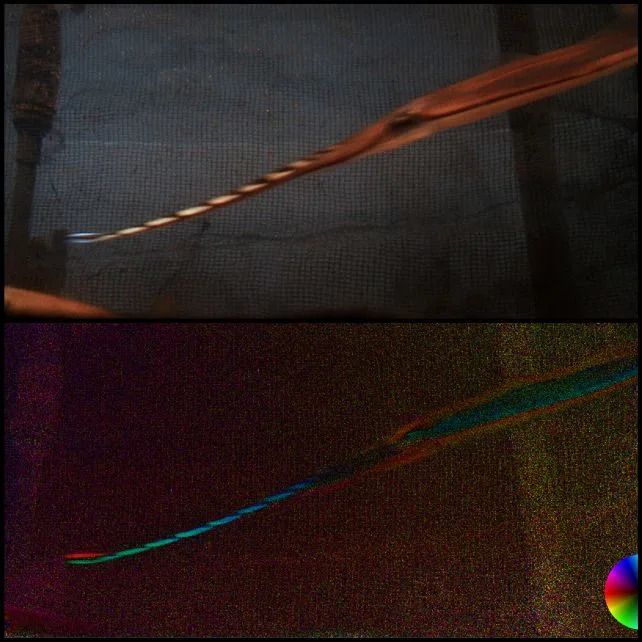
The courtship display of a male Andrea cuttlefish in normal (top) and polarized light (bottom). (Arata Nakayama)
Analysis of the footage showed the polarized bands only appeared during courtship, and were absent in baseline states. The cylindrical geometry of the arm amplifies the effect, effectively acting as a biological "waveplate" specialized for mating displays.
Implications
The discovery adds a hidden dimension to animal signaling: polarization-based ornaments may be widespread among species that perceive polarized light but remain invisible to humans. Whether cuttlefish use such signals in contexts beyond courtship — for example, in aggression or camouflage — remains an open question.
Publication: The study was published in the Proceedings of the National Academy of Sciences (PNAS).
Help us improve.