Ants survive extreme falls because their small size and body design change how they interact with air. They reach terminal velocity in under one second, so they never accelerate to the high speeds that make impacts deadly for larger animals. A high surface-area-to-mass ratio increases air resistance, and a tough exoskeleton helps absorb impact. In other words, terminal velocity — not height — largely determines the danger of a fall.
Why Ants Can Survive a 100-Story Fall — And Humans Usually Can't
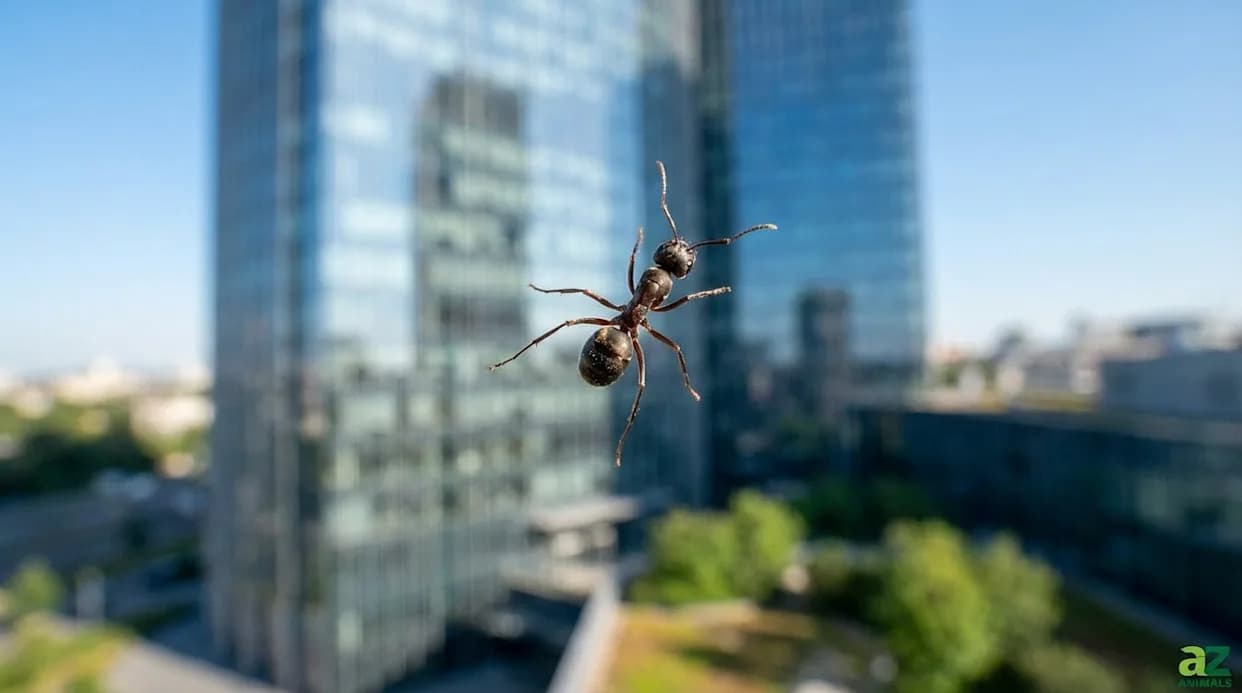
A close-up of an ant crawling on a glass window with a blurred high-rise city building in the background.© A-Z Animals
Some tiny creatures survive falls from heights that would be fatal to people. Ants, for example, can often drop from skyscrapers and walk away. Their size and body design change the physics of falling, and their biology helps them absorb impact.
How Size Shapes Falling
Terminal velocity — the steady top speed an object reaches while falling through air — is central to this difference. For ants and other very small insects, air resistance quickly balances gravity. They reach terminal velocity in under a second and never accelerate to the high speeds that make impacts lethal for larger animals.

An ant that falls from a high place will likely survive.©Faisal.k/Shutterstock.com(Faisal.k/Shutterstock.com)
Surface Area, Mass, and Drag
Most ants are under an inch long, and their light mass combined with a relatively large surface area gives them a high surface-area-to-mass ratio. Air behaves like a fluid, so that ratio determines how much drag an object experiences. For ants, that drag acts much like a tiny parachute, slowing descent and keeping impact speeds low.
Biology: Built to Withstand Impact
A tough, flexible exoskeleton helps ants survive collisions that would crush softer-bodied animals. The exoskeleton spreads and absorbs forces from impact, and many ants simply bounce when they hit the ground rather than shatter or suffer fatal injuries.
What Really Determines Danger
The critical factor in whether a fall is deadly is whether and how fast the animal reaches its terminal velocity — not the absolute height of the drop. Because ants reach a low terminal velocity almost immediately and have resilient bodies, they can survive falls from heights that would be unimaginable for humans.
In short: Tiny size + high drag + strong exoskeleton = a fall that’s survivable for an ant but deadly for a much larger animal.
Help us improve.