The study, published in Physical Review X, shows that two species of aquatic worms—Lumbriculus variegatus and Tubifex tubifex—sweep loose sand into organized piles by undulating their flexible, segmented bodies. Researchers reproduced the effect with a filamentous robot made of linked microbots and confirmed the dynamics with simulations. The key factors are activity and flexibility: longer, more pliable filaments sweep particles over wider areas and form larger clusters. The work points to potential applications in soft robotics and decentralized materials handling.
How Aquatic Worms Sweep Sand Into Neat Piles — And What Robots Reveal About the Physics
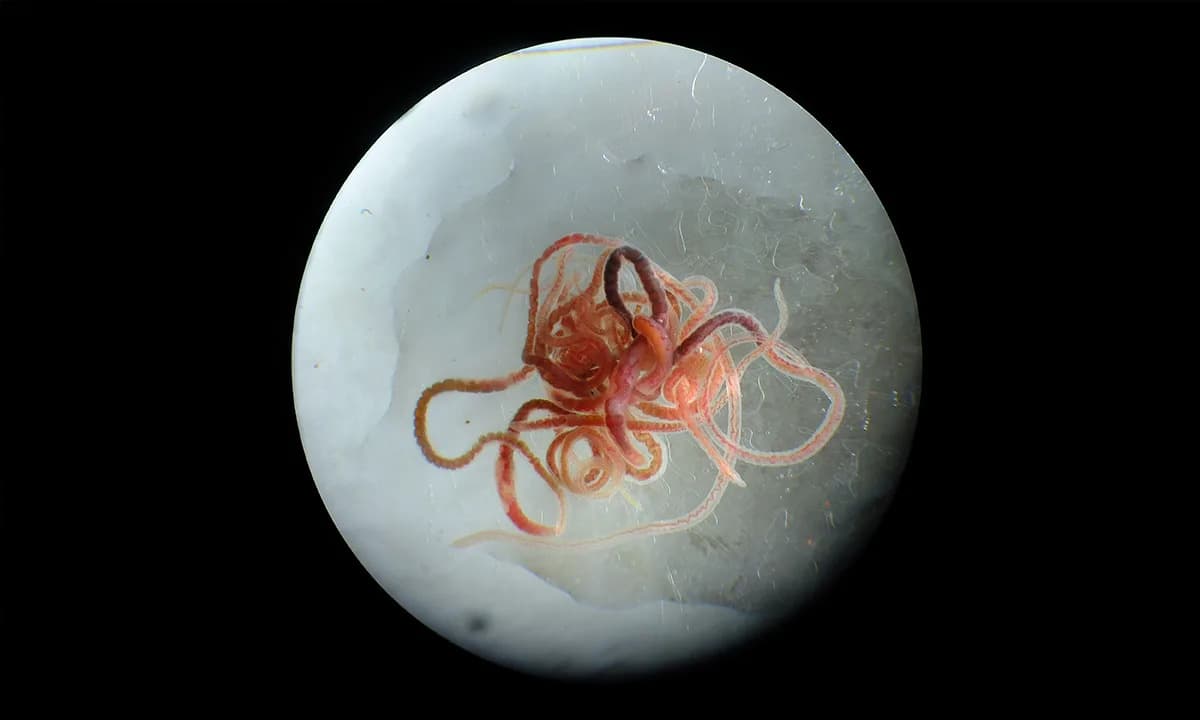
Lead image: JuanCarlosPalauDiaz / Shutterstock
What happens when an aquatic worm is placed in a shallow dish of sand? According to a new study in Physical Review X, two species of tiny aquatic worms naturally sweep loose sand into organized heaps simply by undulating their flexible bodies.
The animals and the observation
The research team — from Georgia Tech, the University of Amsterdam and Sorbonne University — examined the behavior of two very slender, segmented species, Lumbriculus variegatus and Tubifex tubifex. Adults of these species reach roughly 8 inches (≈20 cm). Each body segment contains its own muscles, giving the worms pronounced flexibility and the ability to generate complex undulations. While the animals moved through fine sand, the researchers noticed that their motion consistently reorganized the substrate into piles and clusters. Because these worms lack centralized brains, the effect is not a deliberate "tidying" but an emergent consequence of their movement and body mechanics.
Robotic mimicry and mathematical tests
To probe the mechanism, the team built a filamentous robot: self-propelled microbots connected by flexible rubber links to reproduce the worms' undulating motion. They also ran mathematical simulations of an active filament moving among passive particles in a confined arena. Both the physical robot and the simulations reproduced the animals' sand-sweeping behavior.
"It is fascinating to see how living worms can organize their surroundings just by moving," said Antoine Deblais of the University of Amsterdam. "Their activity and flexibility alone are enough to collect particles and reshape their environment," added Saad Bhamla of Georgia Tech.
Key ingredients and trends
The experiments and simulations identified two essential ingredients for the sweeping mechanism: activity (self-driven undulation) and flexibility (a segmented, pliant body). The team found clear trends:
- More flexible filaments sweep particles from a larger area.
- Longer, more pliable filaments produce larger, denser sand clusters than shorter or stiffer ones.
- The collective effect arises without centralized control; simple local motion of the filament is sufficient to aggregate particles.
Implications
These results bridge biological observation and engineered systems. They suggest that simple, decentralized motion in flexible structures can be harnessed in soft robotics and materials-handling applications to gather, sort, or reorganize granular matter. The findings also contribute to our understanding of how simple organisms can create large-scale environmental structure through purely mechanical interactions.
Originally reported in Nautilus; study published in Physical Review X.
Help us improve.