The James Webb Space Telescope has uncovered MoM-z14, currently the most distant galaxy observed, dating to about 280 million years after the Big Bang. With a record redshift of z = 14.4, the galaxy appears brighter, denser and more chemically enriched than expected for its age. The finding, led by Rohan Naidu and reported in a preprint to be published in the Open Journal of Astrophysics, offers a new window into the cosmic dawn and will be followed by further observations to confirm and expand the discovery.
JWST Reveals MoM-z14 — The Most Distant Galaxy Yet, Seen 280 Million Years After the Big Bang
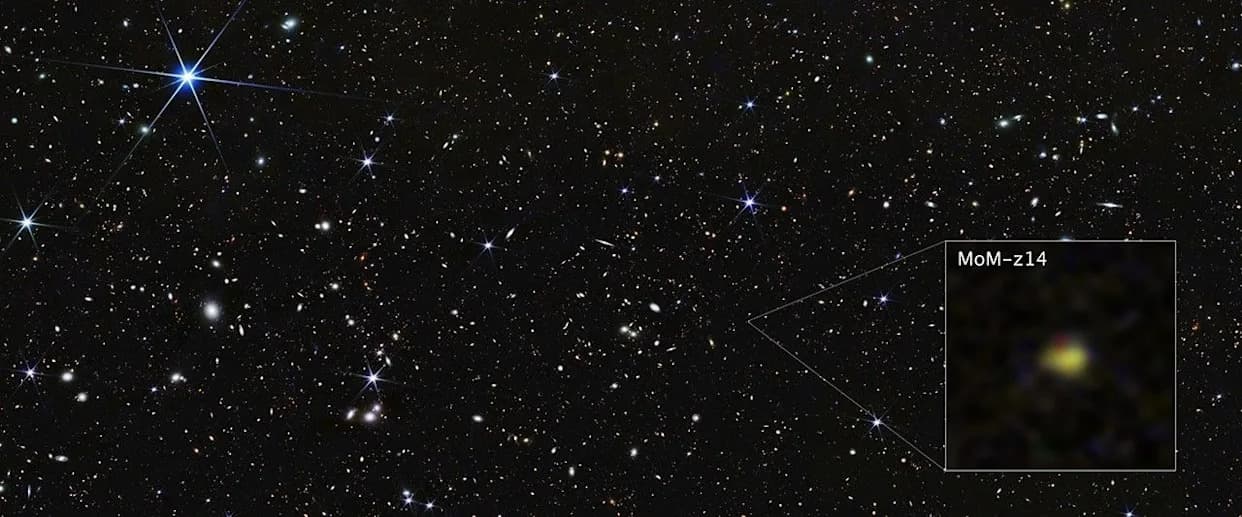
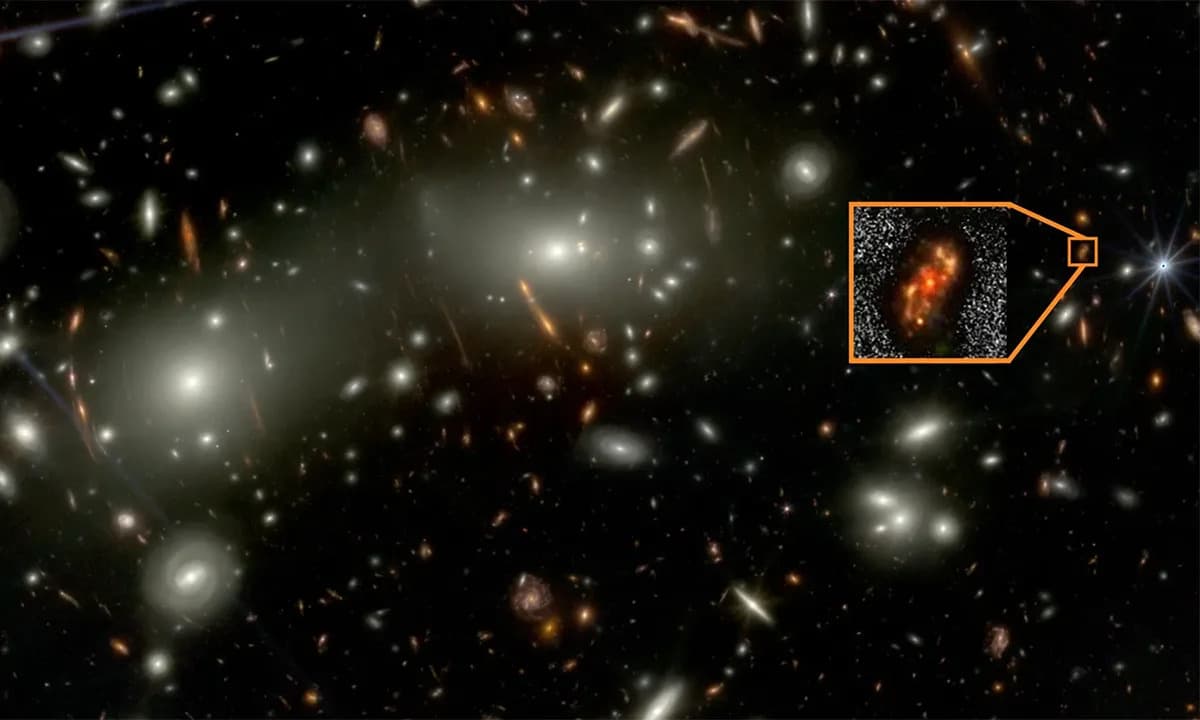
The farthest galaxy ever detected, MoM-z14.(NASA/ESA/CSA/STScI/Rohan Naidu/M.I.T. (image); Joseph DePasquale/STScI (image processing))
Astronomers using NASA’s James Webb Space Telescope (JWST) have identified the most distant galaxy observed so far: a luminous object called MoM-z14, which existed roughly 280 million years after the Big Bang. The discovery, announced by the research team and described in a preprint led by Rohan Naidu (MIT), marks a new record for the earliest cosmic structures detected.
According to the team and NASA, the light from MoM-z14 has traveled for more than 13 billion years to reach our telescopes. The galaxy displays unexpectedly strong emission for its age — appearing brighter, denser, and more chemically enriched than many models predicted for the cosmic dawn.
How the distance was measured: Astronomers use redshift — the stretching of light as the universe expands — to determine how distant and how ancient a source is. MoM-z14 has a reported redshift of z = 14.4, which places it at an epoch when the universe was only a few hundred million years old.
Why this matters
Finding such a bright and enriched galaxy so early challenges some expectations about how quickly stars and heavy elements formed after the Big Bang. MoM-z14 offers a new laboratory to study early star formation, galaxy growth, and the processes that chemically enriched the first galaxies.
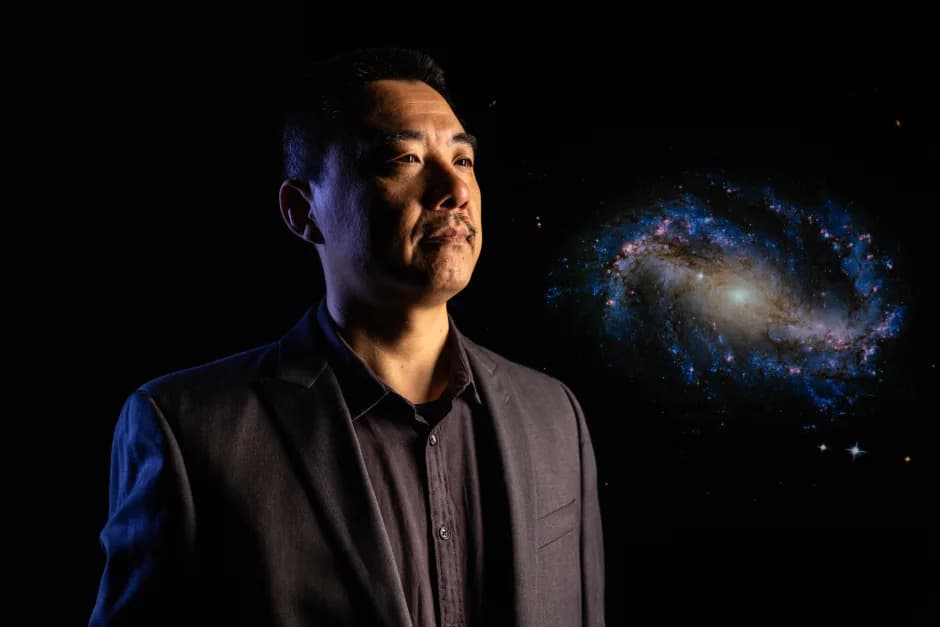
“With Webb, we are able to see farther than humans ever have before, and it looks nothing like what we predicted, which is both challenging and exciting,” said Rohan Naidu, lead author of the preprint, in a NASA statement.
Co-author Yijia Li (Penn State) added that Webb is revealing the early universe in unprecedented detail and that many more discoveries likely lie ahead as observations and analyses continue to improve.
Next steps
The team expects follow-up observations and more JWST surveys to refine properties of MoM-z14 and to uncover even more distant galaxies. Independent confirmation, deeper spectra and additional data will help determine whether MoM-z14 is typical or an unusually luminous outlier in the earliest epochs.
Context note: The discovery is described in a preprint that the authors say will be published soon in the Open Journal of Astrophysics. Independent verification and further peer-reviewed analysis will clarify the implications for early galaxy formation models.
Help us improve.