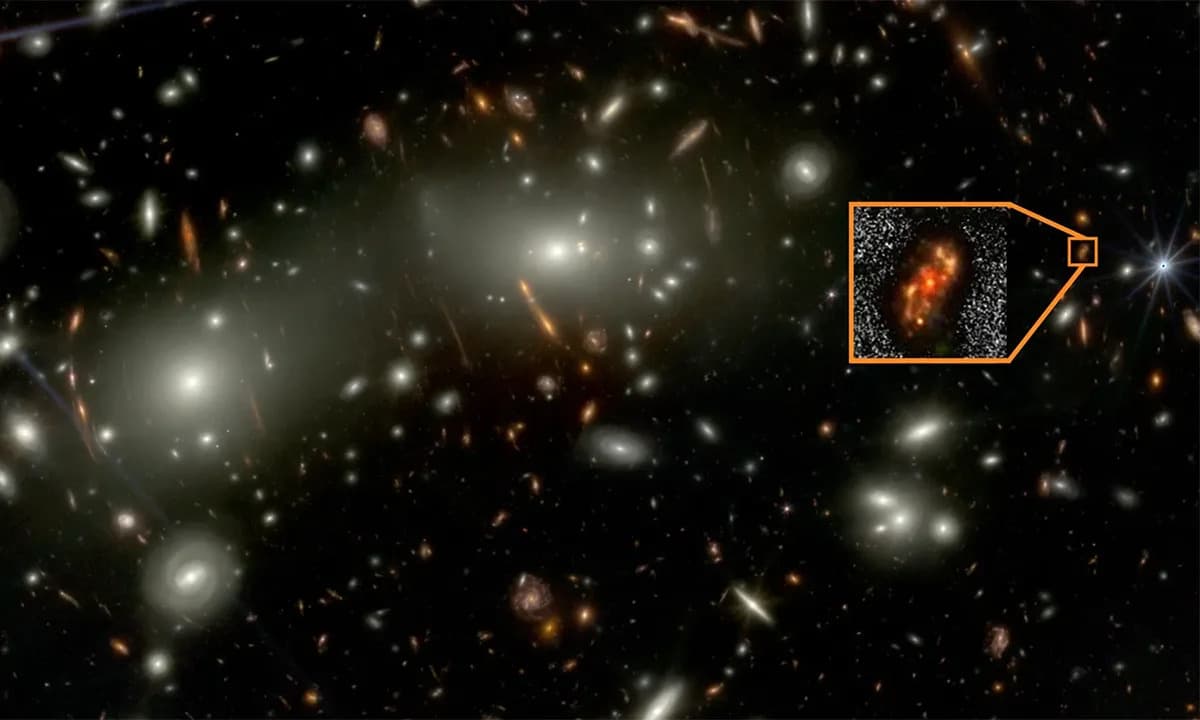
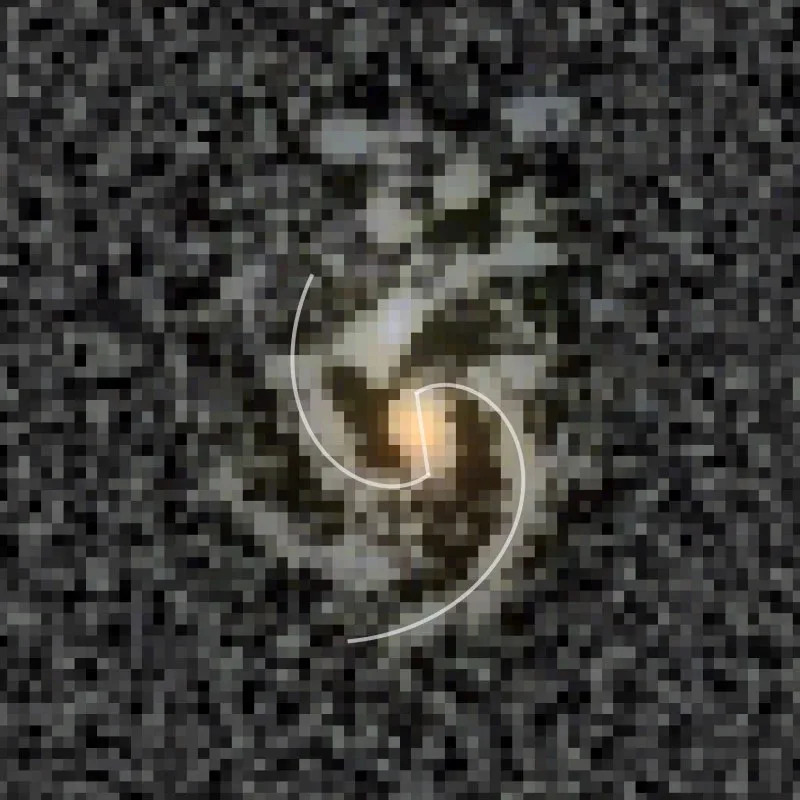
A University of Pittsburgh–led team has confirmed COSMOS-74706 as the most distant spectroscopically verified, unlensed barred spiral galaxy, dating to more than 11.5 billion years ago. The result combines JWST imaging with MOSFIRE spectroscopy on Keck I and was presented at AAS 247 on 8 January 2026. Bars funnel gas inward, can feed central black holes, and influence star formation; this finding helps constrain when bars first appeared in the Universe.
Spectroscopy Confirms Earliest Known Milky Way–Like Barred Spiral — Formed Just 2 Billion Years After the Big Bang
Credit: Ivanov, D. et al. (2026)
A team led by the University of Pittsburgh has identified COSMOS-74706 as the most distant, spectroscopically confirmed, unlensed barred spiral galaxy yet observed, forming just ~2 billion years after the Big Bang. High-resolution imaging from the NASA/ESA/CSA James Webb Space Telescope (JWST) combined with follow-up spectroscopy from MOSFIRE on the Keck I telescope allowed the team to place the galaxy at an age of more than 11.5 billion years.
Observations and Confirmation
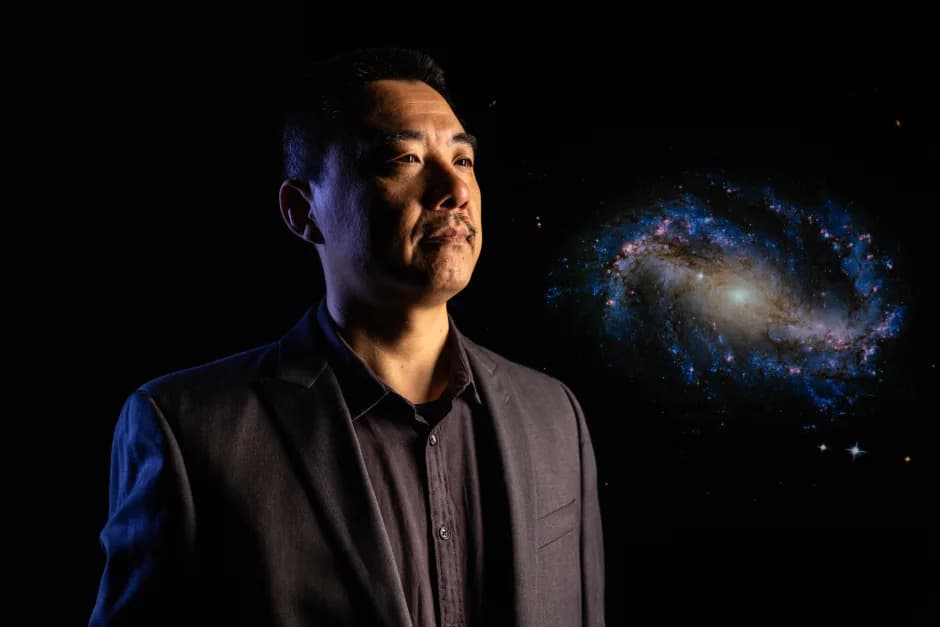
The discovery was led by Daniel Ivanov, a graduate student in Physics and Astronomy at the Kenneth P. Dietrich School of Arts and Sciences. The team first identified the barred spiral morphology in JWST imaging archived at the Space Telescope Science Institute. They then secured independent spectroscopic confirmation with the Multi-Object Spectrograph for Infrared Exploration (MOSFIRE) at Keck I, which provides a more definitive distance and age measurement than lensing-based or redshift-only estimates.
Why This Matters
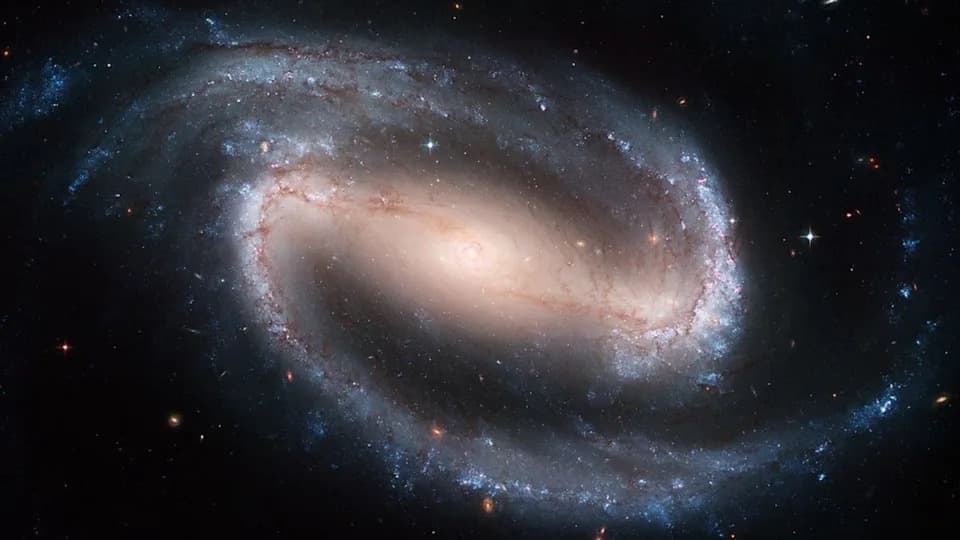
Galaxies are commonly classified by the Hubble Sequence into ellipticals, spirals, and lenticulars. Barred spirals — including our Milky Way — host a linear stellar bar crossing the central region. Those bars play a central role in galaxy evolution: they funnel gas inward from the outer disk, can help feed the central supermassive black hole, and influence (often suppressing) star formation across the disk.
Hubble image of the Barred Spiral Galaxy NGC 1300. | Credit: NASA/ESA/The Hubble Heritage Team (STScI/AURA)/P. Knezek (WIYN)
While simulations have suggested that bars could form very early — potentially as far back as ~12.5 billion years after the Big Bang — direct observational evidence has been scarce. Previous candidate barred spirals at high redshift were often identified using gravitational lensing or crude redshift estimates, both of which introduce extra uncertainties or distortions. Spectroscopy, as used for COSMOS-74706, offers a stronger, more direct confirmation.
"This galaxy was developing bars two billion years after the birth of the Universe — two billion years after the Big Bang," Ivanov said in a University of Pittsburgh news release. "It’s the highest-redshift, spectroscopically confirmed, unlensed barred spiral galaxy. In principle, I think that this is not an epoch in which you expect to find many of these objects. It helps to constrain the timescales of bar formation. And it’s just really interesting."
Presentation and Context
The team presented their results on 8 January 2026 at the 247th meeting of the American Astronomical Society (AAS) in Phoenix, Arizona. COSMOS-74706 adds an important observational data point for models of early galaxy evolution and the formation timeline of structural features such as bars.
Implications: Confirming a barred spiral this early strengthens the idea that internal dynamical processes that produce bars were active within the first few billion years of cosmic history. Further JWST observations and ground-based spectroscopy will be essential to determine how common early bars were and how they influenced galaxy growth.
Original reporting and the first version of this story appeared on Universe Today.
Help us improve.