The James Webb Space Telescope has produced the largest and sharpest dark matter map to date, covering nearly 800,000 galaxies in the constellation Sextans from roughly 255 hours of observations. Researchers analyzed about 250,000 galaxies for gravitational lensing to reveal dense dark matter concentrations and filamentary bridges that mirror visible matter. The Webb map—twice the resolution of a 2007 Hubble map—captures structures formed 8–11 billion years ago and supports the idea that dark matter’s gravity guided galaxy formation. Follow-up surveys are planned with the Nancy Grace Roman Space Telescope, targeted for launch as early as fall 2026.
James Webb Produces Largest, Sharpest Dark Matter Map — Reveals Cosmic Web in New Detail
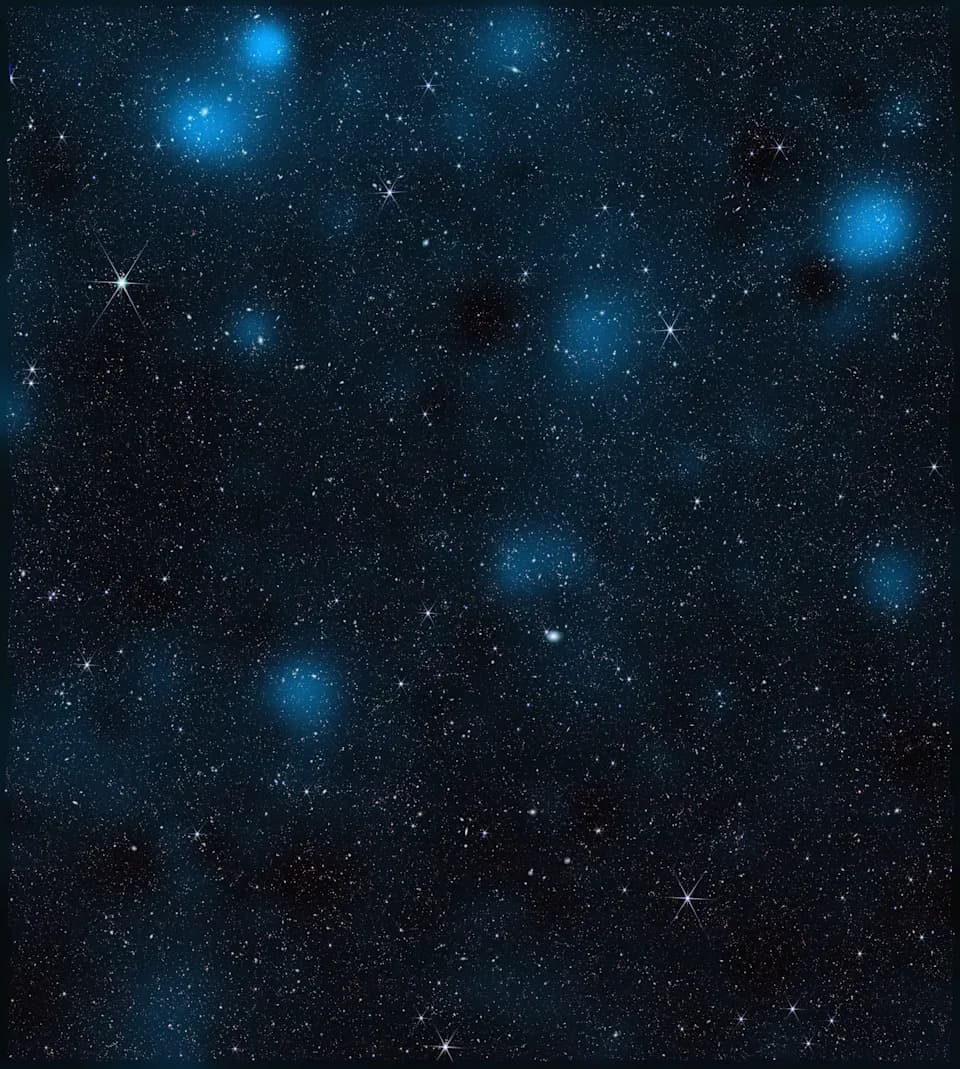
Scientists used data from NASA’s James Webb Space Telescope to produce one of the most detailed, high-resolution maps of dark matter, which is invisible but represented here in blue, in this image of nearly 800,000 galaxies.
A new, ultra–high-resolution map of dark matter made with observations from NASA’s James Webb Space Telescope offers the clearest view yet of the invisible scaffolding that shaped the universe.
Published Jan. 26 in Nature Astronomy, the map covers the constellation Sextans and identifies nearly 800,000 galaxies. Researchers assembled the map from about 255 hours of Webb observations taken in January, April and May 2023 and again in January 2024, using Webb’s Mid-Infrared Instrument (MIRI).
How the Map Was Made
The team examined roughly 250,000 of those galaxies for the subtle distortions dark matter causes in light from distant sources — a phenomenon known as gravitational lensing. Although dark matter does not emit, absorb or reflect light, its mass bends space and alters the path of light, producing measurable changes in galaxy shapes. In the published map, regions where Webb detected dark matter are shaded blue.
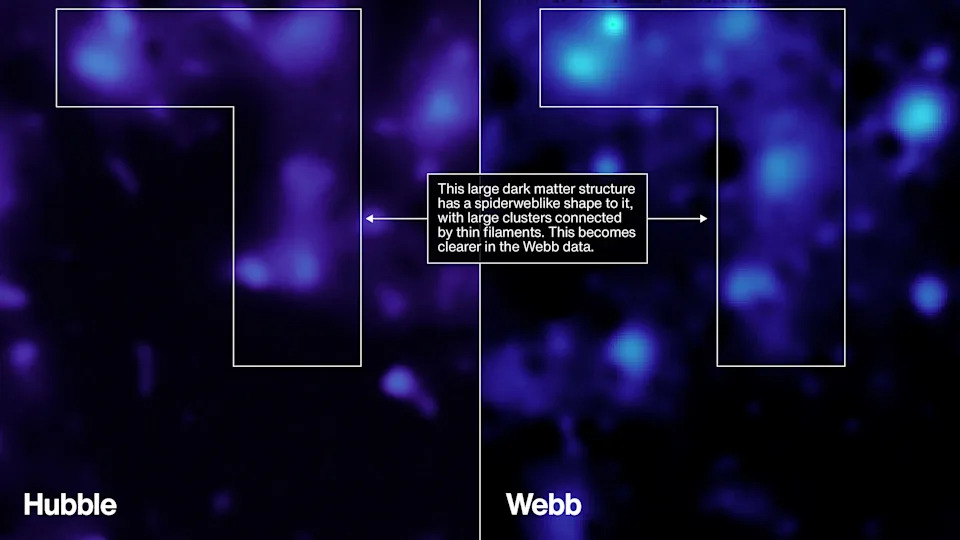
Dense regions of dark matter are connected by lower-density filaments, forming a weblike structure know as the cosmic web. This pattern appears more clearly in the Webb data (at right) than in the earlier Hubble image.
Key Findings
Lead author Diana Scognamiglio of NASA’s Jet Propulsion Laboratory said this Webb map is twice as sharp as previous dark matter maps from other observatories. Compared with a 2007 map of the same region made with Hubble data, Webb’s MIRI provides more than double the resolution and reveals structures that formed roughly 8–11 billion years ago.
“Previously, we were looking at a blurry picture of dark matter. Now we’re seeing the invisible scaffolding of the universe in stunning detail, thanks to Webb’s incredible resolution,” Scognamiglio said.
The analysis shows a close correspondence between dark and ordinary matter: large galaxy clusters coincide with massive dark matter concentrations, and thin filaments of visible matter that connect clusters are mirrored by narrow dark matter strands. Researchers described these connections as a giant cosmic web, with dense knots at cluster locations and filaments forming the bridges between them.
Richard Massey of the Institute for Computational Cosmology at Durham University emphasized the ubiquity and harmlessness of dark matter at human scales: “Billions of dark matter particles pass through your body every second. There’s no harm; they don’t notice us and just keep going.” Still, because dark matter has mass it shapes the large-scale structure of the universe.
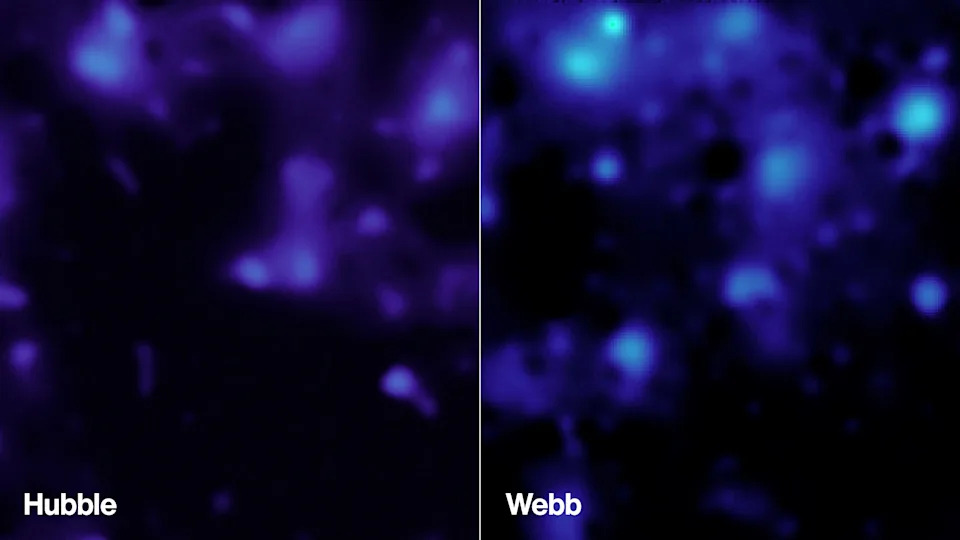
Images used creating data from the Hubble Space Telescope in 2007 (left) and NASA's higher-resolution Webb telescope in 2026 (right) show the presence of dark matter in the same region of the sky.
JPL astrophysicist Jason Rhodes, who led the 2007 mapping project, noted the broader implications: without dark matter’s role in drawing ordinary matter together, the chemical evolution that produced the elements necessary for life may not have occurred in the same way.
What’s Next
Researchers plan to extend these studies with the Nancy Grace Roman Space Telescope, a more powerful mission slated to launch as early as fall 2026. Roman’s wide-field capabilities will allow scientists to map dark matter across much larger regions of the sky and further test theories about how dark and ordinary matter co-evolved.
Original reporting: This story is based on reporting by USA TODAY and the research published in Nature Astronomy.
Help us improve.