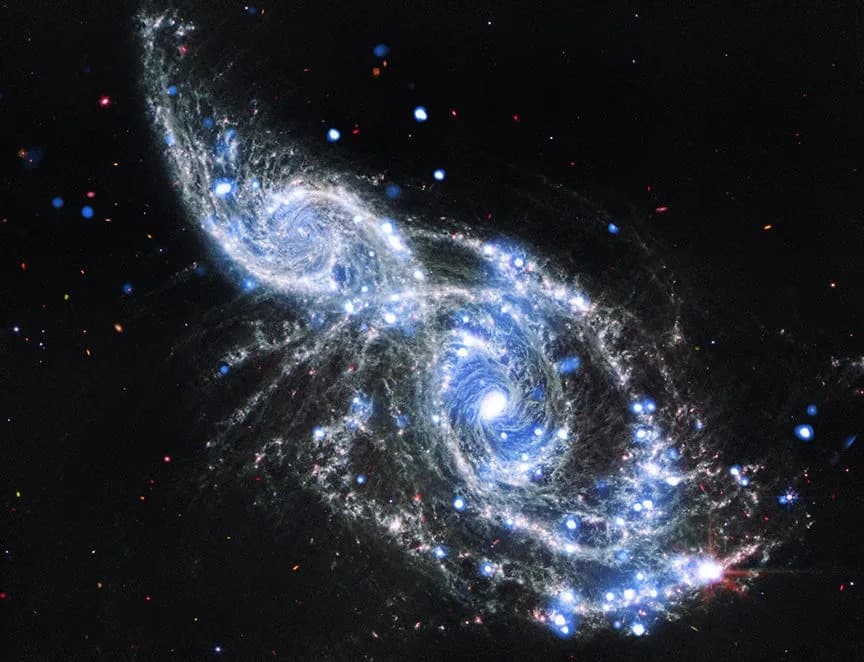
Using JWST imaging, researchers Rashi Jain and Yogesh Wadadekar identified a well-formed spiral galaxy, Alaknanda, only 1.5 billion years after the Big Bang. Despite its youth, the galaxy has a grand-design spiral structure, roughly 10 billion solar masses in stars, and a star-formation rate about 20 times that of the Milky Way (≈60 suns per year). The discovery—published in Astronomy & Astrophysics—challenges current models of how quickly galaxies can assemble and organize.
JWST Finds a Milky Way–Like Spiral Galaxy Just 1.5 Billion Years After the Big Bang
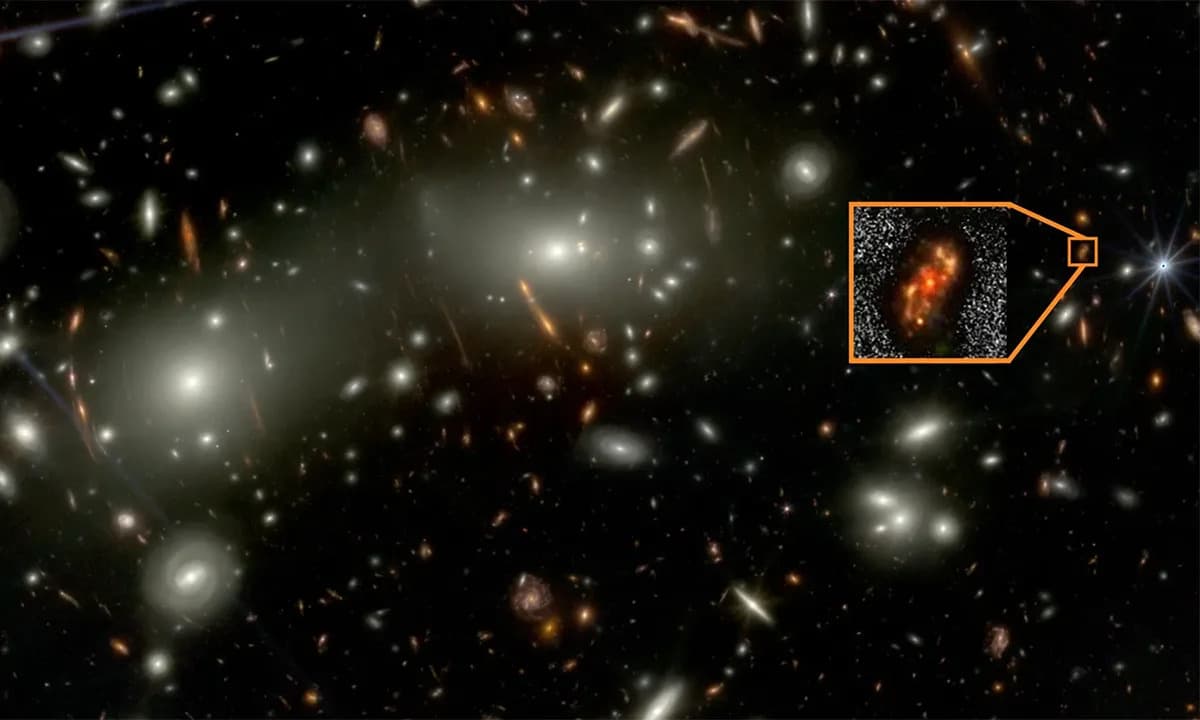
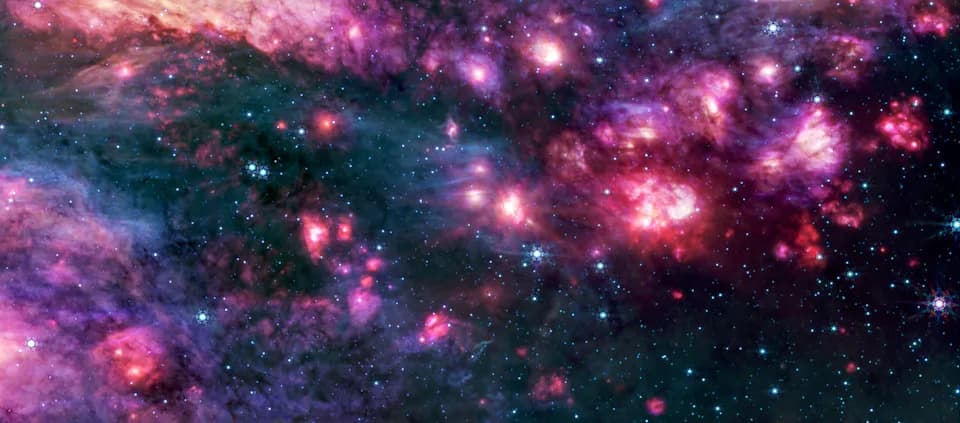
Image of the newly discovered spiral galaxy Alaknanda (inset) as observed in the shorter wavelength JWST bands. Several bright galaxies from the foreground Abell 2744 cluster are also seen. Credit: NASA/ESA/CSA, I. Labbe/R. Bezanson/Alyssa Pagan (STScI), Rashi Jain/Yogesh Wadadekar (NCRA-TIFR)
Astronomers using deep imaging from the James Webb Space Telescope (JWST) have discovered a surprisingly mature spiral galaxy in the early universe. Named Alaknanda, the system shows a clear grand-design spiral disk only 1.5 billion years after the Big Bang—far earlier than most models predict such structure could form.
Galaxies are generally thought to pass through a turbulent adolescence: frequent mergers, clumpy star-forming regions, and asymmetric shapes. Over billions of years, many settle into orderly spiral disks like the Milky Way. Alaknanda upends that picture by combining both rapid structural maturity and intense star formation.
Key observations by Rashi Jain and Yogesh Wadadekar (published in Astronomy & Astrophysics) indicate that Alaknanda assembled roughly 10 billion solar masses of stars in just a few hundred million years and is forming stars at about 20 times the Milky Way’s rate—approximately 60 solar masses per year. Yet its morphology resembles the familiar two-armed, grand-design spiral typically associated with galaxies many billions of years older.
"Alaknanda has the structural maturity we associate with galaxies that are billions of years older," Jain said. "Finding such a well-organized spiral disk at this epoch tells us that the physical processes driving galaxy formation—gas accretion, disk settling, and possibly spiral density waves—can operate far more efficiently than current models predict."
Wadadekar added that the discovery implies the early universe was capable of assembling massive, ordered disks much faster than anticipated: "Somehow, this galaxy managed to pull together 10 billion solar masses of stars and organize them into a beautiful spiral disk in just a few hundred million years. That’s extraordinarily fast by cosmic standards."
The finding forces theorists to revisit how quickly gas can accrete, how disks stabilize, and under what conditions spiral structure can emerge. Future JWST observations and follow-up spectroscopy will test whether Alaknanda is a rare outlier or representative of an unexpected population of early, well-ordered galaxies.
Lead image: NASA/ESA/CSA, I. Labbe/R. Bezanson/Alyssa Pagan (STScI), Rashi Jain/Yogesh Wadadekar (NCRA-TIFR). Original story appeared on Nautilus.
Help us improve.