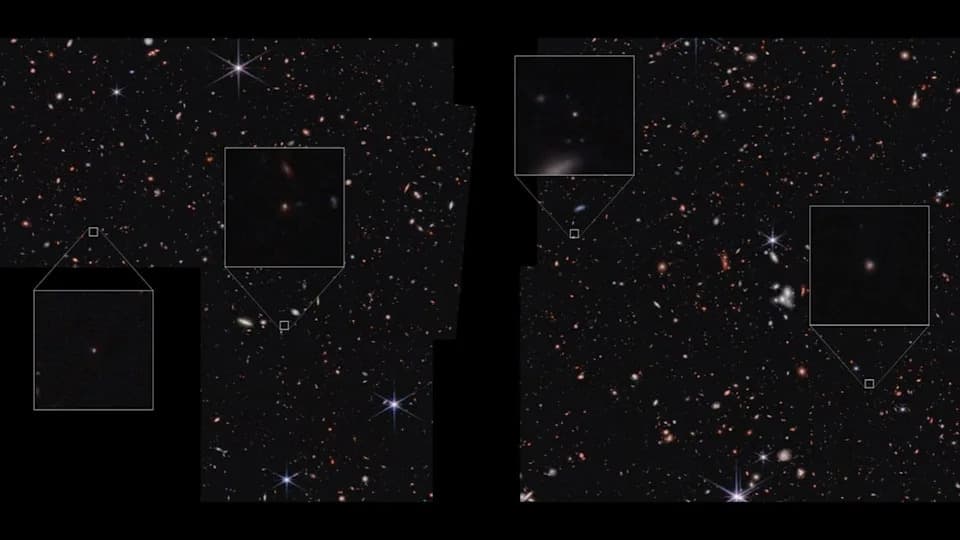
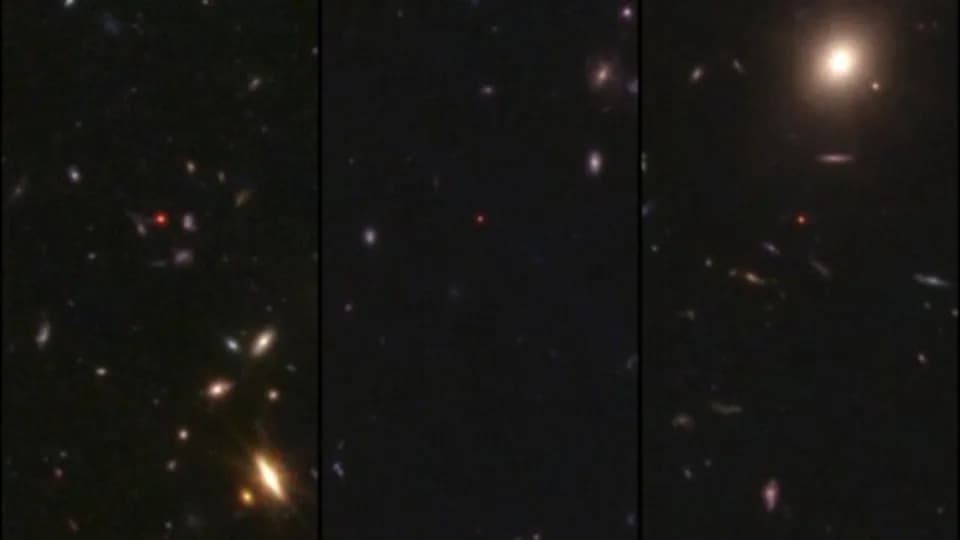
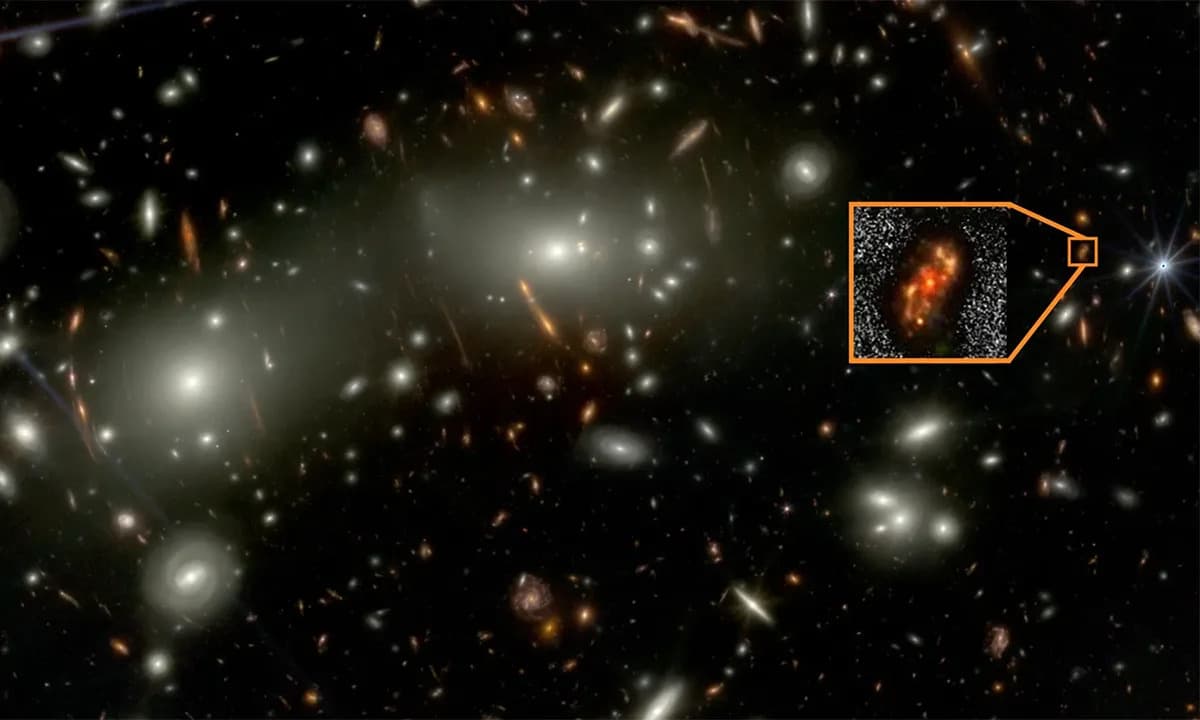
A team at the University of Missouri used JWST to identify a small group of early-universe objects that combine traits of stars and quasars but show narrow rather than broad emission lines. Nicknamed 'platypus galaxies,' these sources could point to quieter, alternative routes for galaxy formation in the early cosmos. The team cautions that more data are needed, and they plan spectroscopy of hundreds of candidates to determine whether these objects form a new category. The study was presented at the 247th AAS meeting.
Mizzou Astronomers Discover 'Platypus Galaxies' in the Early Universe Using JWST

Haojing Yan
Researchers at the University of Missouri (Mizzou) have identified a small population of unusual, point-like objects in the early universe using observations from NASA's James Webb Space Telescope (JWST). The objects show an unexpected combination of properties that led the team to nickname them 'platypus galaxies.'
What Makes Them Unusual?
Found by Haojing Yan and colleagues in Mizzou's College of Arts and Science, the sources resemble both stars and quasars in some respects but crucially lack the broad emission lines typically associated with those objects. Instead, their spectra display narrow emission lines, which are more commonly linked to vigorous star formation in galaxies. This hybrid set of characteristics is what prompted the informal 'platypus' label.
What The Team Says
"Each property on its own is familiar to us," said Haojing Yan, a Mizzou astronomy professor and co-author of the study. "But when added together, they create something we've never seen before."
Bangzheng 'Tom' Sun, a graduate student in Yan's lab and co-author, added that if these objects represent a new galaxy class, "it tells us we've been missing part of the story." Mizzou undergraduate Riley Shive is also listed as a co-author.
Implications For Galaxy Formation
Conventional theories emphasize that galaxies grow largely through mergers and sometimes violent interactions. The newly discovered objects, however, may point to quieter formation paths — systems that assembled without dramatic collisions. While the current evidence is not sufficient to overturn established models, the finding suggests the early universe may have been more diverse in how it formed galactic systems than previously appreciated.
What's Next: Spectroscopy And Larger Samples
To determine whether these are truly a distinct population, the team plans follow-up spectroscopy on hundreds of faint candidates. Spectroscopy disperses an object's light into its component wavelengths — like reading a barcode — and reveals details about ages, chemical composition, and star-formation activity. These observations will test whether the narrow-line, point-like sources are common and how they fit into galaxy-evolution models.
The research, titled 'A new population of point-like, narrow-line objects revealed by the James Webb Space Telescope,' was presented at the 247th meeting of the American Astronomical Society. The work was reported by Janis Reeser for the Columbia Daily Tribune and was prepared with the assistance of AI; journalists participated in all stages of reporting and editing.
Help us improve.