ALMA observations reveal SPT2349-56, a dense galaxy cluster seen 1.4 billion years after the Big Bang with more than 30 galaxies in a ~500,000-light-year region. Its intracluster medium is at least five times hotter than models predict, measured via the Sunyaev–Zeldovich effect on the CMB. Intense star formation and multiple supermassive black holes are likely injecting energy, suggesting clusters can heat and assemble far earlier than expected. Results published in Nature.
Earliest, Hottest Galaxy Cluster Discovered — SPT2349-56 Upends Formation Models
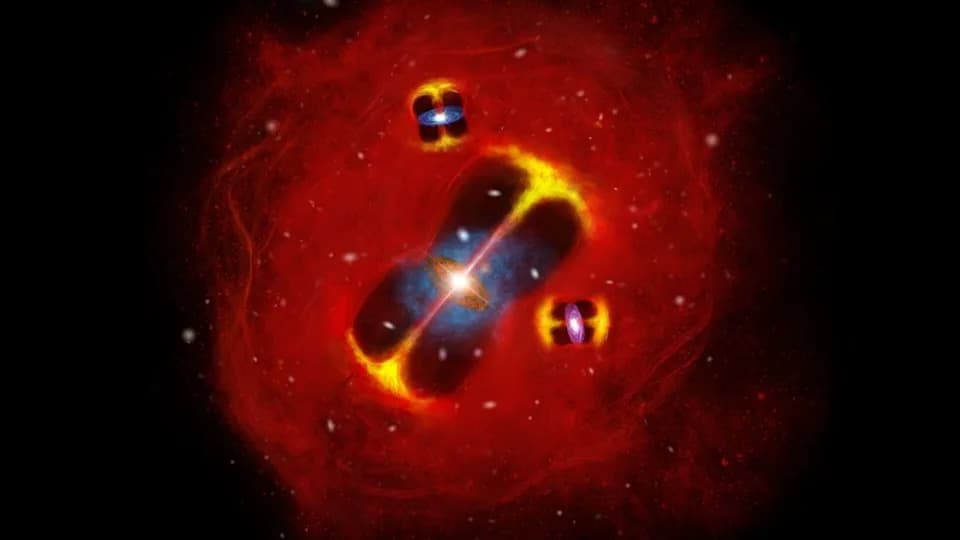
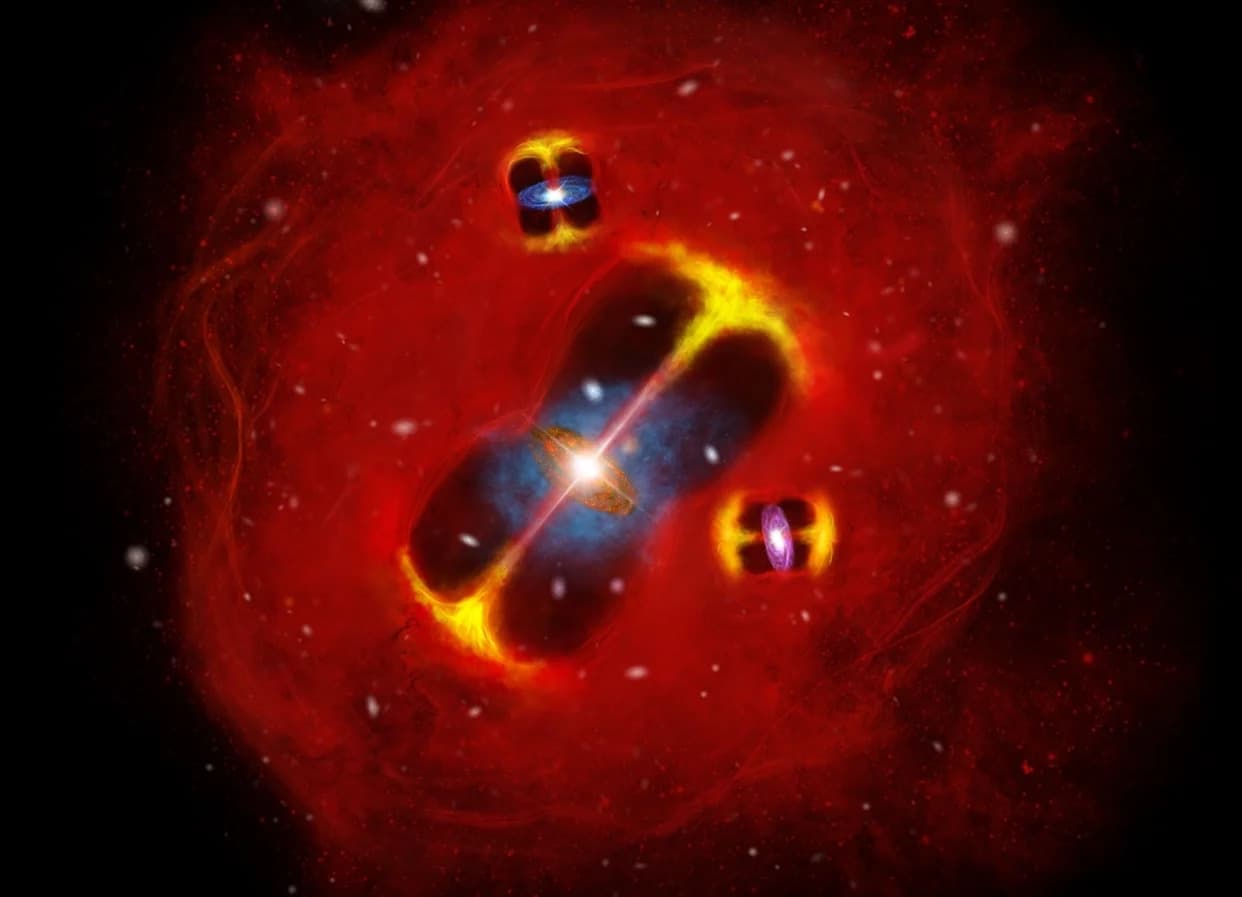
An artist's impression of the galaxy cluster in the very early universe. Containing about 30 galaxies including three with supermassive black holes (depicted here with jets), the cluster is filled with an extraordinarily hot gas (illustrated here in red). | Credit: Lingxiao Yuan.
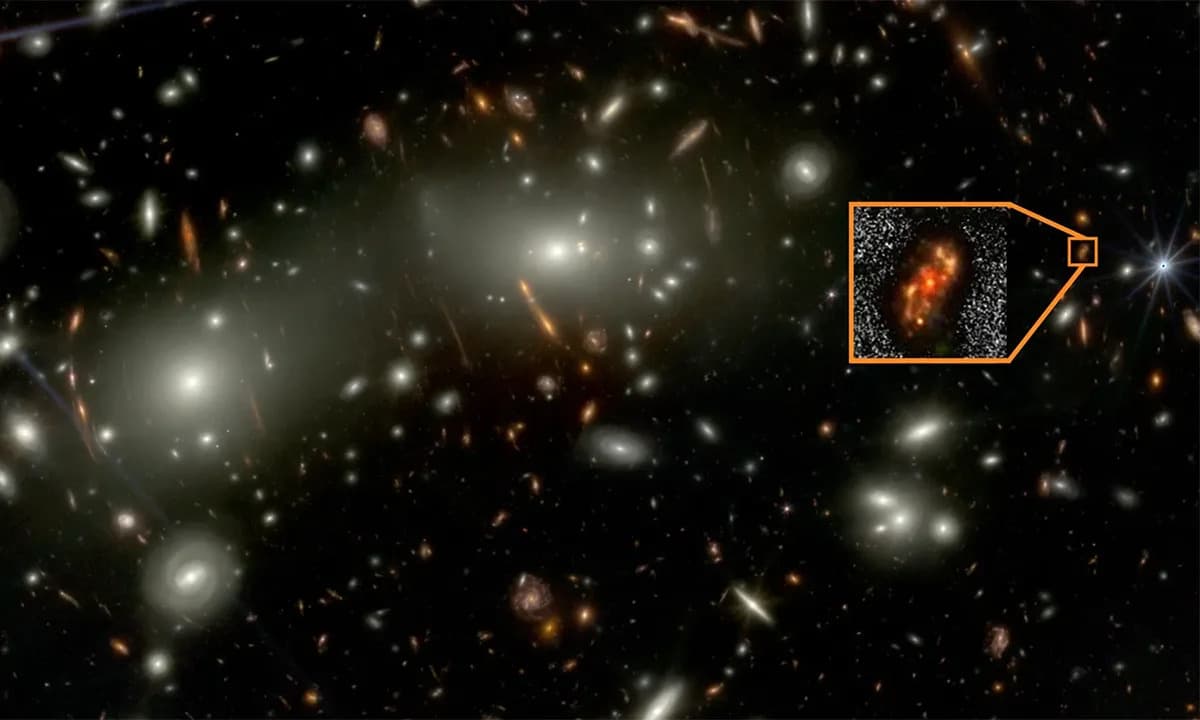
A compact assembly of more than 30 galaxies packed into a region roughly 500,000 light-years across has been identified as it existed just 1.4 billion years after the Big Bang. The system, known as SPT2349-56, shows an intracluster medium far hotter than theoretical models predict, forcing astronomers to rethink how quickly massive structures and their hot atmospheres can form.
What Astronomers Found
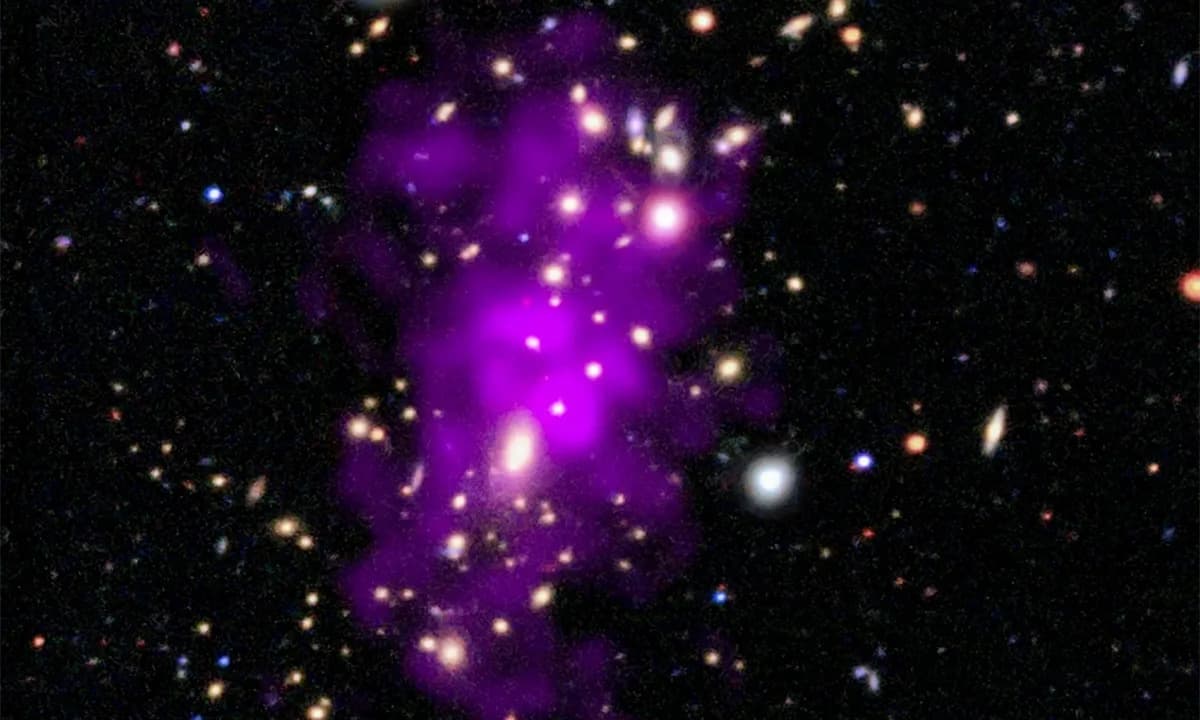
A team using the Atacama Large Millimeter/submillimeter Array (ALMA) investigated SPT2349-56 and measured the temperature of its intracluster medium (ICM) indirectly via the Sunyaev–Zeldovich (SZ) effect. The ICM appears to be at least five times hotter than expected for a system this early in cosmic history — hotter and more energetic than in many present-day clusters.
Why This Is Surprising
According to standard models, the ICM is heated gradually as galaxies and gas collapse into a gravitationally bound cluster. Many distant, earlier structures found by other telescopes are classified as "protoclusters" because they are not yet fully bound; they typically lack the extreme ICM temperatures seen in mature clusters. SPT2349-56, however, appears unusually advanced for its age: compact, gravitationally active and already hosting a searing atmosphere.
Possible Heating Mechanisms
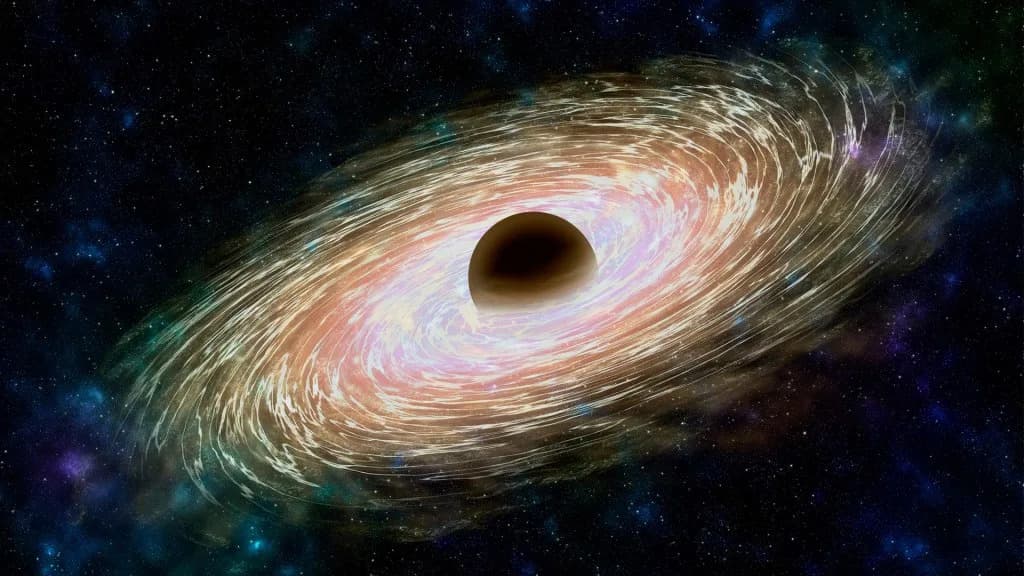
Researchers suggest several mechanisms that could drive this early heating. The cluster hosts intense star formation — the member galaxies are forming stars at a combined rate roughly 5,000 times that of the Milky Way — and recent work has identified multiple supermassive black holes in the system. Both powerful stellar activity (winds and supernovae) and energetic feedback from active black holes can inject large amounts of energy into the surrounding gas, potentially explaining the unexpectedly hot ICM.
"This tells us that something in the early universe, likely three recently discovered supermassive black holes in the cluster, were already pumping huge amounts of energy into the surroundings and shaping the young cluster," said Scott Chapman, professor of astronomy at Dalhousie University.
How the Temperature Was Measured
The SZ effect leaves a distinct imprint on the cosmic microwave background (CMB): CMB photons gain energy by scattering off the fast-moving electrons in hot cluster gas. By measuring that distortion, astronomers can infer the pressure and temperature of the ICM even when the cluster itself is very faint in optical light.
Context and Implications
Previous discoveries have identified structures earlier in cosmic time (for example, assemblies observed around 650–770 million years after the Big Bang), but those are typically protoclusters that lack hot, bound atmospheres. SPT2349-56 appears to have matured and heated far sooner than models predict, highlighting gaps in our theoretical picture of cluster assembly, feedback, and thermalization in the early universe.
"We want to figure out how the intense star formation, the active black holes and this overheated atmosphere interact, and what it tells us about how present galaxy clusters were built," said Dazhi Zhou, lead author of the study and a PhD candidate at the University of British Columbia.
The team's results were published in the journal Nature on Jan. 5.
Help us improve.