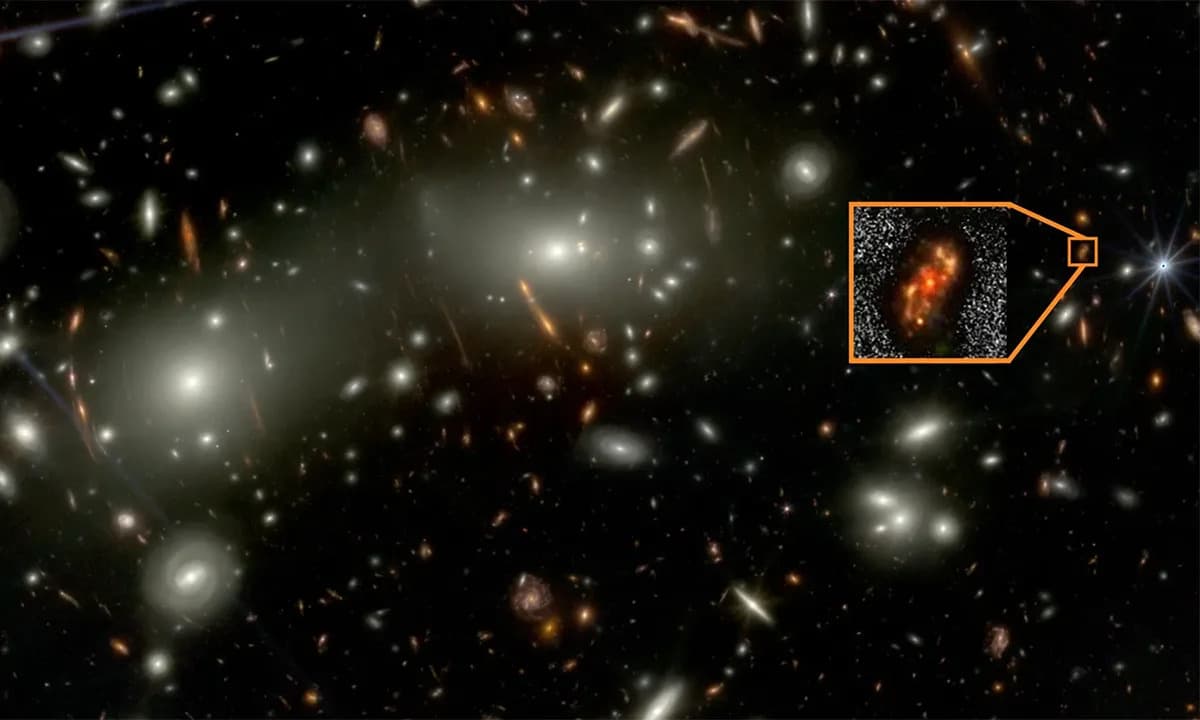
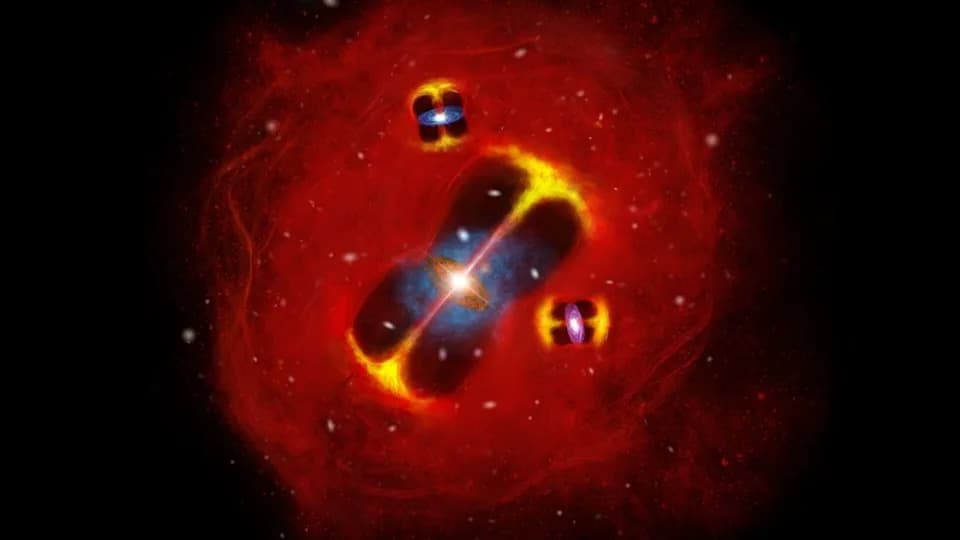
James Webb observations reveal a roughly 50-million-solar-mass black hole in Abell 2744-QSO1 just 700 million years after the Big Bang, despite the host galaxy showing very little stellar mass. Researchers led by Boyuan Liu ran detailed simulations starting from a massive primordial seed and reproduced the black hole mass, sparse stellar population, and some chemical signatures. The results make a primordial origin plausible but do not prove it; major theoretical challenges and alternative explanations remain.
JWST Finds 50-Million-Sun Black Hole Nearly Alone in Early Universe, Challenging Formation Models
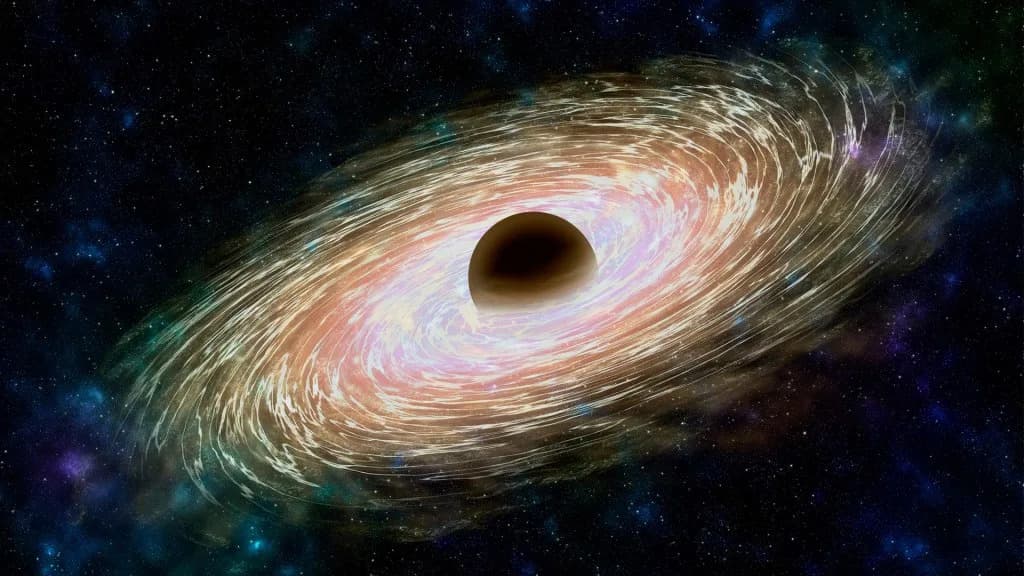
When astronomers trained the James Webb Space Telescope on the distant cosmos they expected to see small, immature galaxies full of young stars. Instead they found a surprising heavyweight: a black hole with an estimated mass of about 50 million times that of the Sun living in a galaxy with very few stars.
The object, catalogued as Abell 2744-QSO1, existed roughly 700 million years after the Big Bang. Its mass and lonely surroundings strain standard models that link the growth of black holes closely to star formation and the assembled stellar mass of their host galaxies.
Why This Is Unexpected
In conventional theory, stars form from collapsing gas clouds and the most massive of those stars later leave behind black holes. Over cosmic time, black holes grow by accreting gas and merging with other black holes. That gradual process makes it difficult to explain how such an enormous black hole could appear so early — especially inside a galaxy with little stellar mass to supply fuel or merger partners.
“This is a puzzle, because the traditional theory says that you form stars first, or together with black holes,” said Boyuan Liu, a co-author on the study and a postdoctoral researcher at the University of Cambridge.
Testing an Older Idea: Primordial Black Holes
To explore alternatives, the research team revisited a decades-old hypothesis: primordial black holes. Proposed by scientists including Stephen Hawking and Bernard Carr, primordial black holes would form directly from extreme density fluctuations in the very early universe rather than from dying stars.
Most primordial black holes predicted in simple scenarios would be tiny and short-lived. The Cambridge-led team asked whether a rare, massive primordial seed could survive and then grow rapidly under favorable early-universe conditions. They built new simulations that follow multiple interacting processes: gas inflow onto the seed, nearby star formation, and how material returned by stellar deaths feeds the black hole.
Starting their simulations with a massive primordial seed of roughly 50 million solar masses, the researchers tracked gas dynamics, star formation, and chemical enrichment. These more sophisticated models reproduced several of QSO1’s observed properties: the black hole mass, the low stellar mass of the host, and the elemental signatures inferred from JWST spectroscopy.
Not Proven — But Plausible
The results do not prove that QSO1’s black hole is primordial. Rather, they show that a primordial origin is consistent with current observations and that standard formation scenarios struggle to reproduce this particular system. The authors plan to refine their models and compare them with future JWST detections to see whether similar systems are common.
Outstanding Challenges
Important challenges remain. Typical primordial-black-hole formation models rarely produce seeds above about one million solar masses, well below the roughly 50 million implied for QSO1. Fast growth might be possible if primordial black holes formed in dense groups and merged quickly, or if unusually rapid accretion occurred — but these processes are uncertain and difficult to model robustly.
Another open question is whether the formation of large primordial seeds requires intense bursts of high-energy radiation; no obvious source of such radiation has been identified near QSO1 so far. The study describing these simulations and comparisons has been posted on arXiv for community scrutiny.
Bottom line: JWST has revealed an early-universe black hole that challenges standard growth models. Simulations show a primordial seed could explain the observations, but confirming that origin will require more sightings and deeper theoretical work.
Help us improve.