Researchers propose that JWST's compact "Little Red Dots" could be the birthplaces of direct-collapse black holes—heavy seeds formed when pristine gas clouds collapse monolithically. These DCBHs, with initial masses of ~10,000–1,000,000 solar masses, could explain supermassive black holes seen just 500 million years after the Big Bang. High-resolution simulations reproduce the observed abundance and properties of Little Red Dots, but confirmation requires higher-resolution and broader spectral observations.
Could JWST’s Mysterious “Little Red Dots” Be Nurseries for Direct-Collapse Black Holes?
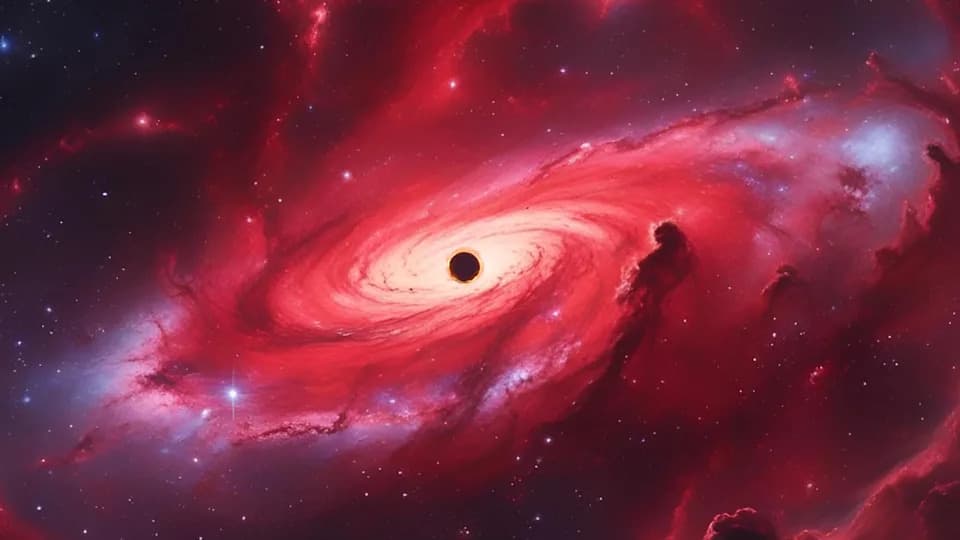
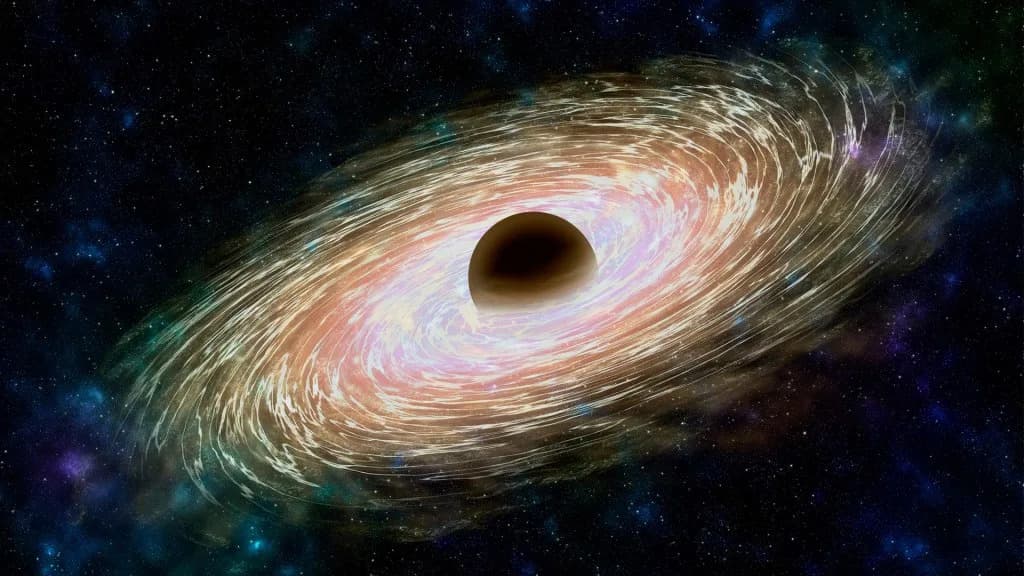
An illustration shows a direct collapse black hole forming at the heart of a Little Red Dot. | Credit: Robert Lea (created with Canva)
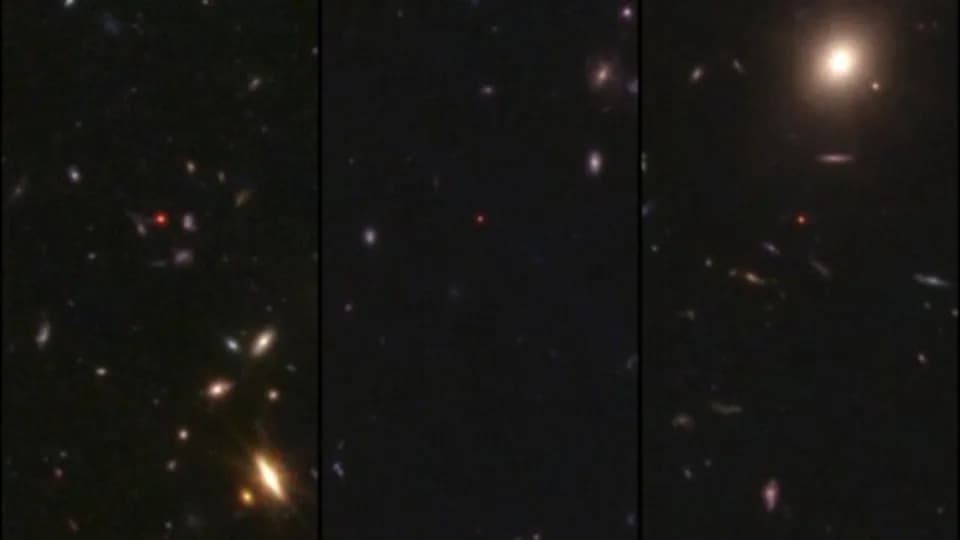
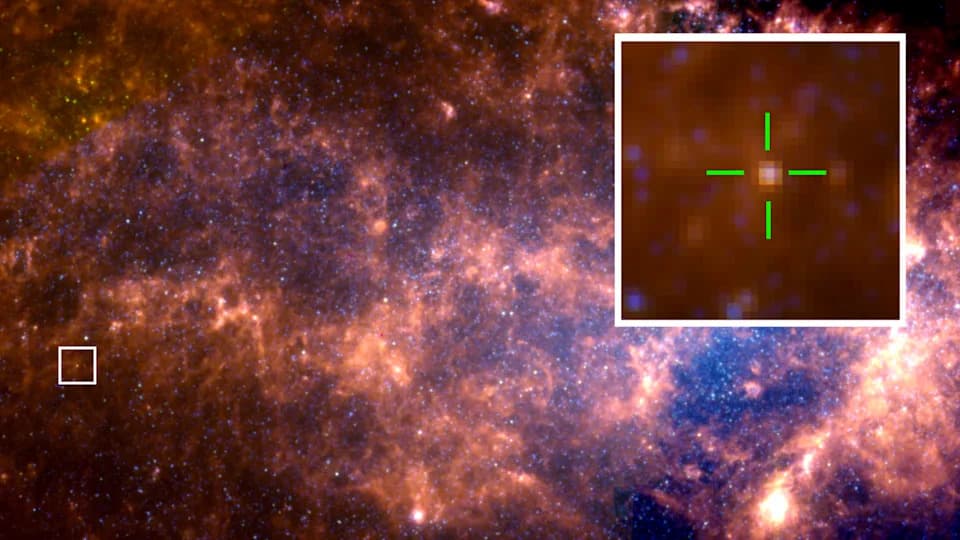
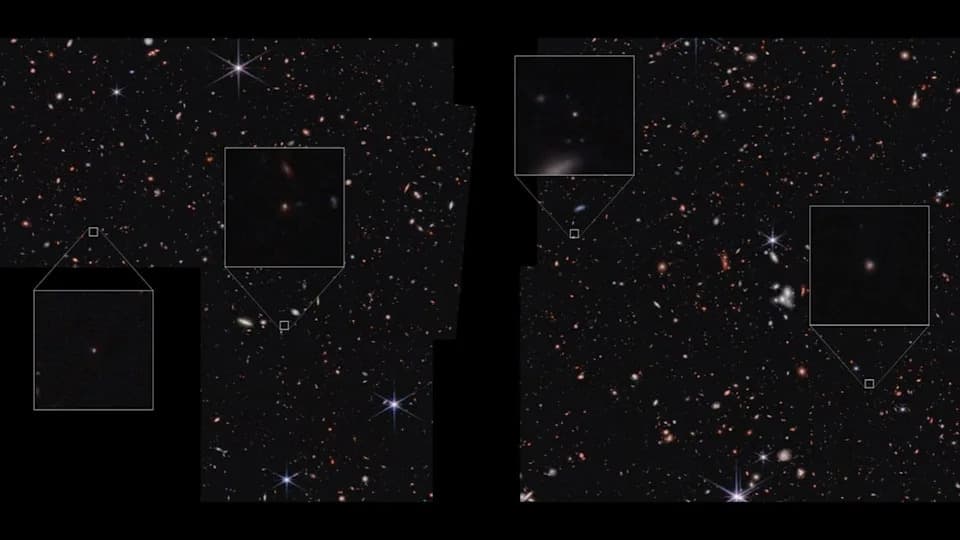
Little Red Dots—compact, unusually red sources discovered by the James Webb Space Telescope (JWST)—may mark the birthplaces of especially massive black holes that formed not from dying stars but via the direct collapse of enormous, pristine gas clouds.
That possibility could help solve two puzzles raised by JWST observations: the identity of the Little Red Dots themselves and the existence of many supermassive black holes already in place as early as ~500 million years after the Big Bang. Traditional growth channels, which rely on stellar remnants and long sequences of mergers, struggle to produce billion-solar-mass black holes so quickly.
Heavy Seeds vs. Light Seeds
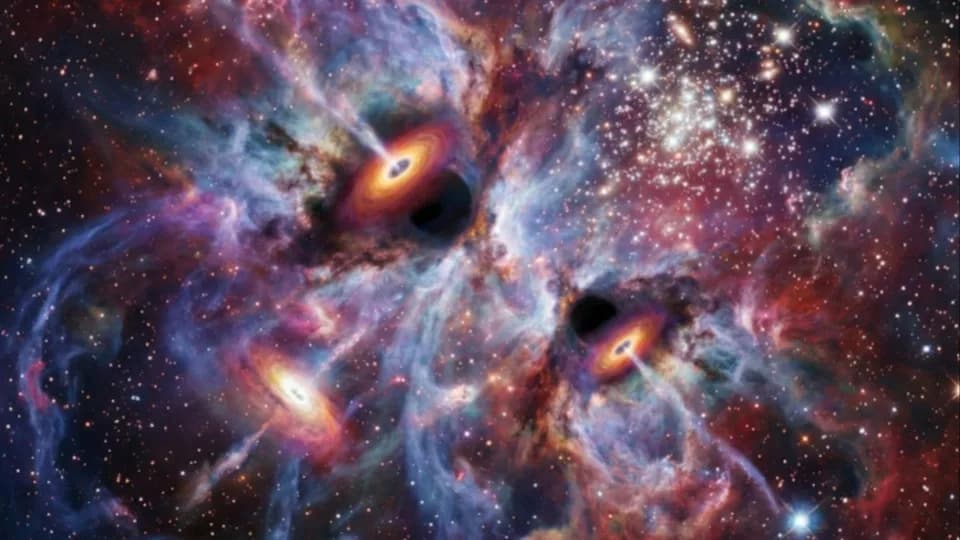
Researchers suggest a heavy-seed scenario in which direct-collapse black holes (DCBHs) form when extremely overdense, metal-free gas collapses monolithically in the centres of certain dark matter haloes. Unlike "light seeds"—stellar-mass black holes left behind when massive stars die—DCBHs can begin life with masses of order 10,000–1,000,000 solar masses, giving them a major head start toward becoming supermassive.
"All galaxies likely harbor a supermassive black hole at their centre, whose origin represents one of the frontier mysteries of modern astrophysics. One theoretical pathway to the formation of the heaviest black holes is that of direct collapse," said Elia Cenci of the University of Geneva.
Cenci explains that forming a DCBH requires narrow environmental conditions: gas must remain essentially pristine (free of heavy elements) and avoid forming molecular hydrogen, which would cool and fragment the collapsing cloud into many smaller stars instead of a single monolithic collapse.
Linking Simulations to Observations
Cenci and colleagues ran high-resolution cosmological simulations and found that newly formed DCBHs naturally reproduce the abundance and several physical properties inferred for JWST's Little Red Dots. Their models suggest these compact red sources could be faint, massive black holes enshrouded by dense gas and nascent stars—objects that earlier telescopes could not easily detect.
"Our results show that direct-collapse black holes that are newly formed naturally match the overall abundance and key physical characteristics inferred for the enigmatic Little Red Dots discovered with the JWST," Cenci said. "If future studies confirm this connection, Little Red Dots may represent the first direct observational evidence of the birth of the most massive black holes in the universe."
Another key observational trait is that Little Red Dots appear to decline in number by about 1.5 billion years after the Big Bang (roughly redshift z ≈ 6). The team argues this disappearance is expected: as the universe evolves, successive generations of stars pollute gas with heavier elements and stellar feedback alters gas inflows, making the pristine, monolithic collapse channel for DCBH formation far less likely.
Confirming the DCBH interpretation will require higher-resolution imaging and broader spectral coverage to disentangle the relative contributions of accreting black holes and surrounding stars, and to probe the dynamics and thermodynamic state of the dense gas reservoirs. Meanwhile, the team is expanding their simulation suite to test a wider range of formation conditions and to better quantify how closely DCBHs and Little Red Dots are related.
Publication: The study appears in Monthly Notices of the Royal Astronomical Society.
Help us improve.