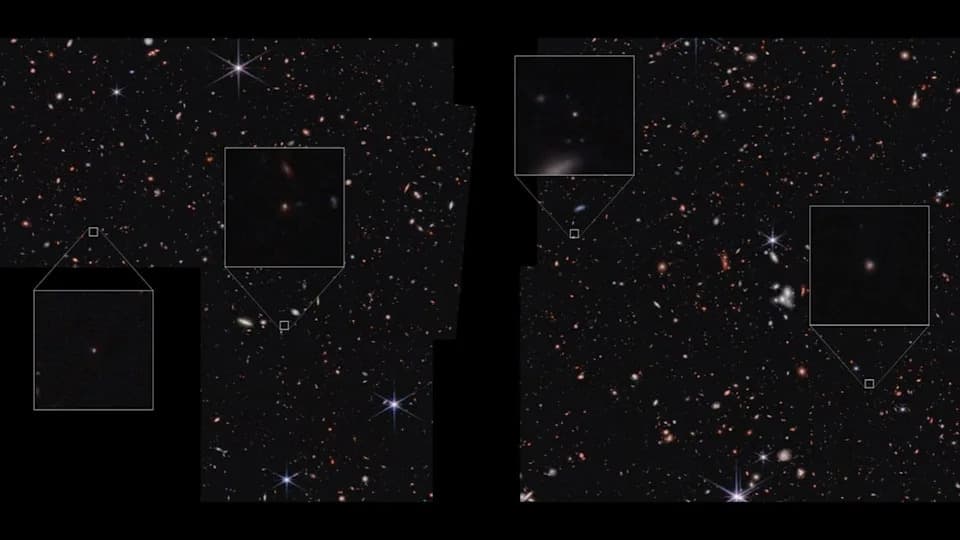
Using JWST, astronomers identified the most distant supernova yet observed—SN in GRB 250314A—from when the universe was roughly 730 million years old. A gamma-ray burst discovered last March prompted infrared follow-up nearly four months later, allowing the team to separate the supernova's fading light from its host galaxy. The explosion's emission resembles nearer supernovae, challenging expectations that early, metal-poor stars would produce much bluer, brighter blasts. The findings are published in Astronomy & Astrophysics.
JWST Spots Most Distant Supernova Yet — A Star Died at the Dawn of the Universe

Lead image: 24K-Production / Shutterstock
The James Webb Space Telescope (JWST) has helped astronomers identify the most distant supernova ever observed: SN in GRB 250314A, an exploding star whose light began its journey when the universe was only about 730 million years old.
Last March, a team detected a bright eruption of gamma rays from an unexpectedly early epoch. Follow-up observations with JWST's infrared camera nearly four months later allowed researchers to separate the faded light of the explosion from the much fainter glow of its host galaxy. The discovery, published in Astronomy & Astrophysics, places this event at the edge of the observable universe and provides a rare glimpse of stellar death in the first billion years after the Big Bang.
"Almost every supernova ever studied has been relatively nearby to us, with just a handful of exceptions to date," said Antonio Martin-Carrillo of University College Dublin. "When we confirmed the age of this one, we saw a unique opportunity to probe how the universe was there and what type of stars existed and died back then."
Surprisingly, the electromagnetic signature of SN in GRB 250314A closely resembles that of supernovae seen in the local universe. Astronomers had expected earlier stars—formed in a metal-poor environment lacking heavier elements—to produce brighter, bluer explosions, but this event does not clearly follow that prediction. That result challenges simple assumptions about how the first generations of stars died and suggests more complex stellar physics or environments in the early cosmos.
Beyond its intrinsic interest, this observation demonstrates JWST's ability to study transient events at extreme distances by combining high-sensitivity infrared imaging with rapid follow-up after high-energy alerts such as gamma-ray bursts. Continued observations of similar events will help refine models of early star formation, stellar evolution, and the chemical enrichment of the young universe.
Publication: The discovery and analysis appear in Astronomy & Astrophysics.
Help us improve.