Bats use Doppler shifts—the change in echo pitch caused by their own motion—to navigate cluttered environments, a new study in Proceedings of the Royal Society B finds. Researchers observed wild pipistrelle bats flying through an eight-meter “bat accelerator” lined with about 8,000 plastic leaves; bats sped up when foliage moved with them and slowed when it moved toward them. The results show non-Doppler-specialist bats can use motion-induced acoustic cues and suggest potential applications for drone and autonomous-vehicle navigation.
‘Bat Accelerator’ Shows How Bats Use Motion-Induced Doppler Shifts to Navigate
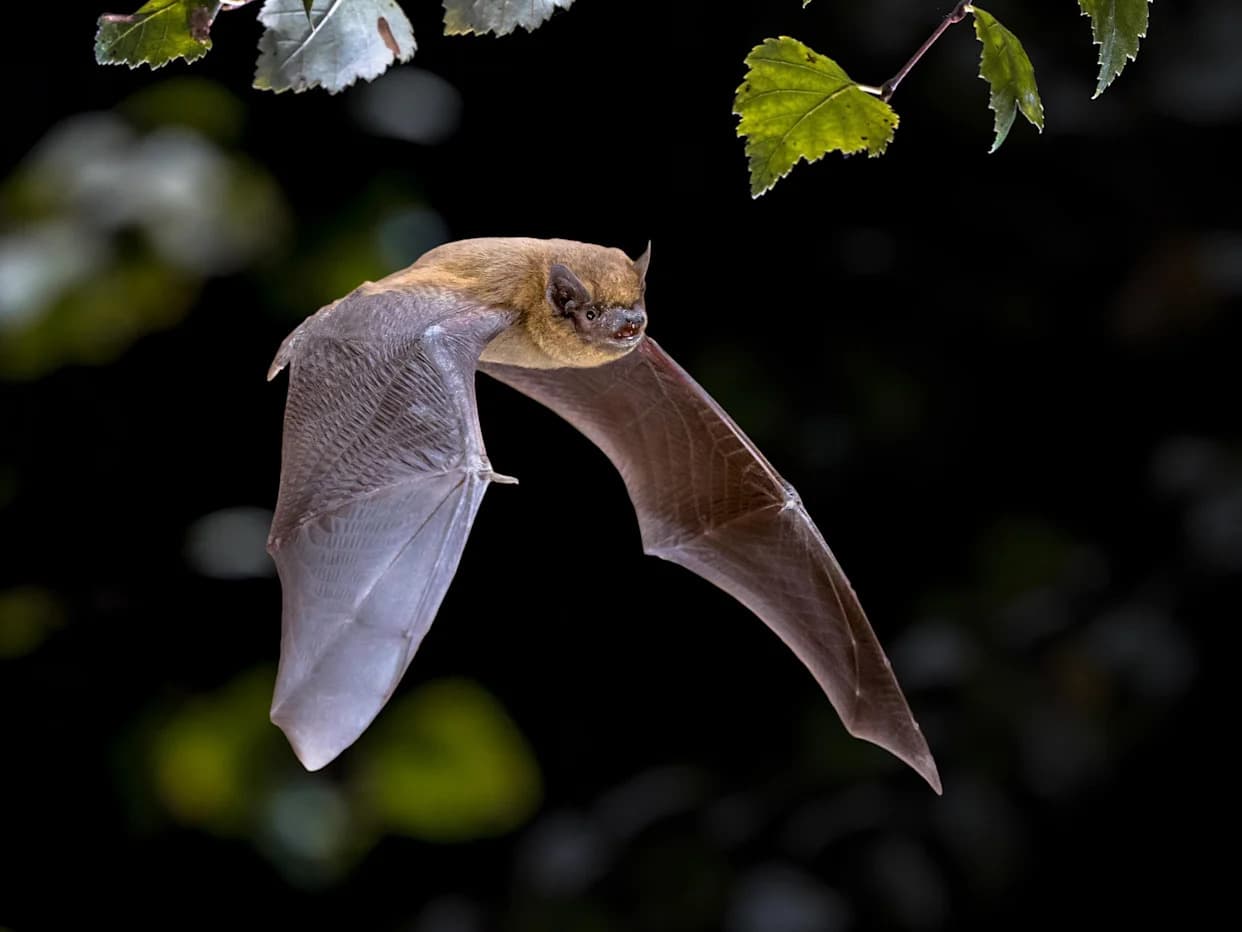
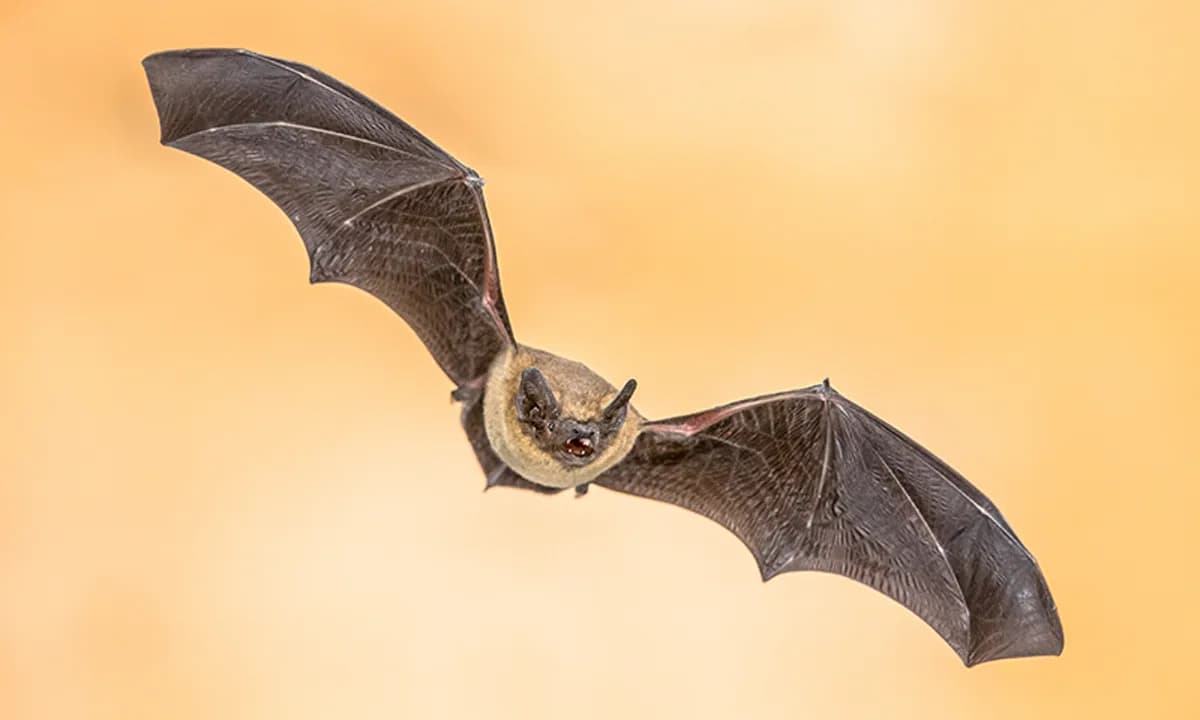
A pipistrelle bat.(Rudmer Zwerver)
Bats are masterful navigators, threading through dark caves and dense forests by listening to echoes of their own calls. A new study in Proceedings of the Royal Society B reveals that bats can exploit changes in echo pitch caused by their own movement—Doppler shifts—to pick out useful echoes from a cluttered acoustic scene.
Marc Holderied, a professor of sensory biology at the University of Bristol and a co-author of the study, likens the challenge to trying to hear a single voice at a crowded party. In a natural environment strewn with trees, leaves and other reflectors, thousands of overlapping echoes can make it difficult for a bat to determine which signals correspond to obstacles or open space.
How the Experiment Worked
To test whether bats use motion-induced frequency changes to navigate, researchers observed wild pipistrelle bats flying through an inventive field apparatus the team nicknamed the “bat accelerator.” The setup consisted of an approximately eight-meter tunnel of synchronized treadmills draped in artificial foliage—roughly 8,000 plastic leaves stapled on by hand, according to Athia Haron, a medical engineering research associate at the University of Manchester and co-author.
The key idea was simple: if bats rely on Doppler cues produced by their own motion, changing the direction in which the foliage moved relative to the bats’ flight should alter the bats’ perceived motion and therefore their flight speed.
“As the bat is moving, this Doppler shift, in this complex echo of thousands of reflectors, carries information,”
—Marc Holderied
What the Researchers Observed
When the treadmill foliage moved in the same direction as the bats’ flight, the animals tended to accelerate; when the foliage moved toward the bats—creating the illusion that the environment was closing in—the bats slowed down. “We tricked them into thinking that their speed is different,” Holderied said. These behavioral responses indicate that bats monitor motion-induced frequency changes in echoes and use that information to regulate flight speed.
Importantly, pipistrelle bats are not considered Doppler-specialist species, which suggests that reliance on motion-induced Doppler cues may be more widespread across bat species than previously appreciated.
Broader Implications
Beyond advancing our understanding of bat sensory ecology, the findings have practical implications. Haron and colleagues suggest that motion-based acoustic cues could inspire better navigation systems for drones and autonomous vehicles faced with cluttered or echo-rich environments. Early engineering work is already underway to explore these possibilities.
The experiment combines clever field engineering with behavioral observation to reveal a subtle yet powerful sensory strategy: bats do not just passively receive echoes, they actively interpret how self-motion reshapes those echoes to find their way.
Help us improve.