The marble berry (Pollia condensata) appears vividly blue not because of pigment but due to microscopic, twisted multilayers in its outer cell walls that produce structural colour by light-wave interference. Researchers at the University of Cambridge measured the fruit's reflectivity at about 30% — higher than any previously reported land-based biological material — and found sparse green and red reflecting cells create a unique pixelated effect. The durable, non-nutritive display likely evolved to attract birds for seed dispersal. The study appears in PNAS.
The 'Blue Marble' Berry Isn't Pigmented Blue — It's a Living Optical Illusion
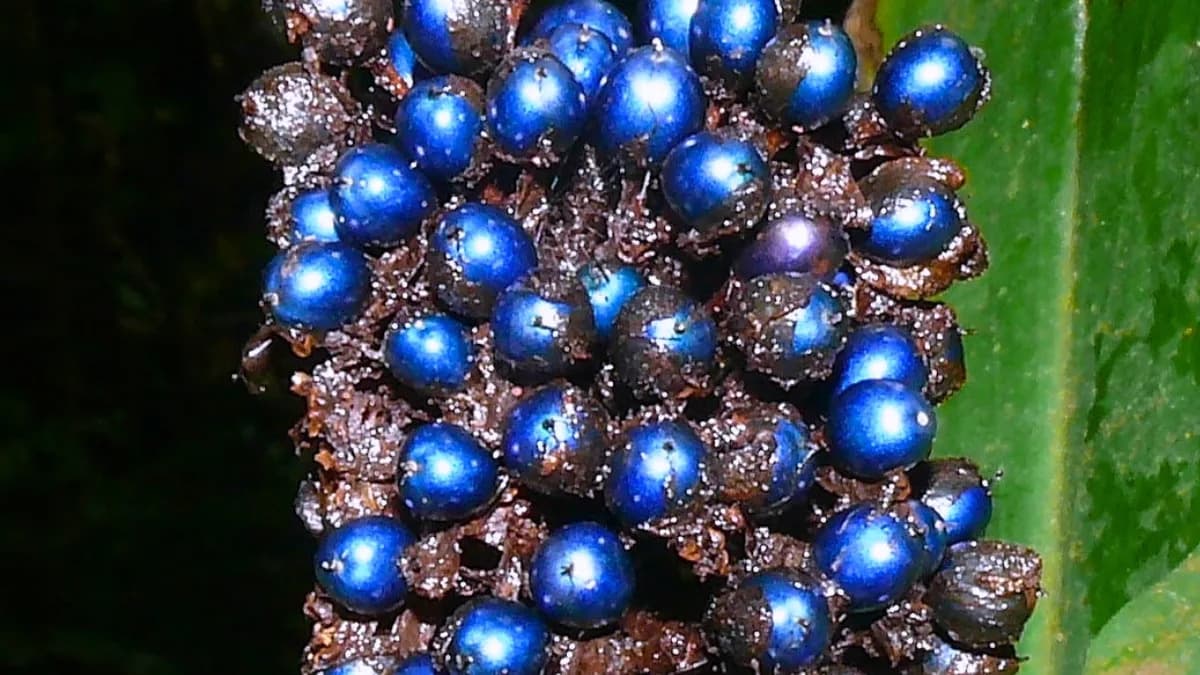
Bright blue berries
The marble berry (Pollia condensata), native to parts of Africa, looks like a tiny, permanent gem thanks to a vivid metallic blue sheen — but the fruit contains no blue pigment. Its striking color is a product of microscopic structure, not chemistry.
A team led by researchers at the University of Cambridge examined the berry's outer cells under a microscope and discovered a twisted, multilayered arrangement of cellulose fibres in the cell walls. These layers create structural colour: incoming light waves interfere with one another so that some wavelengths cancel out and others reinforce. In this case, blue wavelengths are preferentially reflected.
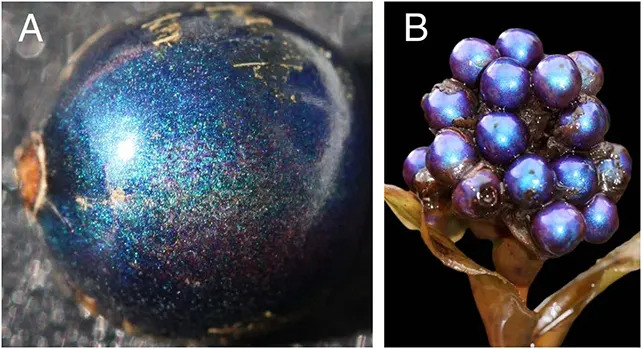
Examples of the fruit in nature. (Vignolini et al.,PNAS, 2012)
Remarkably, the marble berry reflects about 30% of incident light, a reflectivity higher than any previously reported for land-based biological materials — surpassing many beetle exoskeletons, bird feathers and even the well-known iridescent scales of Morpho butterflies.
The fibre stacks are not perfectly uniform across cells, so while blue dominates, a sparse mix of green- and red-reflecting cells produces a subtly pixelated, pointillist appearance. That unusual patterning appears to be unique among known organisms.

Subscribe to ScienceAlert's free fact-checked newsletter
Researchers suggest the display has an ecological purpose: the brilliant, durable sheen visually attracts birds, which then disperse the plant's seeds. Because the effect is structural rather than pigment-based, the berry's appearance can remain intact for decades even after the tissue is dead — an efficient, long-lasting signal that doesn't rely on offering nutrition.
Similar structural-colour strategies exist elsewhere in nature (peacock feathers and Morpho butterflies are well-known examples), though the marble berry's combination of extreme reflectivity and a pixelated colour mosaic is exceptional and rare among fruits.
"This obscure little plant has hit on a fantastic way of making an irresistible shiny, sparkly, multi-colored, iridescent signal to every bird in the vicinity, without wasting any of its precious photosynthetic reserves on bird food," said Beverley Glover, a plant scientist at the University of Cambridge.
The findings were published in the journal PNAS. Beyond natural history, the study highlights how evolution has refined optical materials — a source of inspiration as engineers and materials scientists develop new colours and coatings based on structural optics.
Help us improve.