Researchers at the University of Georgia discovered that six North American bat species fluoresce under ultraviolet light, a finding reported in Ecology and Evolution. The team examined 10 museum specimens of each species and observed photoluminescent glow on wings and hind limbs. While the trait appears likely to be genetic, its mechanism and adaptive value remain unknown. Scientists say further research could shed light on bat evolution and inform conservation because of bats’ roles in pollination and pest control.
Scientists Find Six Common North American Bats Glow Under UV Light — What It Could Mean
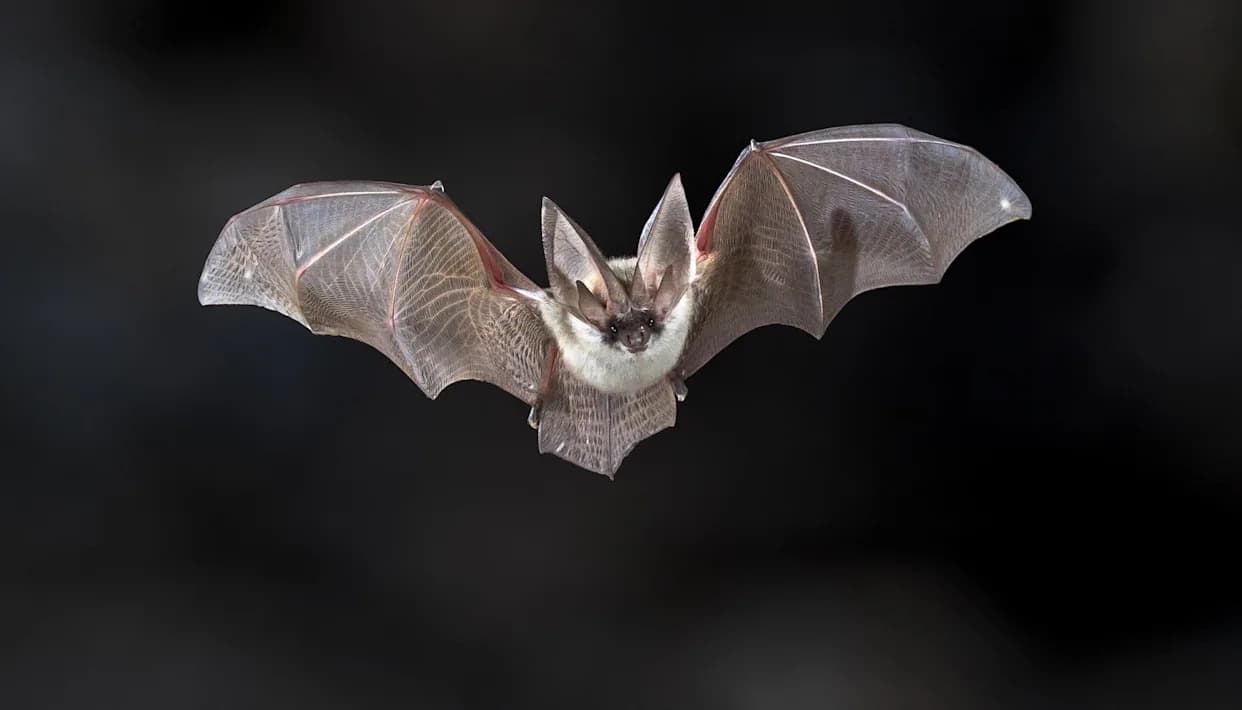
Photo Credit: iStock
Researchers at the University of Georgia report that six North American bat species exhibit a visible glow when exposed to ultraviolet (UV) light — a surprising discovery that expands knowledge of biofluorescent mammals and could have implications for conservation and ecological research.
Study and Methods
The findings, published in the journal Ecology and Evolution, come from examinations of museum specimens at the Georgia Museum of Natural History in Athens. Lead author Briana Roberson and her colleagues inspected 10 preserved specimens of each species and used controlled UV illumination to document photoluminescent responses.
What They Observed
The team reported a photoluminescent glow primarily on the bats' wings and hind limbs. The six species observed to fluoresce under UV light were:
- Big brown bat (Eptesicus fuscus)
- Eastern red bat (Lasiurus borealis)
- Seminole bat (Lasiurus seminolus)
- Southeastern myotis (Myotis austroriparius)
- Gray bat (Myotis grisescens)
- Brazilian free-tailed bat (Tadarida brasiliensis)
Context and Inspiration
Roberson's work was motivated by earlier discoveries of biofluorescence in other mammals, including a 2019 study on flying squirrels and a 2024 paper in Mammalian Biology that reported fluorescent digits in Mexican free-tailed bats. Those findings prompted researchers to test whether additional bat species shared similar traits.
“It’s ultimately some sort of mutation, and then that mutation somehow gets perpetuated because it’s beneficial,” said Steven Castleberry, a coauthor and professor of wildlife ecology and management at the University of Georgia, in a university press release.
Why This Matters
Although the underlying mechanism and adaptive purpose remain unknown, the discovery could help scientists better understand how bats adapt to changing environments and inform conservation strategies. Bats provide important ecosystem services: for example, the lesser long-nosed bat is a key pollinator of blue agave (used to make tequila), and other species help control agricultural pests. A study in Ecological Applications found bats reduced insect damage to growing macadamia nuts by roughly 40% on average.
What Remains Unclear
Researchers caution that the observed glow should be described as biofluorescence or photoluminescence (material absorbing UV and re-emitting visible light), not bioluminescence (light produced by an organism’s chemical reactions). The genetic basis, evolutionary origin, and ecological role — if any — of the trait are still open questions.
“It is most likely that this [luminescent] feature was inherited a long time ago by the ancestors to all modern mammals,” said Kenny Travouillon, terrestrial zoology curator at the Western Australian Museum, per CNN. “Why do they glow? We don’t know. So continuing to do research on this topic is important.”
Further research with live animals, broader taxonomic sampling, and chemical analyses of fur and skin will be needed to determine how widespread this trait is, how it is produced, and whether it confers any ecological advantages.
Help us improve.