Researchers led by Cees Passchier discovered tiny, parallel tunnels in marble and limestone outcrops in Namibia, Oman and Saudi Arabia. Microscopic and geochemical evidence — including biological material and calcium carbonate deposits inside the tunnels — argues against an abiotic origin. The team ruled out cyanobacteria and fungi as likely creators and proposes colonies of endolithic microbes formed the burrows. It remains unknown whether the organisms responsible still exist.
Tiny Tunnels in Desert Marble Likely Dug by an Unknown Ancient Microbe
Scientists Found Evidence of Unknown Life in RocksConstantine Johnny - Getty Images
For most organisms, rock is a surface to live on or a structure to attach to — not food. Yet exposed outcrops of marble and limestone in Namibia, Oman and Saudi Arabia contain tiny, parallel tunnels that a new study suggests were created by microscopic life.
Discovery and Evidence
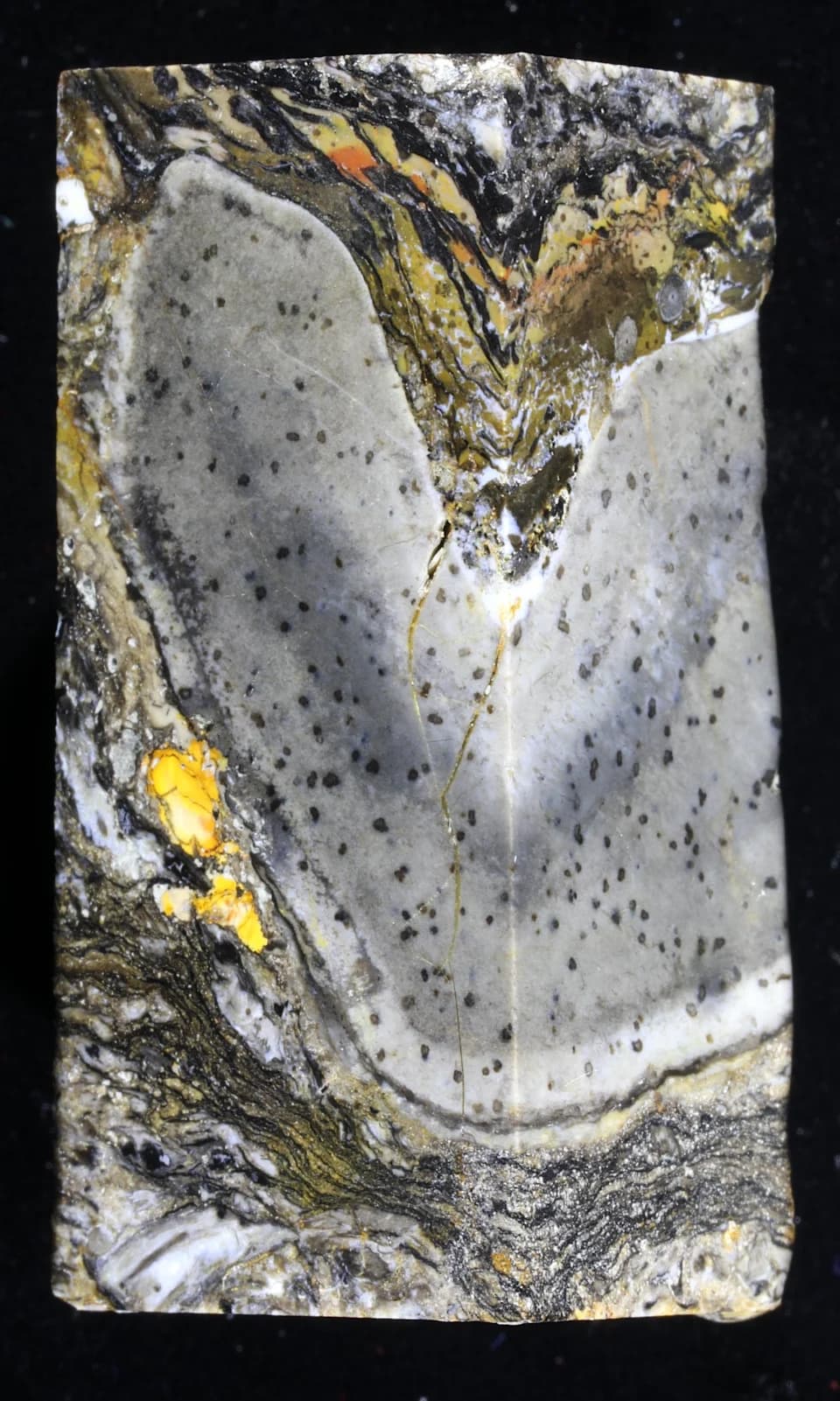
Geologist Cees Passchier of Johannes Gutenberg University Mainz and his team identified these micro-burrows after erosion revealed fossilized tunnel systems. Although no living creatures were observed in the openings, the researchers recovered biological material and fine calcium carbonate dust from inside several tunnels. Detailed microscopic and geochemical analyses indicate the structures were not produced by ordinary weathering or abiotic chemical processes.
“A biotic origin of the observed structures supposes the presence of liquid water, without which biological growth would be impossible,” the authors write in a study published in the journal Geomicrobiology Journal. They note that the currently arid regions receive occasional rain, frequent coastal fog and experienced wetter intervals in the past.
Which Organisms Could Have Done It?
The team considered known rock-dwelling (endolithic) groups — bacteria, fungi and lichen-forming organisms. They ruled out cyanobacteria because those organisms require light for photosynthesis and typically occupy near-surface layers rather than deep tunnels. Fungi can chemically bore into rock, but fungal activity usually leaves distinct chemical signatures and ordered mycelial networks; the tunnels here are parallel, evenly spaced and lack the filamentous patterns typical of fungal growth.
Instead, several lines of evidence point toward colonies of microbes: the tunnels are wider than a single microscale organism would make, they display growth-ring–like features consistent with repeated expansion or successive generations, and they contain carbonate dust that is commonly produced by mineral-dissolving microbes. To date, however, no fossilized cells or intact organisms have been recovered — only morphological and geochemical traces.
Implications and Open Questions
The researchers conclude that no known abiotic weathering mechanism accounts for the microstructural and geochemical observations, and therefore a biological origin is the most plausible explanation. Whether the microbe or microbial community that excavated these tunnels still exists is unknown: it may have gone extinct or may persist in hidden niches.
These findings add to our understanding of how life can interact with and modify mineral surfaces in extreme environments. They also highlight gaps in our knowledge about ancient microscopic ecosystems and raise intriguing possibilities for the study of life’s limits — on Earth and, potentially, on other rocky worlds.
Locations: Namibia, Oman and Saudi Arabia. Published in: Geomicrobiology Journal. Lead researcher: Cees Passchier (Johannes Gutenberg University Mainz).
Help us improve.