
Scientists from UiT and international partners discovered the Freya gas-hydrate mounds west of Greenland at about 3,640 metres depth — possibly the deepest active gas-hydrate cold seep recorded. ROV sampling found methane, traces of crude oil and a diverse chemosynthesis-based community including tubeworms, snails and amphipods. Sediment chemistry suggests hydrocarbons come from Miocene-era, plant-derived deposits. The discovery has important implications for carbon cycling, Arctic biodiversity and the risks of future deep-sea mining.
World’s Deepest Gas-Hydrate Cold Seep Found Off Greenland — A Hidden, Life-Rich Carbon Reservoir

worm discovered in gas hydrate sediment
Researchers have discovered an active gas-hydrate cold seep on the seabed west of Greenland that may be the deepest of its kind yet recorded and supports a rich, chemosynthesis-based community of deep-sea animals.
The features, named the Freya gas-hydrate mounds, were located during the Ocean Census Arctic Deep EXTREME24 expedition led by scientists from UiT The Arctic University of Norway with international partners. A pronounced gas flare in the water column alerted the team to unusual activity beneath their vessel and prompted deployment of a remotely operated vehicle (ROV) for close inspection.
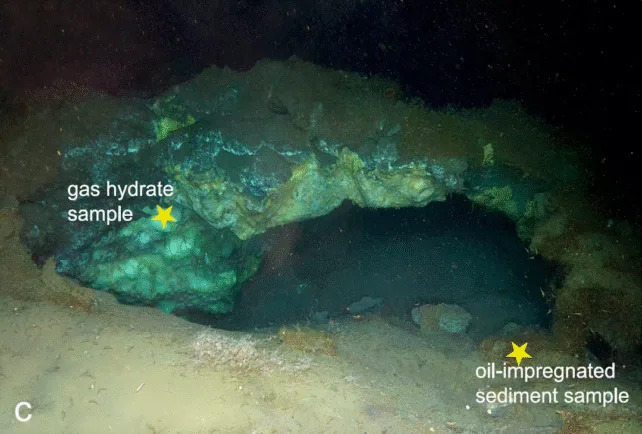
One of the Freya hydrate gas mounds, with sample sites marked. (Panieri et al.,Nature Communications, 2025)
The ROV surveys revealed exposed mounds of crystalline gas hydrate — a frozen lattice of methane and water stabilized by the deep ocean's high pressure and low temperature. Scientists collected samples of leaking methane, traces of crude oil, and sediments that harboured diverse organisms.
Depth and Significance. The Freya mounds are located at about 3,640 metres (roughly 11,940 feet), making this seep substantially deeper than most documented gas-hydrate systems, which commonly occur at depths shallower than ~2,000 metres. Finding active hydrate seepage at these ultra-deep depths expands our understanding of where carbon-rich deposits can persist and where chemosynthetic life can flourish.
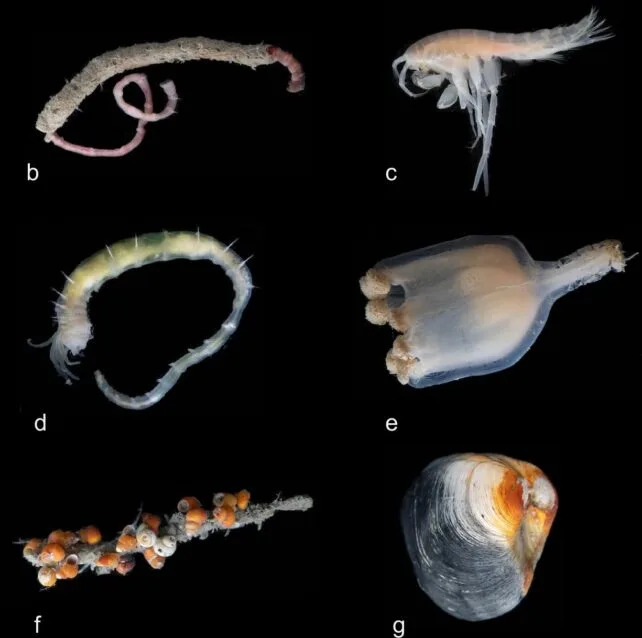
Animals discovered at the Freya mounds included tubeworms (b), shrimp-like crustaceans (c), bristle worms (d), and bivalves (g) (Panieri et al.,Nature Communications, 2025)
Life on the Mounds. The biological community is sustained by chemosynthetic microbes that convert methane, sulfide and other hydrocarbons into energy. Observed fauna include siboglinid and maldanid tubeworms, skeneid and rissoid snails, and melitid amphipods. At the family level, the community resembles Arctic hydrothermal-vent ecosystems found at comparable depths.
Origins of the Carbon. Chemical analyses of sediments indicate that the oil and some gases likely derive from carbon-rich deposits formed from flowering plants that once grew in a warmer, forested Greenland during the Miocene epoch (about 23 to 5.3 million years ago). These ancient, plant-derived deposits explain the hydrocarbon supply that sustains seep communities and also underline why the region is of resource interest.

Subscribe to ScienceAlert's free fact-checked newsletter
Implications for Climate, Biodiversity and Policy. Nearly one-fifth of the planet's methane is estimated to be stored as gas hydrate in marine sediments. Understanding where hydrates occur, how stable they are, and how they interact with deep-sea ecosystems is vital for assessing their role in global carbon cycling and climate. The discovery also raises urgent questions about potential impacts of deep-sea mining and resource extraction on fragile, isolated habitats.
"This discovery rewrites the playbook for Arctic deep-sea ecosystems and carbon cycling," said expedition co-chief scientist Giuliana Panieri. Marine ecologist Jon Copley of the University of Southampton, who participated in the expedition, added that such "island-like" habitats should be considered for protection from future mining impacts.
The team's findings are published in the journal Nature Communications. Continued exploration and careful stewardship will be essential to balance scientific discovery, conservation, and any future resource interests in the deep Arctic.


