New research in Scientific Reports argues that Ice Age giant kangaroos such as Procoptodon goliah (≈6.5 ft, ~550 lb) were anatomically distinct from modern red kangaroos and could likely hop. Fossil comparisons show shorter, thicker foot bones and broader heels that could withstand landing forces, while stiffer tendons made them better at short, powerful bursts than long-distance bounding. The authors propose a mixed locomotor repertoire combining brief hops with bipedal or quadrupedal walking.
Ice Age Giants: 550‑Pound Kangaroos Likely Still Hopped, New Study Finds
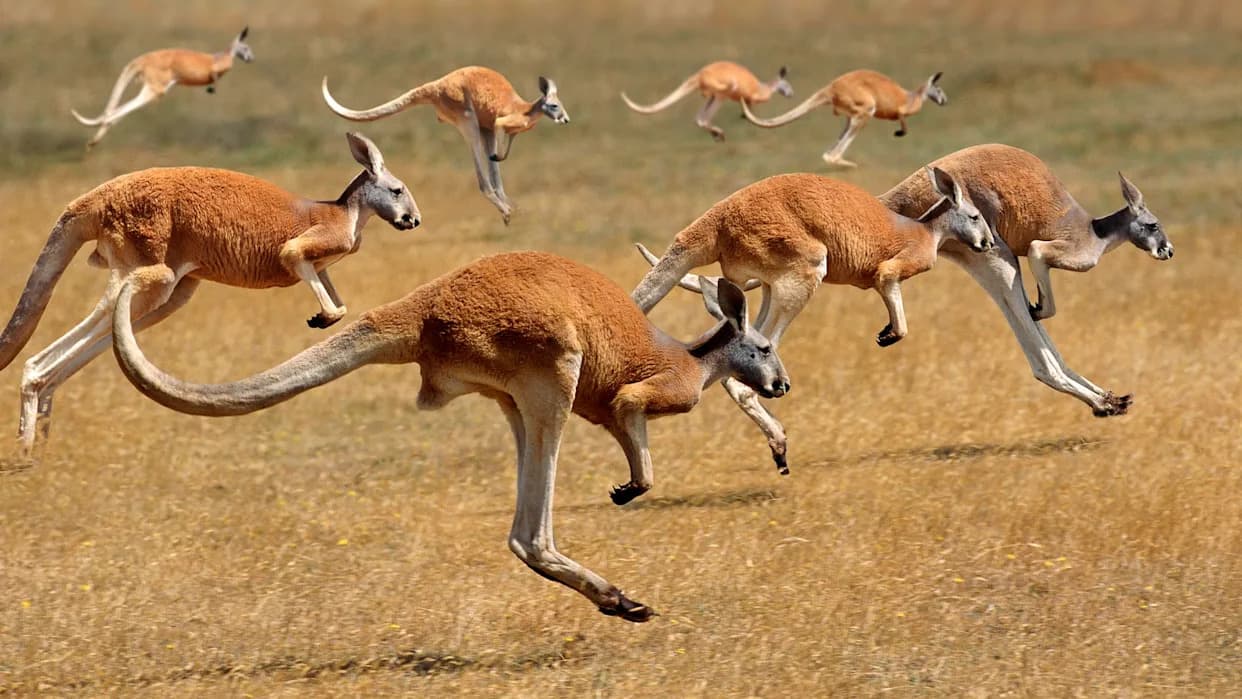
Red kangaroos are the largest hopping animals today, but their ancestors were almost double their size.
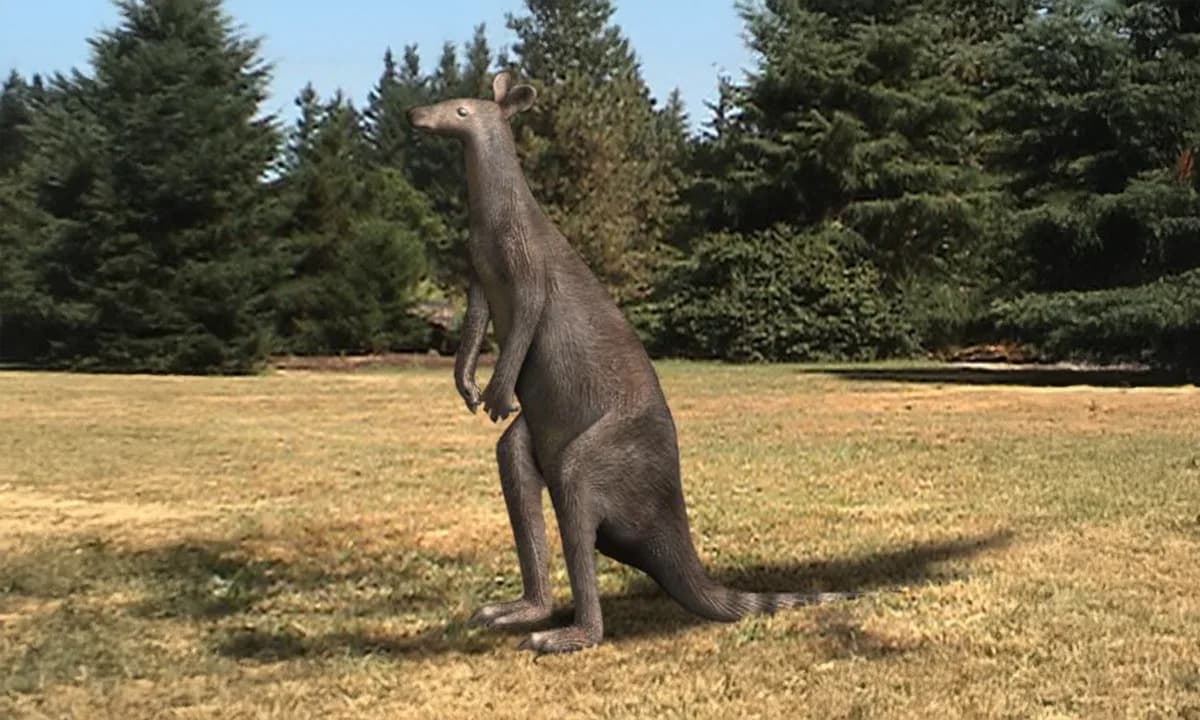
New research suggests that some Ice Age kangaroos — including the giant Procoptodon goliah — were anatomically adapted to hop despite weighing as much as 550 pounds. Rather than being simply oversized versions of modern red kangaroos, these megafaunal marsupials appear to have evolved different bone and tendon structures that helped them manage the stresses of hopping.
For millennia the largest living hopper has been Australia’s red kangaroo (Osphranter rufus). A large male can exceed five feet in height, weigh about 200 pounds, reach speeds near 37 mph and cover roughly six feet per leap. But during the Late Pleistocene, members of the Sthenurinae subfamily included much bulkier forms: paleontologists estimate that the largest species, Procoptodon goliah, stood around 6.5 feet tall and may have weighed up to 550 pounds.
It has been argued that scaling up the anatomy of a modern red kangaroo would make hopping mechanically impossible above roughly 330 pounds. Megan Jones, an evolutionary scientist at the University of Manchester, says that approach overlooks important anatomical differences between extinct and living species.
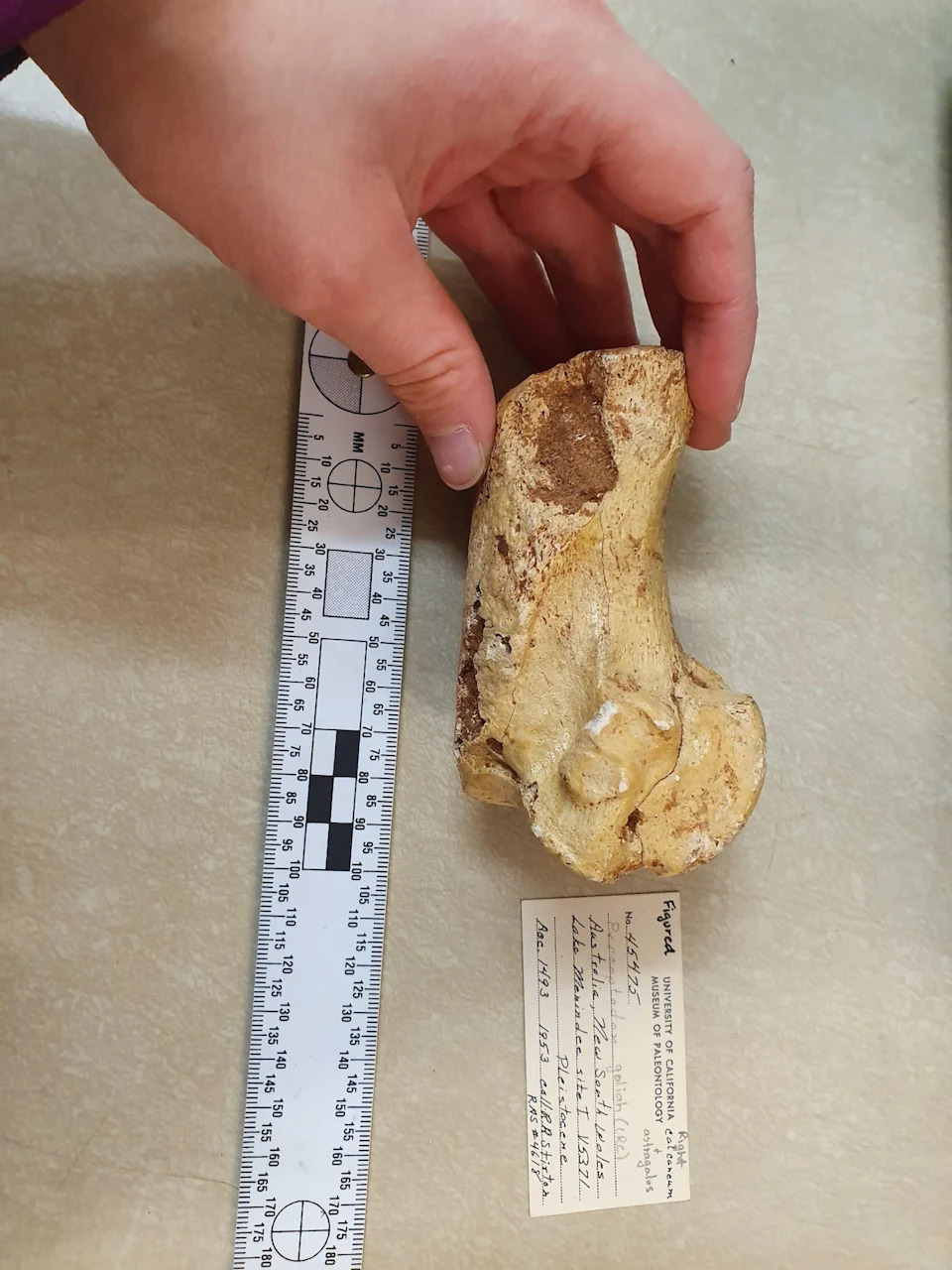
Scientists analyzed ancient kangaroo bones to see if their anatomy could support hopping. Credit:Megan Jones / UCMP
“Previous estimates were based on simply scaling up modern kangaroos, which may mean we miss crucial anatomical differences,” Megan Jones said. “Our findings show that these animals weren’t just larger versions of today’s kangaroos — they were built differently, in ways that helped them manage their enormous size.”
Published in Scientific Reports, the study compares the skeletons of living kangaroos with fossils from several Sthenurinae species. The authors focused on two constraints for hopping: the load-bearing capacity of foot bones and whether the ankle could anchor tendons strong enough to support locomotion.
Compared with modern kangaroos, Sthenurinae skeletons show shorter, stouter (thicker) foot bones and broader heels. That configuration would better resist the intense downward forces produced during landing. Powerful, robust tendons anchored to those broader heels could also help manage peak loads, even if the tendons stored less elastic energy overall.
“Thicker tendons are safer, but they store less elastic energy,” said Katrina Jones, a University of Bristol biologist and co-author. “This likely made giant kangaroos slower and less efficient hoppers — better suited to short bursts of movement rather than long-distance bounding.”
The team concludes that Ice Age giant kangaroos probably used hopping as part of a broader movement repertoire: short bursts to cross rough ground or evade predators, combined with walking on two legs or even occasional quadrupedal support. In short, these megafaunal 'roos were adapted for power and stability rather than sustained, energy-efficient hopping like many modern kangaroos.
While questions remain about exact locomotor mechanics and behavior, the study highlights how differences in skeletal design — not just size — determine what extinct animals could do. The paper calls for continued biomechanical and comparative work to refine our understanding of how these remarkable animals moved across Pleistocene Australia.
Help us improve.