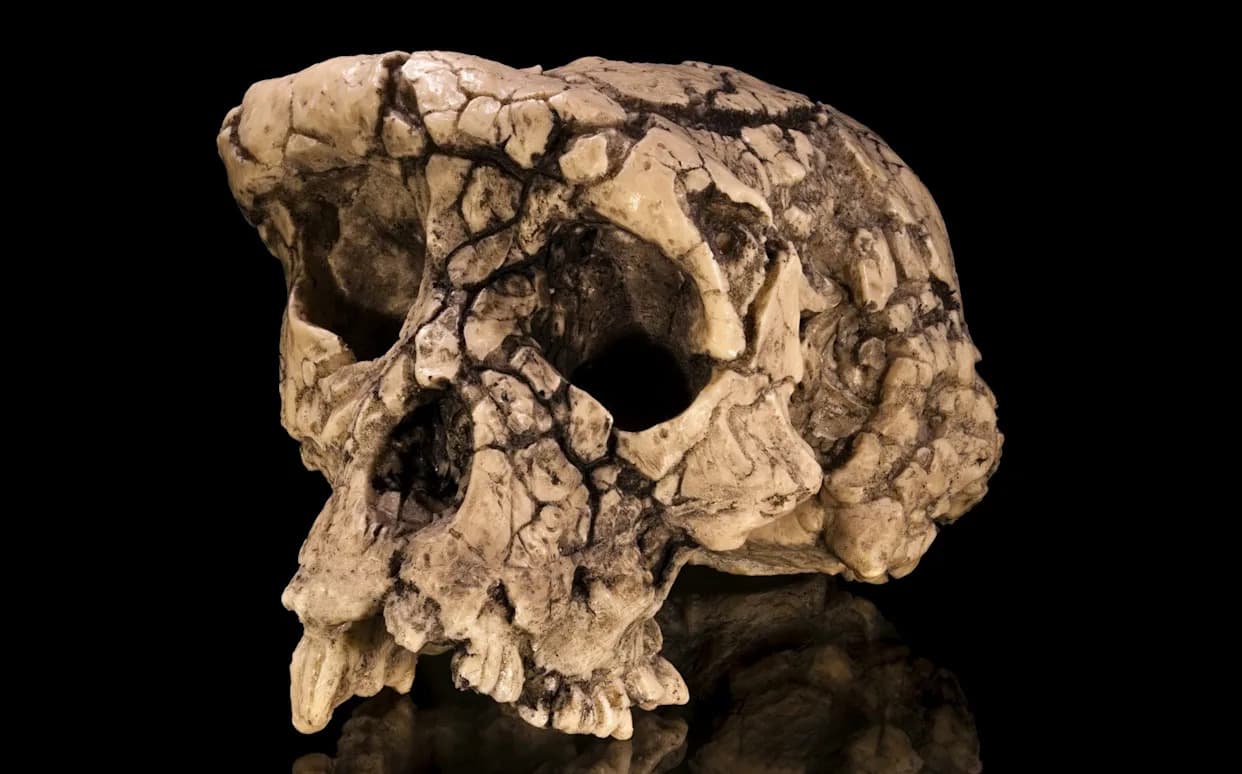
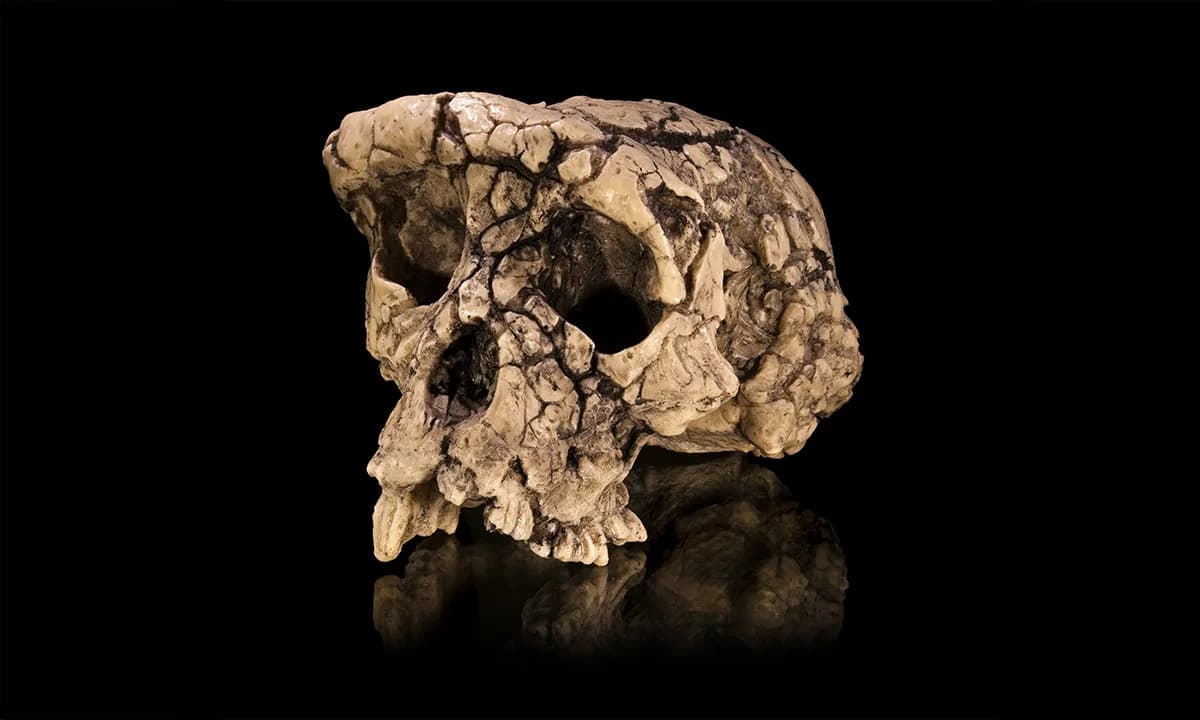
The reanalysis of a ~7-million-year-old Sahelanthropus tchadensis femur reveals a subtle femoral tubercle and two additional human-like traits—an inwardly twisted shaft and a lateral gluteal attachment—features associated with upright walking. Although the species retains curved arm bones for climbing, the combination of femoral features suggests frequent bipedalism on the ground. Experts welcomed the observations but note the findings complicate whether bipedalism alone proves hominin status and what the last common ancestor of humans and chimpanzees looked like.
Tiny Bump on 7-Million-Year-Old Fossil Suggests Ancient Ape Walked Upright — Could Be Earliest Hominin
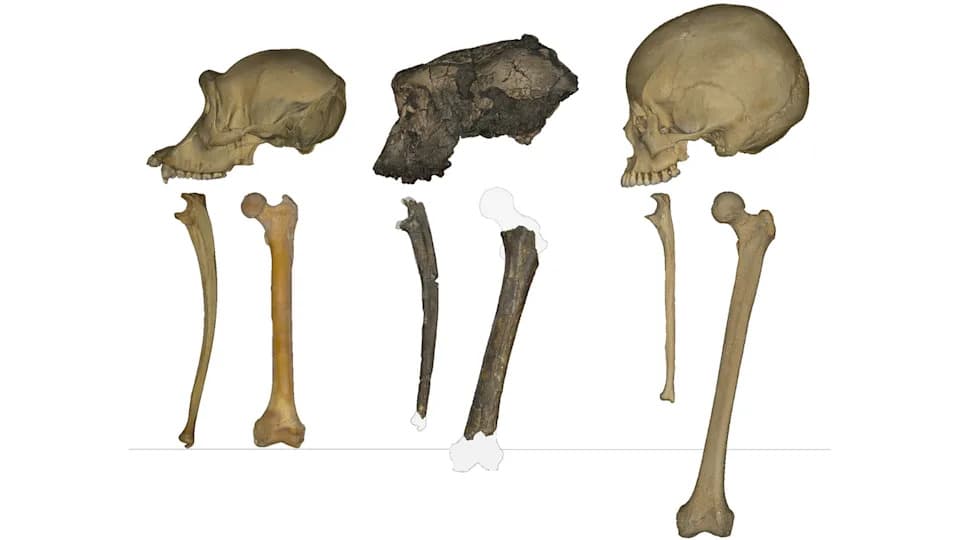
Sahelanthropus tchadensis' (center) knees and hips functioned more like humans' (right) than chimpanzees' (left). | Credit: Williams et al, Science Advances (2026) CC-BY-4.0
The discovery of a previously unnoticed projection on the thigh bone of a roughly 7-million-year-old fossil ape strengthens the case that the animal walked on two legs when on the ground, according to a new study published Jan. 2 in Science Advances. The research team identifies a tiny femoral tubercle—previously unreported—that, together with other human-like features of the femur, suggests the specimen may belong to the early human lineage.
What the Researchers Found
The fossil belongs to Sahelanthropus tchadensis, first described in 2002 from material recovered in what is now Chad. In a reanalysis of three-dimensional scans of limb bones, the authors report three key observations on the femur: an inwardly twisted femoral shaft that brings the knees closer to the midline (a human-like alignment), a distinct lateral prominence where the largest gluteal muscle attaches, and a subtle bump on the anterodistal femur identified as the femoral tubercle.
Why These Features Matter
These anatomical traits are functionally linked to bipedal mechanics in hominins. The femoral tubercle in particular is a small projection associated with muscles and tendons used during upright walking and — according to the authors — is known only from members of the human lineage. The combination of traits suggests a gait more similar to early hominins than to extant nonhuman apes.
Tree Climbing and Terrestrial Walking
At the same time, S. tchadensis retains strongly curved arm bones, indicating adaptations for climbing and arboreal activity. The researchers conclude that this species likely combined climbing with significant time spent on the ground walking bipedally.
Methods and Comparative Analysis
Williams and colleagues examined 3D scans of the femur and ulna and compared these elements with femora from living and fossil great apes and hominins. While overall limb proportions showed similarities to chimpanzees and bonobos, the team found several clear differences in femoral anatomy that support habitual bipedality.
Scientific Debate and Reaction
Sahelanthropus has been controversial since 2002. Early proponents emphasized the skull's centrally positioned foramen magnum as evidence of upright posture, but critics argued that feature alone did not prove habitual bipedalism. The newly reported tubercle and additional femoral traits prompted positive responses from external experts: Jeremy DeSilva of Dartmouth College called the new observations convincing and said he wished he had noticed them earlier.
'That [bump] really sold it to us,' said Scott A. Williams, associate professor of paleoanthropology at New York University and the study's lead author. 'That really convinced me that, OK, we think it's a biped, and therefore, we think it's a member of the hominin lineage.'
Implications
If S. tchadensis is confirmed as a hominin, it pushes the history of upright walking back to about 7 million years ago and suggests the last common ancestor of humans and chimpanzees may have been more chimpanzee-like in many ways while still capable of bipedal locomotion. Alternatively, as some experts caution, the species might represent a bipedal ape that evolved terrestrial walking independently of the human lineage. Either outcome complicates reconstructions of the last common ancestor and highlights the mosaic nature of early hominin evolution.
Conclusion
The new study adds strong morphological evidence for bipedal locomotion in Sahelanthropus tchadensis through a combination of subtle and clear femoral features. While the finding does not end the debate about the species' exact place in our family tree, it raises important questions about how and when bipedalism evolved.
Publication: Science Advances, Jan. 2. External reactions were reported in Live Science.
Help us improve.