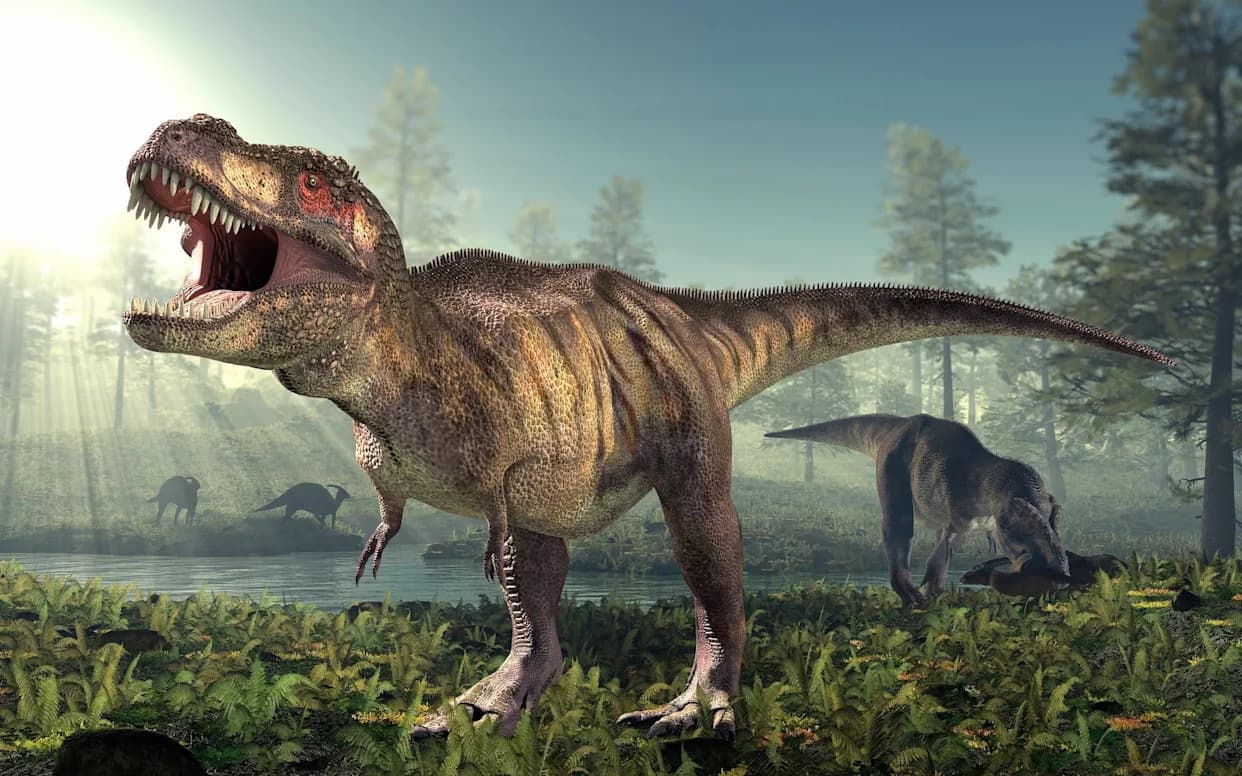
The largest growth dataset assembled for Tyrannosaurus rex—17 leg-bone specimens examined with polarized light—reveals previously hidden annual growth marks. Using a new statistical reconstruction, researchers found T. rex likely reached its peak mass (~8 tons) at about 35–40 years, not around 25 as earlier studies suggested. Variable ring spacing indicates year-to-year flexibility in growth tied to resources and environment, and the results add weight to debates over whether some fossils labeled T. rex represent other taxa such as Nanotyrannus.
Revised Fossil Analysis Shows T. rex Took Decades Longer To Reach Full Size
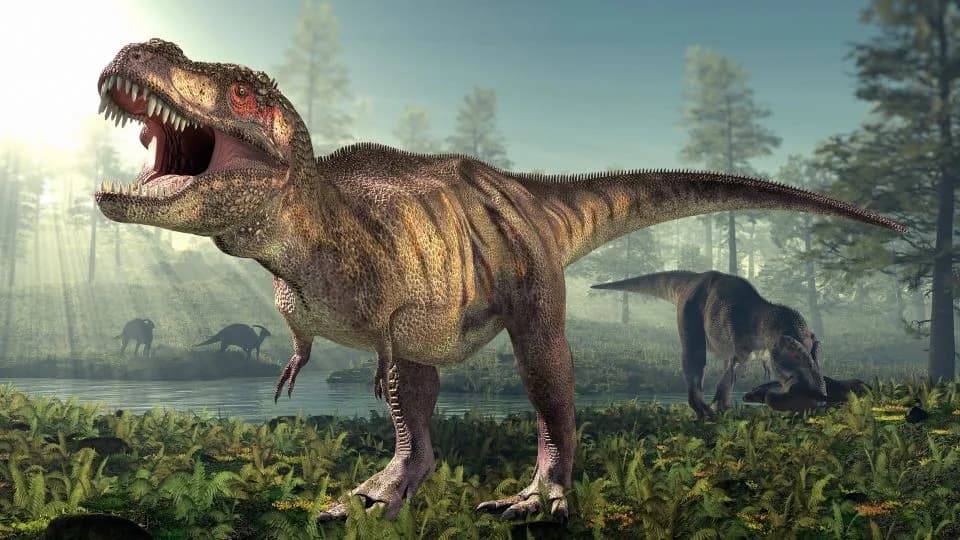
Tyrannosaurus rex is known as the king of the dinosaurs. - Roger Harris/Science Photo Library RF/Getty Images
A new study using polarized-light microscopy and a novel statistical approach suggests Tyrannosaurus rex grew far more slowly and lived longer than previously believed. By revealing previously hidden growth marks in leg bones from 17 individuals—the largest T. rex growth dataset assembled to date—researchers reconstructed year-by-year growth trajectories and concluded these giants reached maximum mass much later in life.
Hidden Growth Rings Reveal Slower, Longer Growth
Paleontologists traditionally estimate dinosaur age and growth rates by counting annual growth rings preserved in fossilized bones. Earlier work indicated T. rex typically stopped growing around 25 years of age and rarely lived past roughly 30. But in a paper published in the journal PeerJ, the team used polarized light to detect subtle, previously unreported growth marks in femora and tibiae from 17 specimens.
The analysis indicates that a typical T. rex would not reach its peak weight—about 8 tons—until roughly 35 to 40 years of age. Unlike tree rings, the growth marks preserved in dinosaur bone usually record only the final 10–20 years of an animal's life, so combining data from individuals at different life stages was essential to reconstruct a full growth curve.
New Statistical Reconstruction
Because the specimens spanned early juveniles through adults, the researchers applied a statistical method that merges partial growth records from multiple animals to reconstruct annual growth increments. Using this approach, they concluded that T. rex increased in body mass more slowly than earlier estimates implied and spent much of its life at intermediate sizes rather than rapidly sprinting to maximum stature.
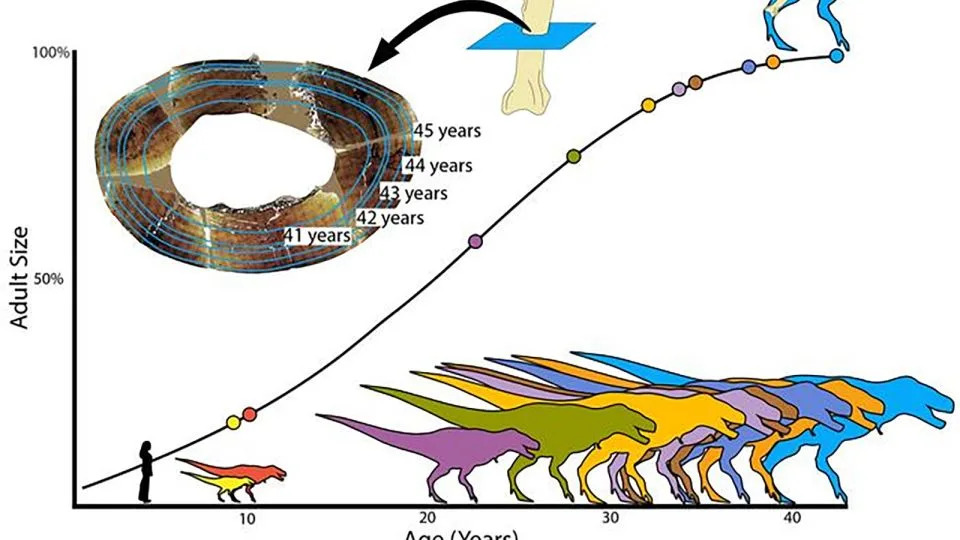
A diagram shows the percentage of a Tyrannosaurus rex's adult size that it would have reached at different life stages. - Dr. Holly Woodward Ballard
“Instead of a rapid sprint to full size, T. rex spent much of its life at intermediate body sizes and did not quickly reach the roughly 40-foot total body length once assumed,” said lead author Holly Woodward, a professor of anatomy at Oklahoma State University.
Woodward and colleagues also found that growth-ring spacing could vary markedly within a single individual—some years show substantial mass gain, while other years show little—suggesting flexible growth likely tied to food availability and environmental conditions.
Implications For Species Identification And Methods
Variation among reconstructed growth curves adds fuel to the ongoing debate about whether fossils long labeled Tyrannosaurus rex might represent more than one species or subspecies. For example, recent work has argued that some specimens thought to be teenage T. rex may instead belong to a distinct taxon, Nanotyrannus. The current study does not settle that question, but the authors say the growth patterns make the possibility intriguing.
Study coauthor Nathan Myhrvold, a mathematician and paleobiologist, cautioned that interpreting multiple, closely spaced growth marks is difficult and that standard protocols used in many growth studies may need revision in light of these findings.
“We found strong evidence that the protocols typically used in growth studies may need to be revised,” Myhrvold said in the authors’ statement.
Why This Matters
Slower, prolonged growth alters how scientists think about T. rex's life history and ecology: by growing more slowly over decades, these predators may have occupied a broader range of feeding niches throughout life and reached sizes that minimized competition with other species. The discovery of a previously unrecognized kind of growth mark also has broader implications for reconstructing life histories across extinct dinosaurs.
Study details: Polarized-light microscopy on 17 T. rex leg bones; largest dataset to date for the species; published in PeerJ. Quotes and contextual comments were provided to media by the authors and outside experts.
Help us improve.