LTE440 is an open-source Lunar Time Ephemeris developed by a team at Purple Mountain Observatory and described in Astronomy and Astrophysics. It provides a reproducible method to translate Earth time into a consistent lunar timescale by accounting for relativistic effects and the Moon's orbital dynamics. Clocks on the Moon run slightly faster than on Earth due to a combination of weaker gravity and orbital motion; a crossover altitude near 3,500 km matches Earth's clock rate, while geostationary orbit (~35,786 km) and the Moon (~384,400 km) show progressively larger differences. LTE440 is openly available, and other agencies and companies will likely produce their own implementations.
China’s LTE440: An Open-Source Standard for Lunar Time — What It Means and Why It Matters

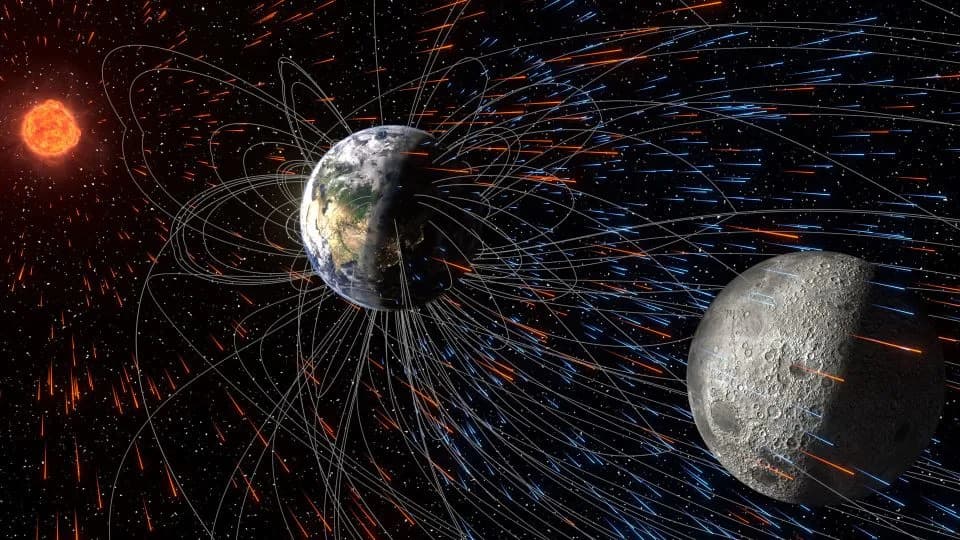
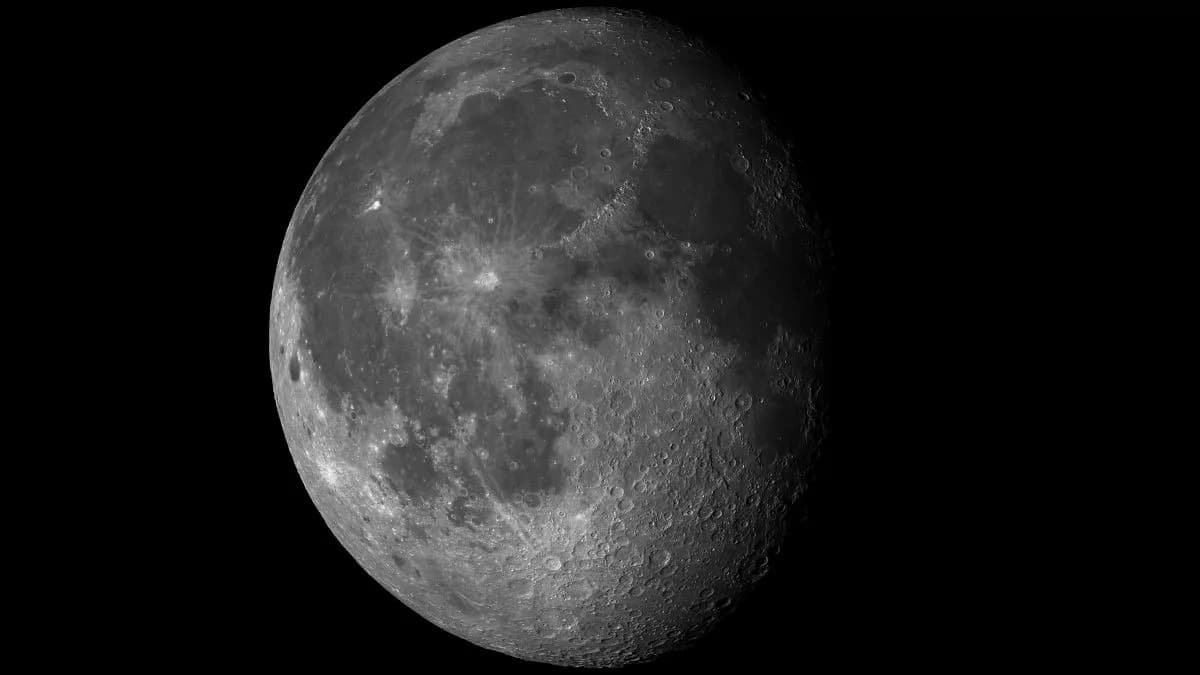
(Credit: NASA)
A research team at the Purple Mountain Observatory in Nanjing has released an open-source tool called the Lunar Time Ephemeris (LTE440), described in a paper published in Astronomy and Astrophysics. LTE440 translates Earth-based time into a consistent lunar timescale, an essential foundation for navigation, communications, and precision systems as activity around and on the Moon expands.
Why a Lunar Time Standard Matters
Many modern technologies — satellite navigation, scientific experiments, and coordinated operations — require clocks that agree to very tight tolerances. Relativistic effects make clocks on the Moon run at a different rate than identical clocks on Earth, so a reliable, well-documented translation between Earth time and lunar time is necessary for safe and predictable operations.
How Relativity Changes Clocks
Two main relativistic factors affect clock rates: velocity (special relativity) and gravitational potential (general relativity). Higher velocity slows a clock down relative to a slower one; a weaker gravitational field speeds a clock up relative to one in a stronger field. For orbiting objects these effects can partially cancel.

A distorted watch face
There is a crossover altitude near ~3,500 km where an orbiting satellite would experience a net time flow roughly equal to a clock on Earth because the velocity-related slowdown balances the gravity-related speedup. Above that altitude the gravity-related effect dominates and clocks run faster than on Earth: geostationary orbit sits at about 35,786 km, and the Moon’s average distance is about 384,400 km, producing a noticeably larger net acceleration of lunar clock rates.
What LTE440 Does
LTE440 implements a precise, reproducible model for converting Earth time (e.g., UTC) into a consistent lunar timescale, accounting for the Moon’s gravity, its slightly elliptical orbit, and relativistic corrections. Because it is open-source, other teams — including international space agencies and commercial actors — can inspect, adopt, and adapt the code for navigation, surface operations, scientific timestamps, and mission planning.
Beyond National Headlines
Although commentators often frame such milestones as geopolitical competitions, the technical value of an open, well-documented lunar time standard transcends national origin. LTE440 is a practical contribution to an international ecosystem of tools that will support future lunar infrastructure. It is also likely that NASA, ESA, private companies, and others will develop complementary or alternative implementations tailored to their missions.
In short: LTE440 is a timely, open technical milestone that helps turn the Moon into an environment where clocks — and the systems that depend on them — can function predictably.
Help us improve.