Satellite data reveal fan-shaped, delta-like deposits in Coprates Chasma, indicating rivers once flowed into a standing body of water. The deltas sit at approximately -3,650 to -3,750 meters relative to the Martian reference level, implying an ocean roughly the size of Earth’s Arctic Ocean. Researchers date the deposits to about three billion years ago and say these ancient coastlines are prime targets in the search for traces of past life on Mars.
Mars Might Have Had an Arctic-Sized Ocean — Ancient Sea Level Reconstructed

Mars with oceans
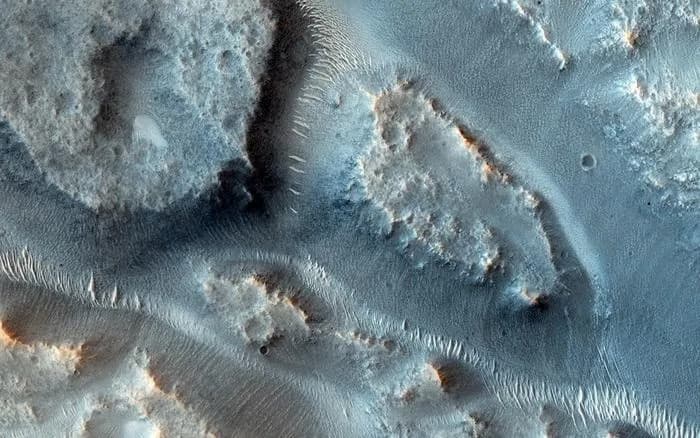
Mars is awash with signs that it was once much wetter. New research using data from three orbiting satellites identifies fan-shaped, delta-like deposits in Coprates Chasma (part of the Valles Marineris system) and uses their elevation to reconstruct the sea level during the wettest known period in Martian history.
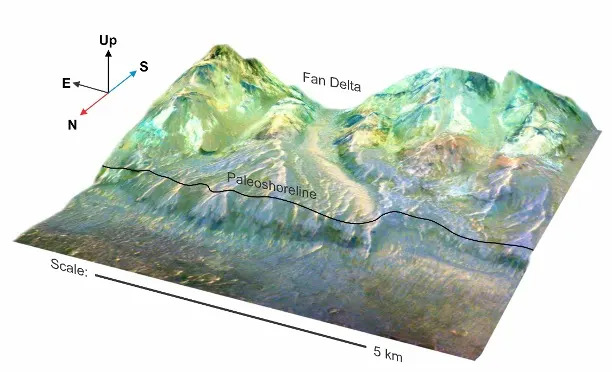
A model of the Martian coastline. (ESA/ExoMars – TGO/CaSSIS/Ignatius Argadestya)
What the Team Did
Researchers from institutions in Italy and Switzerland analyzed high-resolution satellite imagery and topographic data to map sedimentary deposits in Coprates Chasma. These fan-shaped formations closely resemble terrestrial river deltas — the triangular deposits formed where rivers flow into standing bodies of water.

Subscribe to ScienceAlert's free fact-checked newsletter
“Delta structures develop where rivers debouch into oceans, as we know from numerous examples on Earth,” said Fritz Schlunegger, a geomorphologist at the University of Bern.
Key Findings
All identified delta-like deposits lie between 3,650 and 3,750 meters below the Martian surface reference level. That elevation is roughly 1,000 meters above the deepest point of Valles Marineris and implies a former sea with an approximate footprint similar to Earth’s Arctic Ocean. The researchers estimate these sediments were deposited about three billion years ago — a few hundred million years later than some prior hypotheses for a northern ocean.
“We were able to provide evidence for the deepest and largest former ocean on Mars to date — an ocean that stretched across the northern hemisphere of the planet,” said Ignatius Argadestya, a geologist at the University of Bern.
Implications for Habitability and Exploration
Whether that water escaped to space or drained underground, the growing evidence suggests a substantially wetter past for Mars and bolsters the idea that some regions could have been habitable. Because life on Earth appears to have emerged relatively quickly once conditions permitted, these newly mapped ancient coastlines are promising targets to search for preserved traces of early life.
The full study is published in the journal npj Space Exploration.
Help us improve.