The Moon’s resources—water ice, metals and rare isotopes such as helium‑3—are drawing growing commercial and national interest as launch and robotic technologies advance. Private firms and national programmes are testing excavators, drills and landers, while SpaceX’s Starship could substantially lower transport costs. Current international law is fragmented and ambiguous about private extraction and benefit‑sharing. Binding multilateral rules that emphasize stewardship, clear access rights and equitable benefit‑sharing are urgently needed to reduce risks to science, the environment and international security.
The Race To Mine The Moon Is On — Why Urgent International Rules Are Needed

Fifty years after NASA won the "space race" with the Apollo 11 moon landing, the agency hopes to revamp its lunar exploration program with the help of international partners. . | Credit: NASA
The idea of mining the Moon has moved from science fiction to an accelerating commercial and national priority. The Moon's proximity to Earth, coupled with deposits of potentially valuable materials, has pushed companies and governments to develop excavators, drills, landers and rovers—and to plan missions that could lead to resource extraction within the next decade.
What’s on the Moon
Scientists and prospectors point to a range of materials on the lunar surface and in permanently shadowed polar craters: uranium, potassium, phosphorus, water ice, platinum-group metals and the rare isotope helium-3, which some hope could one day feed low‑pollution fusion power. Confirming the distribution and concentrations of these resources requires more exploration missions and in-situ measurements.
Who Is Building The Tools
Private companies and national agencies are rapidly demonstrating the hardware needed for prospecting and extraction. Seattle startup Interlune, with Iowa manufacturer Vermeer, is developing an electric lunar excavator intended to recover helium-3; its prototype reportedly can process up to 100 metric tons of regolith per hour, with a reconnaissance mission planned for 2027 and a pilot plant proposed for 2029.
Astrobotic (Pittsburgh) is developing the Griffin-1 lander to carry a rover built by Astrolab for surface analysis, while Houston’s Intuitive Machines has built the Nova‑C lander and supported NASA science missions. Under NASA programmes such as PRISM and the Polar Resources Ice Mining Experiment-1 (PRIME‑1), technologies like Honeybee Robotics’ Trident drill have been tested to bore into and extract lunar soil.
SpaceX’s Starship—if it reaches full operational capability—promises to change economics: analysts estimate it could cut launch costs by roughly US$250–$600 per kilogram, enabling shipment of heavier equipment and larger infrastructure to the lunar surface.
More Countries Are Joining
The landscape is no longer US-centric. China aims for crewed lunar landings by 2030 and robotic construction of bases, working with Russia and others toward an International Lunar Research Station by about 2035. Australia plans a 2026 rover to test oxygen extraction and regolith handling. Japan’s SLIM mission focuses on precision landings, and private Japanese company ispace is developing prospecting rovers. In Europe, the Argonaut programme supports ESA’s first lunar lander development with industrial partners across the EU.
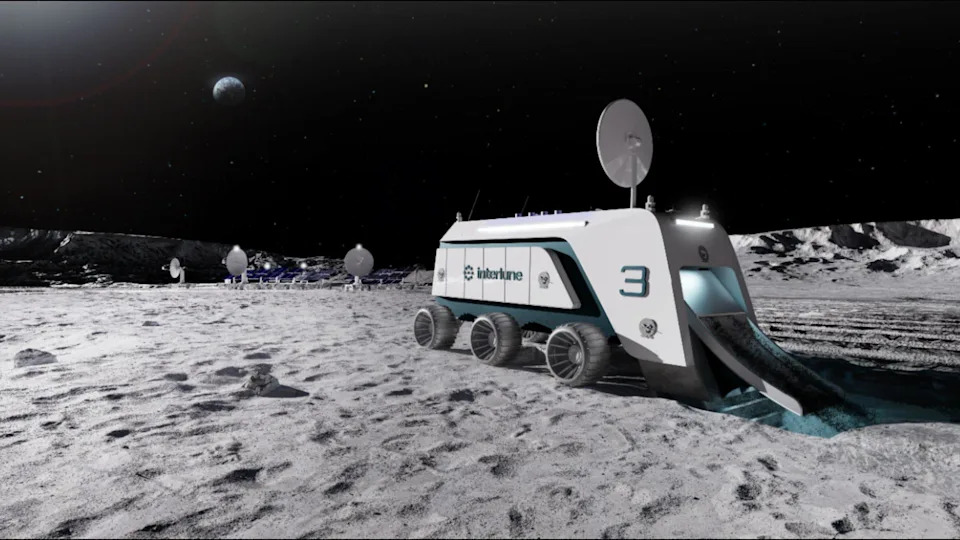
An illustration of the electric lunar harvester, developed by Interlune, designed to mine minerals on the moon. | Credit: Interlune
Gaps In Law And Governance
Current international law on space dates largely from the Cold War. The 1967 Outer Space Treaty bars national appropriation of celestial bodies and declares that exploration shall benefit “all mankind,” but it does not clearly resolve whether private extraction of resources is permitted or how benefits should be shared. The 1979 Moon Agreement proposed treating lunar resources as the “common heritage of mankind” and creating an international regime for exploitation, but it was never ratified by major spacefaring nations.
In recent years, domestic laws and voluntary arrangements have filled the vacuum. The US Commercial Space Launch Competitiveness Act (2015) and similar laws in Luxembourg, the UAE and Japan grant private actors rights to extracted resources. The non-binding Artemis Accords (2020) set voluntary principles—transparency, safety zones and coordination—but function more like a coalition framework than universal law.
Risks: Conflict, Science Loss, And Environmental Harm
The legal ambiguity benefits early movers and those with clear domestic rules, but it also raises serious concerns. Large-scale excavation could damage scientifically important sites, contaminate pristine environments, and create debris hazards. Astronomers and preservation advocates warn that mining could interfere with observations or destroy sites of geological and historical value.
Security concerns are real: valuable resources like water ice are concentrated in limited regions, and overlapping claims or unilateral exclusion zones could spark diplomatic or even military tensions. Competing governance frameworks—differences between obligations under the Outer Space Treaty and the principles in the Artemis Accords, for example—could compound disputes.
What Needs To Happen
Policymakers face a narrowing window to craft international rules that match technological progress. Binding agreements between major space powers that emphasize stewardship, clarify access and property rights, and establish equitable benefit‑sharing and environmental protections would reduce the risk of conflict and help ensure sustainable development of the Moon.
Short term: Fund reconnaissance missions and transparent data-sharing so all states can assess resources. Medium term: Negotiate multilateral rules on safety/exclusion zones, environmental protections and dispute resolution. Long term: Create an agreed mechanism for benefit‑sharing that encourages investment while protecting global public interests.
The race to mine the Moon is now as much a policy and diplomatic challenge as an engineering one. Without clear, equitable international rules, rapid technological advances risk producing conflict, environmental harm and unequal economic gains. With foresight and cooperation, lunar development can be steered toward sustainable and inclusive outcomes.
Help us improve.