
NIST researchers modeled Mars’ gravitational field along its orbit and validated results with in‑situ measurements, finding that Mars’ clocks run on average 421.5 μs per Earth day faster than Earth clocks. Mars’ weaker gravity, more eccentric orbit, and sensitivity to external perturbations make its timekeeping far more variable than Earth’s or the Moon’s. The model’s residuals average about 100 ns/day, a major improvement but still roughly 100× less precise than lunar models.
Mars Clocks Tick Faster — And Far More Irregularly Than Earth or Moon Time

Gravitational lensing, or light bending around massive objects, is another example of general relativity at play. Photo: NASA/ESA/HST
The National Institute of Standards and Technology (NIST) has published new calculations showing that clocks on Mars run measurably faster than clocks on Earth — and that Martian time is far more variable than terrestrial or lunar time.
Why it matters: Precise timekeeping underpins navigation, communications and positioning systems (think GPS and next‑generation wireless). Any future Martian navigation or 5G‑style network will need accurate Mars↔Earth time conversions to function correctly.
How gravity and motion change time
According to Einstein's general relativity, clocks in stronger gravitational fields tick more slowly. Timekeepers already correct for Earth's gravity and the Sun and Moon when they tune GPS and other precision systems. The NIST team modeled Mars’ gravitational field at many points along its orbit and validated their predictions against in‑situ gravitational measurements made on Mars.
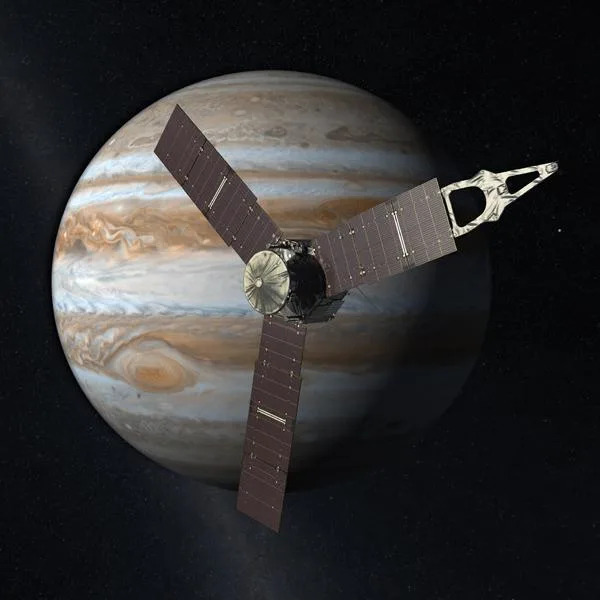
The Juno spacecraft contributed Martian gravity measurements as it flew past the red planet. Photo: NASA/JPL/Caltech
Why Mars is messier
Several factors make Martian timekeeping more complicated than on Earth or the Moon:
- Weaker surface gravity: Mars’ mass is only about 10% of Earth’s, so surface gravity is weaker and, all else equal, time flows slightly faster there.
- High orbital eccentricity: Mars’ orbit is noticeably more elliptical than Earth’s, so the Sun’s influence on local clock rates varies more over a Martian year.
- External perturbations: Mars’ lower mass makes it more susceptible to gravitational tugs from other bodies (including Earth), which change the planet’s motion and local gravity over time.
What the NIST model finds
The researchers report an average difference of 421.5 microseconds (μs) per Earth day between Mars and Earth — that is, a Martian clock advances about 421.5 μs faster per Earth day than an Earth clock would. While small, this offset is large enough to disrupt high‑precision services if left uncompensated.
The model’s residuals — the discrepancies between predicted clock rates and direct gravitational observations on Mars — average about 100 nanoseconds (ns) per day. That level of precision is impressive but still roughly 100× worse than the team’s lunar time conversions (about 1 ns/day), highlighting how much more variable Mars’ environment is for timing.
Bottom line: NIST’s new Martian time model is a major improvement over prior work and provides a practical foundation for future Mars navigation and communications, but further data and refinements will be needed to reach lunar‑level precision.
Implications: Accurate Mars–Earth time conversion will be essential for precise positioning, interplanetary communications, and any time‑sensitive services on Mars. The NIST results bring us closer to that goal while underscoring the technical challenges ahead.


