The young star V1298 Tau, about 20 million years old and 350 light-years away, hosts four unusually low-density, 'puffy' planets whose radii (5–10 Earth radii) far exceed their masses (~5–15 Earth masses). Nearly a decade of observations with Kepler, TESS and ground telescopes — plus a crucial third transit caught by Las Cumbres Observatory — allowed researchers to measure masses via transit-timing variations and fix the outer planet's orbit. Simulations indicate the planets have already lost significant atmosphere, will cool and contract, and are likely to evolve into super-Earths and sub-Neptunes over billions of years.
Rare 'Puffy' Baby Planets Around V1298 Tau Provide a Missing Link in Planet Formation

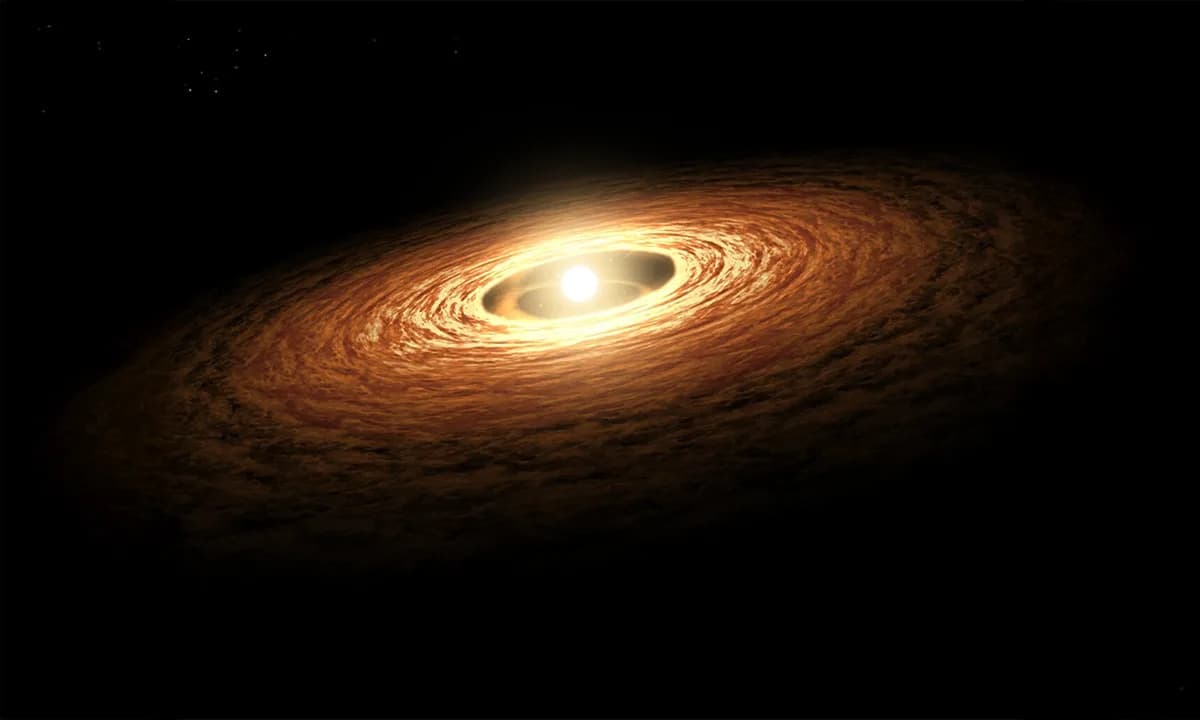
An illustration of four confirmed protoplanets swirling around the star V1298 Tau . | Credit: Astrobiology Center, NINS
A team of astronomers has captured an unusually clear view of four infant, extremely low-density planets orbiting the young star V1298 Tau. Located about 350 light-years from Earth and only ~20 million years old, V1298 Tau's planetary quartet gives researchers a rare, direct look at a formative stage that bridges gas-and-dust protoplanetary disks and the compact multi-planet systems commonly seen in the Milky Way.
What Was Observed
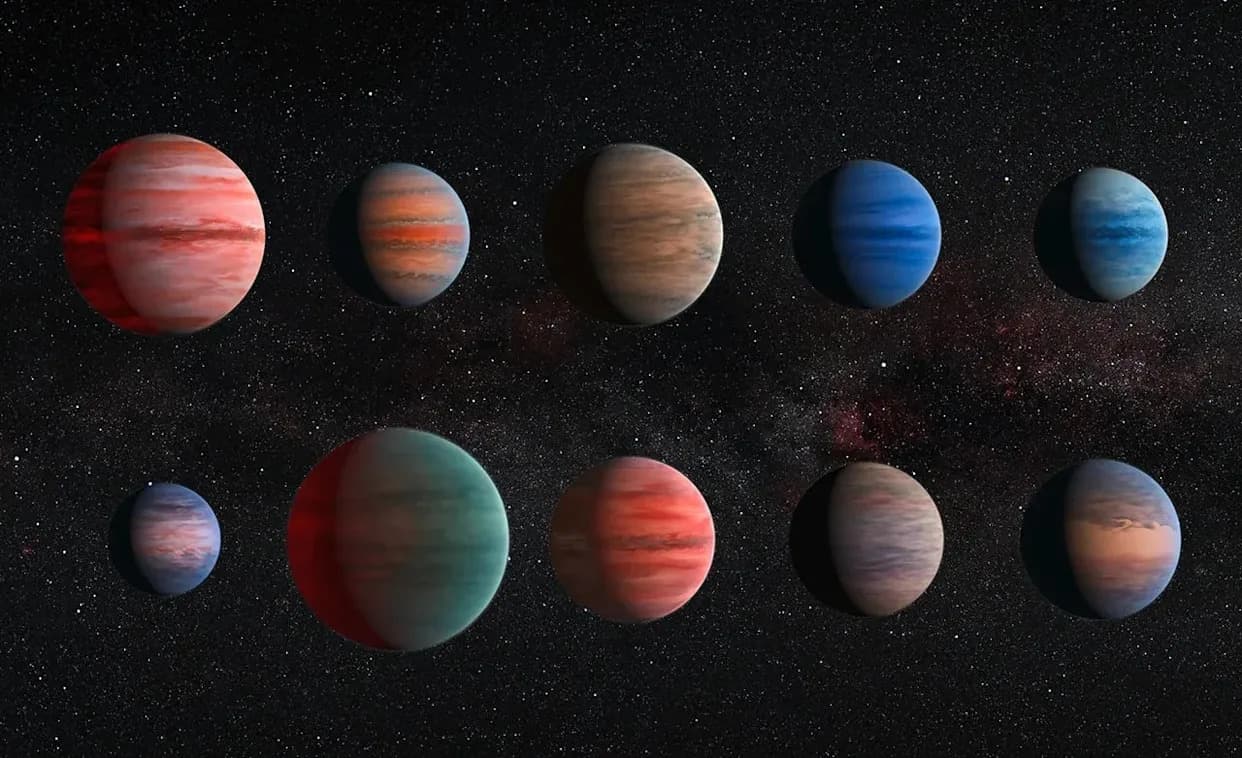
Over nearly a decade of observations using NASA's Kepler and TESS space telescopes plus multiple ground-based facilities, researchers measured transit signals and transit-timing variations (TTVs) to determine the planets' sizes, orbital periods and masses. One planet is roughly Jupiter-sized in radius, while the other three are intermediate between Neptune and Saturn. Despite radii of about 5–10 Earth radii, the measured masses are only ~5–15 Earth masses, making these worlds among the least dense ever found — so 'puffy' that the team likened them to Styrofoam.
How the Measurements Were Made
The team used small differences in the timing of each planet's transit across the star — TTVs produced by mutual gravitational tugs — to infer planetary masses. This technique is particularly effective for young, active stars because it is less affected by stellar flares than other methods. A crucial breakthrough came when the Las Cumbres Observatory network caught a third transit of the outermost planet, V1298 Tau e, resolving a 6.5-year gap and allowing the researchers to fix its orbital period and fully model the system's dynamical interactions.
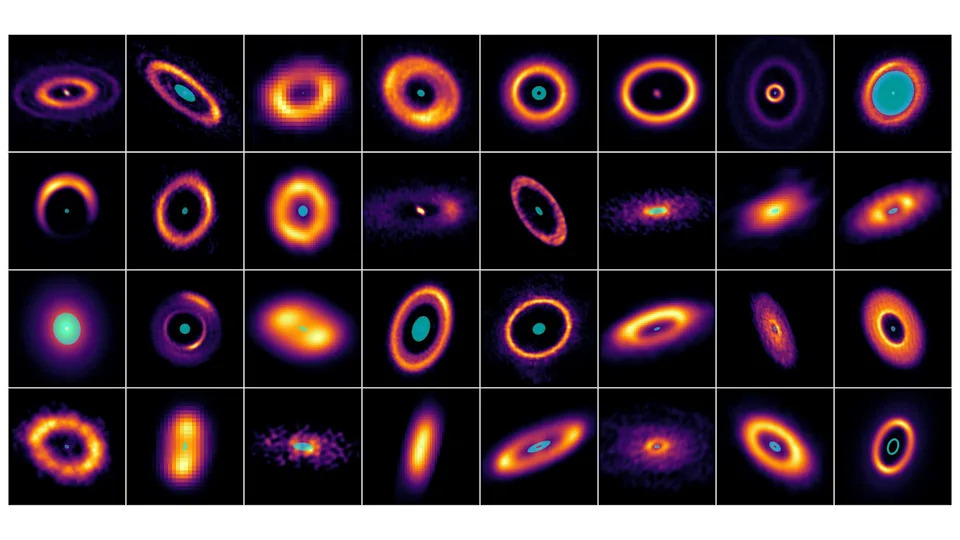
A collage of planet-forming discs seen in 32 infant star systems. The new research offers insights into how and when baby planets form. | Credit: ESO, ESA/Gaia/DPAC, M. Vioque et al.
Why This Matters
These observations provide a rare snapshot of early planetary evolution. The planets appear to be 'inflated' with thick atmospheres that they are already losing. Thermal and atmospheric-evolution simulations from the study suggest the quartet has shed a substantial fraction of its original envelopes and cooled faster than some models predicted. Over the next billions of years, the systems' members are expected to contract and become super-Earths and sub-Neptunes — the compact planets that dominate many mature exoplanetary systems but are absent from our own Solar System.
"What's so exciting is that we're seeing a preview of what will become a very normal planetary system," said John Livingston, the study's lead author. Co-author Trevor David added, "They are indeed exceptionally 'puffy,' which gives us a crucial, long-awaited benchmark for theories of planet evolution."
Context and Publication
The V1298 Tau system was first identified in 2019. Its crowded architecture of several oversized planets in relatively tight orbits is unusual, observed previously in only a very small number of systems (for example, Kepler-51). The new mass and radius measurements were published on Jan. 7 in the journal Nature and provide an observational benchmark for models of atmospheric loss, cooling and long-term dynamical evolution.
Key Observational Details: Star age ~20 million years; distance ~350 light-years; planetary radii ~5–10 Earth radii; planetary masses ~5–15 Earth masses; datasets include Kepler, TESS and ground-based networks such as Las Cumbres Observatory.
By capturing planets at this early, transient phase, the study helps astronomers trace how chaotic processes after formation sculpt planetary systems over billions of years and offers a tangible 'missing link' in our understanding of planet formation and evolution.
Help us improve.