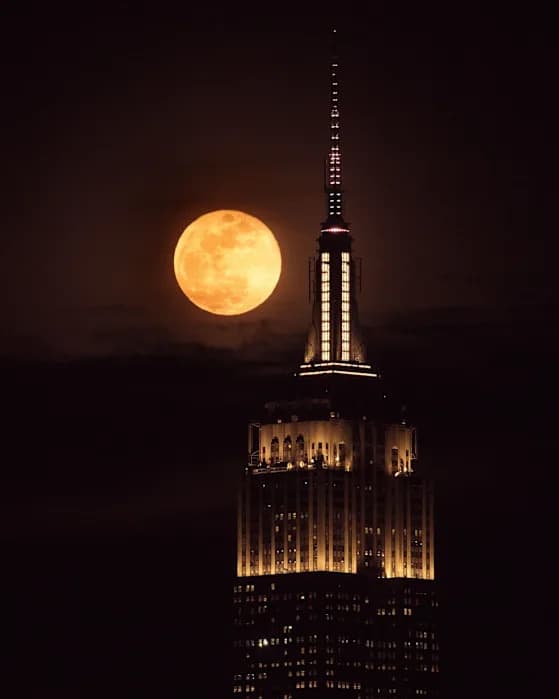
The Full Moon occurs when Earth sits between the Sun and Moon, fully illuminating the lunar face we see. The next Full Moon — the Snow Moon — peaks at 5:09 P.M. EST on Feb. 1, 2026. Key events in 2026 include a total lunar eclipse on March 3 (Worm Moon), a partial lunar eclipse on Aug. 28 (Sturgeon Moon), and a Blue Moon on May 31. Times in the daily listings are referenced to 40°N, 90°W or Eastern Time.
2026 Full Moon Calendar: Dates, Traditional Names, Eclipses and Monthly Phases
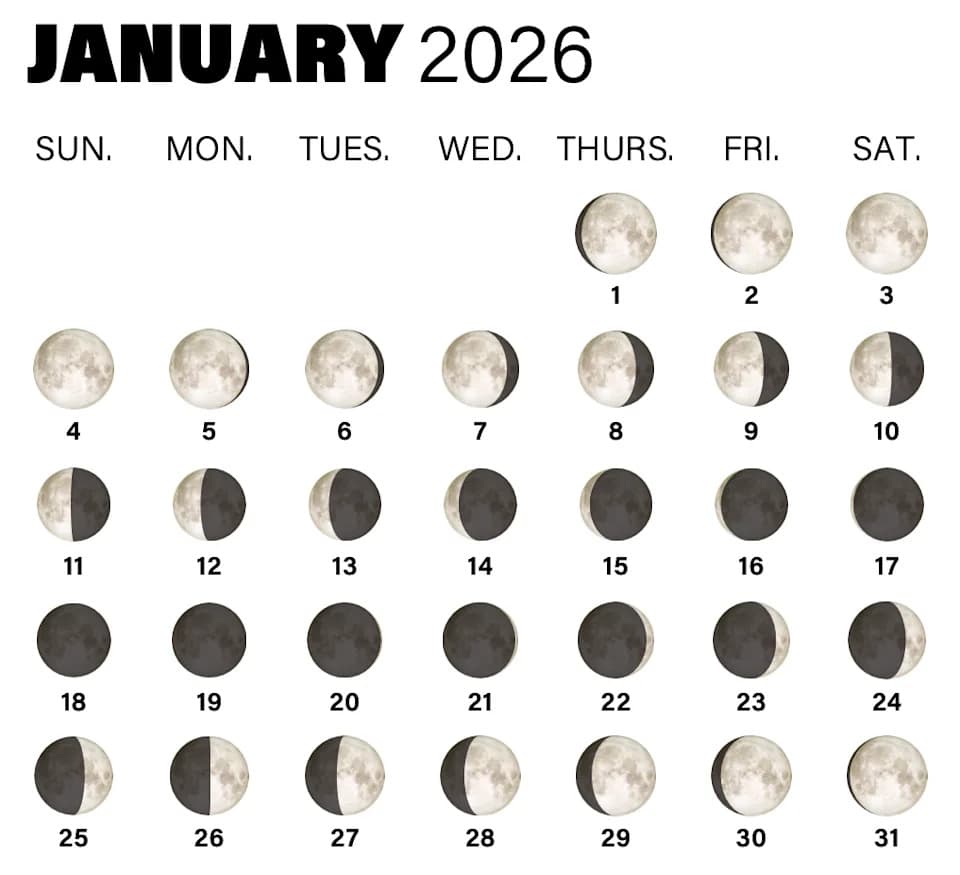
Note: Moon phases in the calendar vary in size due to the distance from Earth and are shown at 0h Universal Time. Credit: Astronomy: Roen Kelly
The Full Moon occurs when Earth sits nearly directly between the Sun and the Moon, allowing the Sun to fully illuminate the lunar hemisphere facing our planet. As the Moon orbits Earth, the angle of sunlight on its surface changes, producing the familiar sequence of lunar phases observers see from Earth.
Next Full Moon: The Snow Moon reaches peak fullness at 5:09 P.M. EST on Sunday, Feb. 1, 2026.
We will refresh this guide regularly with updated moonrise and moonset times, Full Moon schedule notes, and highlights of what to look for in the night sky each week.
Full Moon Dates for 2026 (All Times Eastern; * Denotes Super Moon)
- Saturday, Jan. 3 — 5:03 A.M. — Wolf Moon*
- Sunday, Feb. 1 — 5:09 P.M. — Snow Moon
- Tuesday, March 3 — 6:38 A.M. — Worm Moon | Total Lunar Eclipse
- Wednesday, April 1 — 10:12 P.M. — Pink Moon
- Friday, May 1 — 1:23 P.M. — Flower Moon
- Sunday, May 31 — 4:45 A.M. — Blue Moon (second Full Moon in May)
- Monday, June 29 — 7:57 P.M. — Strawberry Moon
- Wednesday, July 29 — 10:36 A.M. — Buck Moon
- Friday, Aug. 28 — 12:19 A.M. — Sturgeon Moon | Partial Lunar Eclipse
- Saturday, Sept. 26 — 12:49 P.M. — Corn Moon
- Monday, Oct. 26 — 12:12 A.M. — Hunter's Moon
- Tuesday, Nov. 24 — 9:54 A.M. — Beaver Moon*
- Wednesday, Dec. 23 — 8:28 P.M. — Cold Moon*
The images in the original gallery show daily Moon phases for January; January's Full Moon occurred on Saturday, Jan. 3.
Reference location and times: Sunrise, sunset, moonrise, and moonset times listed below are local times for the reference location 40° N, 90° W. Moon illumination values are given for 10 P.M. local time at that same reference point. Unless otherwise noted, all other times in this guide are Eastern.
Daily Sky Notes — January (Reference: 40°N, 90°W)
Wednesday, January 7
Sunrise: 7:22 A.M. Sunset: 4:51 P.M. Moonrise: 9:58 P.M. Moonset: 10:09 A.M. Moon Phase: Waning Gibbous (74%)
Thursday, January 8
Sunrise: 7:22 A.M. Sunset: 4:52 P.M. Moonrise: 11:01 P.M. Moonset: 10:30 A.M. Moon Phase: Waning Gibbous (65%)
Friday, January 9
Sunrise: 7:22 A.M. Sunset: 4:53 P.M. Moonrise: — (below horizon) Moonset: 10:51 A.M. Moon Phase: Waning Gibbous (55%)
Saturday, January 10
Last Quarter Moon occurs at 10:48 A.M. EST.
Sunrise: 7:22 A.M. Sunset: 4:54 P.M. Moonrise: 12:04 A.M. Moonset: 11:13 A.M. Moon Phase: Waning Crescent (45%)
Sunday, January 11
Sunrise: 7:21 A.M. Sunset: 4:55 P.M. Moonrise: 1:06 A.M. Moonset: 11:36 A.M. Moon Phase: Waning Crescent (36%)
Monday, January 12
Sunrise: 7:21 A.M. Sunset: 4:56 P.M. Moonrise: 2:08 A.M. Moonset: 12:01 P.M. Moon Phase: Waning Crescent (27%)
Tuesday, January 13
The Moon reaches apogee (its farthest point from Earth) at 3:47 P.M. EST — 251,928 miles (405,439 km).
Sunrise: 7:21 A.M. Sunset: 4:57 P.M. Moonrise: 3:10 A.M. Moonset: 12:32 P.M. Moon Phase: Waning Crescent (19%)
Wednesday, January 14
This morning the waning Moon passes through Scorpius near Antares, the constellation's reddish heart (magnitude 1.1). About an hour before sunrise the pair stands roughly 15° above the southeastern horizon, with the Moon about 3.5° upper-right of Antares and close to Sigma (σ) Scorpii. Only the Moon's western limb is sunlit, but earthshine may softly reveal its darkened face — a lovely view for early-morning observers and astrophotographers.
The Moon will pass 0.6° due south of Antares later that day at 3:00 P.M. EST.
Sunrise: 7:21 A.M. Sunset: 4:58 P.M. Moonrise: 4:12 A.M. Moonset: 1:10 P.M. Moon Phase: Waning Crescent (12%)
Thursday, January 15
Sunrise: 7:20 A.M. Sunset: 4:59 P.M. Moonrise: 5:11 A.M. Moonset: 1:55 P.M. Moon Phase: Waning Crescent (7%)
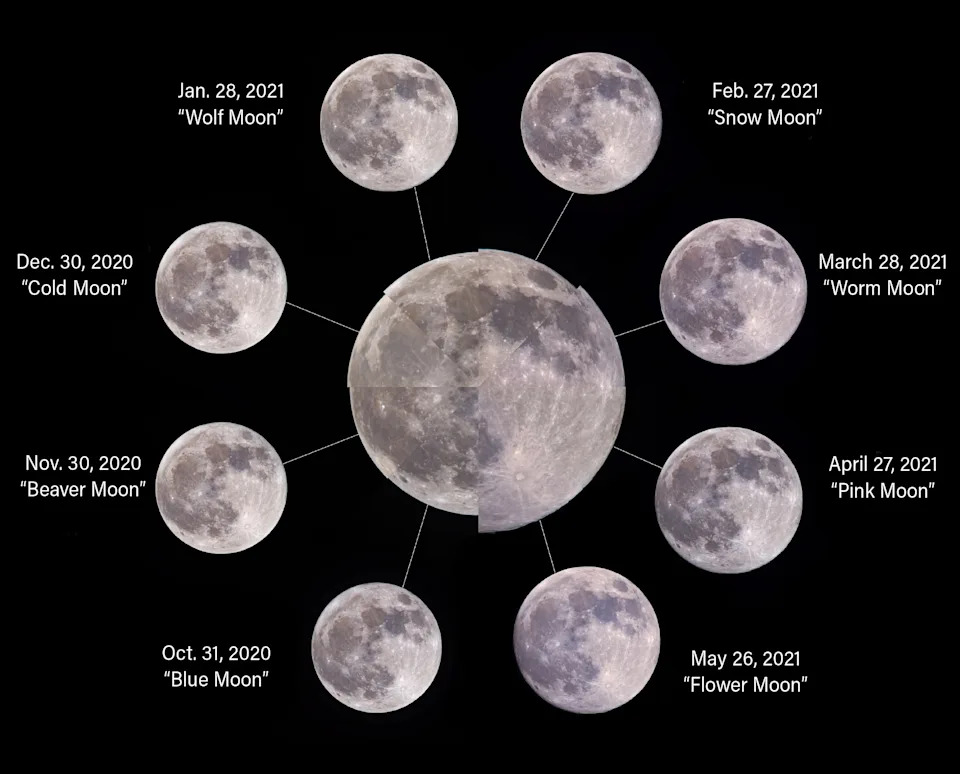
A composite of each month’s Full Moon in 2020 and 2021. Credit: Soumyadeep Mukherjee
Friday, January 16
Sunrise: 7:20 A.M. Sunset: 5:01 P.M. Moonrise: 6:05 A.M. Moonset: 2:48 P.M. Moon Phase: Waning Crescent (3%)
Understanding Lunar Phases
The Moon cycles through eight principal phases: New Moon, Waxing Crescent, First Quarter, Waxing Gibbous, Full Moon, Waning Gibbous, Last Quarter, and Waning Crescent. The synodic month — the interval from one Full Moon to the next — is about 29.5 days. Although the instant of exact fullness is a single moment in time, the Moon appears visually full to the naked eye for roughly three days centered on that instant.
Traditional Full Moon Names
Many Full Moon names come from Native American, Colonial, and other North American traditions; they track seasonal changes and natural events:
- Wolf Moon (January) — Associated with wolves howling in winter.
- Snow Moon (February) — Named for heavy winter snowfall.
- Worm Moon (March) — Marks the return of earthworms as soils thaw.
- Pink Moon (April) — Honors early pink wildflowers.
- Flower Moon (May) — Celebrates spring blooms.
- Strawberry Moon (June) — Time of peak strawberry harvest.
- Buck Moon (July) — When bucks begin growing new antlers.
- Sturgeon Moon (August) — Tied to sturgeon runs in northern lakes.
- Corn Moon (September) — Signals corn-harvest season.
- Hunter's Moon (October) — Linked to autumn hunting traditions.
- Beaver Moon (November) — When beavers prepare for winter.
- Cold Moon (December) — Evokes winter's deep chill.
Other Moon Terms Explained
- Super Moon: A Full Moon occurring near lunar perigee (the Moon's closest orbital point to Earth). When within about 90% of its closest approach it can appear somewhat larger and brighter.
- Blue Moon: The second Full Moon within a single calendar month. It happens roughly every 2.7 years and is not actually blue in color except under rare atmospheric conditions.
- Black Moon: An informal term for either the third New Moon in a season with four New Moons or the second New Moon in a month with two New Moons. It is simply a New Moon and therefore not visible.
- Harvest Moon: The Full Moon nearest the autumnal equinox; it rises soon after sunset and provides extended moonlight useful historically for harvesting.
Full Moon vs. New Moon — And Tides
A Full Moon occurs when Earth is between the Sun and Moon, fully illuminating the Moon's Earth-facing hemisphere. A New Moon occurs when the Moon is between Earth and the Sun and its Earth-facing side is dark. During New and Full Moons, the Sun, Earth, and Moon are aligned and their combined gravity produces spring tides — higher high tides and lower low tides than average.
2026 Lunar Phase Dates (New · First Quarter · Full · Last Quarter)
Jan. 3 · Jan. 10 · Jan. 18 · Jan. 25
Feb. 1 · Feb. 9 · Feb. 17 · Feb. 24
March 3 · March 11 · March 18 · March 25
April 1 · April 10 · April 17 · April 23
May 1 · May 9 · May 16 · May 23
May 31 · June 8 · June 14 · June 21
June 29 · July 7 · July 14 · July 21
July 29 · Aug. 5 · Aug. 12 · Aug. 19
Aug. 28 · Sept. 4 · Sept. 10 · Sept. 18
Sept. 26 · Oct. 3 · Oct. 10 · Oct. 18
Oct. 26 · Nov. 1 · Nov. 9 · Nov. 17
Nov. 24 · Dec. 1 · Dec. 8 · Dec. 17
Dec. 23 · Dec. 30
If you need precise moonrise, moonset, and illumination for your location, consult an astronomical almanac or an online lunar calculator and set it to your coordinates — the times shown here are referenced to 40°N, 90°W or Eastern Time as noted.
Originally published by Astronomy Magazine. This guide will be updated frequently to reflect changes and localized times.
Help us improve.