
The James Webb Space Telescope launched on Dec. 25, 2021, from Kourou, French Guiana, and reached the Sun–Earth Lagrange point about a month later. Its infrared instruments let Webb peer back to the cosmic dawn and return first images in July 2022, producing a torrent of data that has reshaped cosmology. Webb has reinforced the Hubble tension, revealed unexpectedly bright early galaxies and possible habitable exoplanet atmospheres, and raised questions many believe will require future telescopes to answer.
Science History: James Webb Space Telescope Launches on Dec. 25, 2021 — It Immediately Altered Our View of the Cosmos

The James Webb Space Telescope launched on Christmas Day, 2021. It has reshaped our view of the cosmos. | Credit: Getty Images
Milestone: James Webb Space Telescope Launch
Date: Dec. 25, 2021
Location: Guiana Space Centre, Kourou, French Guiana
Teams: Scientists From NASA, The European Space Agency And The Canadian Space Agency
On a cloudy winter morning above the Amazon basin, a rocket lifted an observatory into space that would quickly transform astronomers' picture of the universe.
The James Webb Space Telescope (JWST) rode an Ariane 5 rocket away from Earth at roughly 25,000 mph (40,000 km/h), a launch NASA described as taking the instrument "from a tropical rainforest to the edge of time itself."
About a month after lift-off, Webb arrived at its stable orbital parking spot — the second Sun–Earth Lagrange point — roughly 930,000 miles (1.5 million kilometres) from Earth, balanced between Earth’s and the Sun’s gravity. Its first striking images were returned in July 2022, and the torrent of data since then has reshaped our understanding of the cosmos.
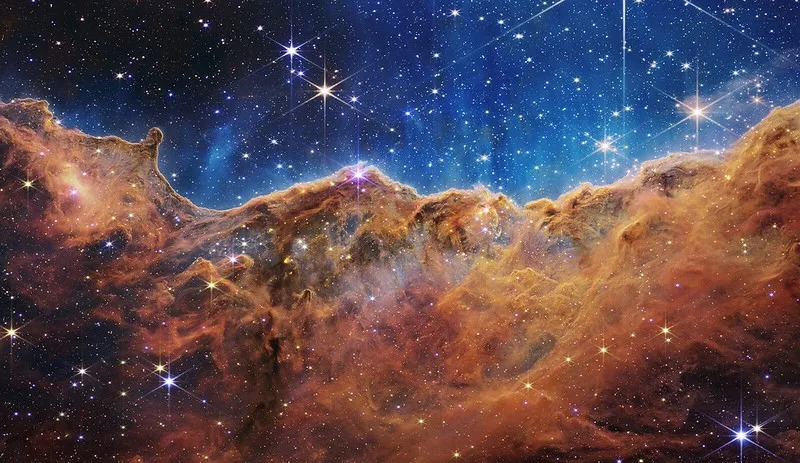
This stunning image of the Cosmic Cliffs was the first one released by JWST. In it, you can see a profusion of stars in their earliest stages of star formation, a frenetic period which lasts between 50,000 and 100,000 years. | Credit: NASA, ESA, CSA, and STScI
Webb’s power lies in its ability to look back toward the so-called "cosmic dawn," the era a few hundred million years after the Big Bang when the first stars ignited.
"The James Webb Space Telescope has proven itself capable of seeing 98% of the way back to the Big Bang," Peter Jakobsen, an affiliate professor of astrophysics at the University of Copenhagen, told Live Science.
Despite its later success, Webb — whose conceptual roots go back to work at Lockheed Martin in the late 1990s — nearly never flew. The now-iconic, roughly $10 billion programme ran massively over budget, suffered lengthy delays and was hobbled at times by what critics called "stupid mistakes."
Part of the reason for those problems was Webb’s unprecedented complexity. Building the telescope required more than 20,000 engineers and hundreds of scientists. Its primary mirror, 21.3 feet (6.5 metres) across, was engineered to fold into a honeycomb pattern to fit inside the rocket fairing and then deploy precisely in space. Despite being segmented and foldable, the mirror’s surface had to be finished so smoothly that, were it the size of a continent, no features would rise or fall more than an ankle’s height, according to Quanta Magazine.
To detect the universe’s earliest light Webb needed to operate in the infrared: photons from the first stars have been stretched, or redshifted, into the infrared over cosmic distances. Because Earth and life on it emit infrared heat that would overwhelm faint ancient signals, Webb had to be stationed in the cold darkness of space to use its infrared instruments effectively.
Once JWST began returning images, it quickly challenged existing models. It reinforced the so-called Hubble tension — the disagreement in measured expansion rates of the universe depending on methods and targets — and has produced tantalizing signs of possibly habitable atmospheres on distant exoplanets. Webb has also revealed incredibly luminous galaxies and what appear to be unexpectedly mature black holes in the very early universe, discoveries that are pushing astronomers toward new theories.
Many of the questions Webb raises — for example, whether other worlds host life — may remain unanswered during its planned roughly 10-year mission. Still, a new generation of observatories should help follow up Webb’s findings: the Vera C. Rubin Observatory is already coming online to map transient events and build a dynamic "movie of the universe," the Nancy Grace Roman Telescope, scheduled for launch in 2027, will probe dark matter and dark energy, the Extremely Large Telescope is expected to begin operations around 2029, and the proposed Habitable Worlds Observatory could arrive in the 2030s to target biosignatures directly.


