Researchers using JWST have identified nine compact, "point-like" sources that combine star-like appearance with galaxy-like narrow emission lines, earning them the nickname "platypuses." Spectra rule out a straightforward quasar classification — the objects are fainter and spectrally narrower — leaving two main interpretations: a new subtype of narrow-line AGN or extremely young (<~200 million years), compact star-forming galaxies. The team presented the results at the AAS meeting and posted a paper on arXiv; follow-up JWST observations and deeper spectroscopy will be crucial to determine their nature.
JWST's 'Platypus' Objects: Nine Puzzling, Point-Like Sources That Could Be Infant Galaxies or A New AGN Class
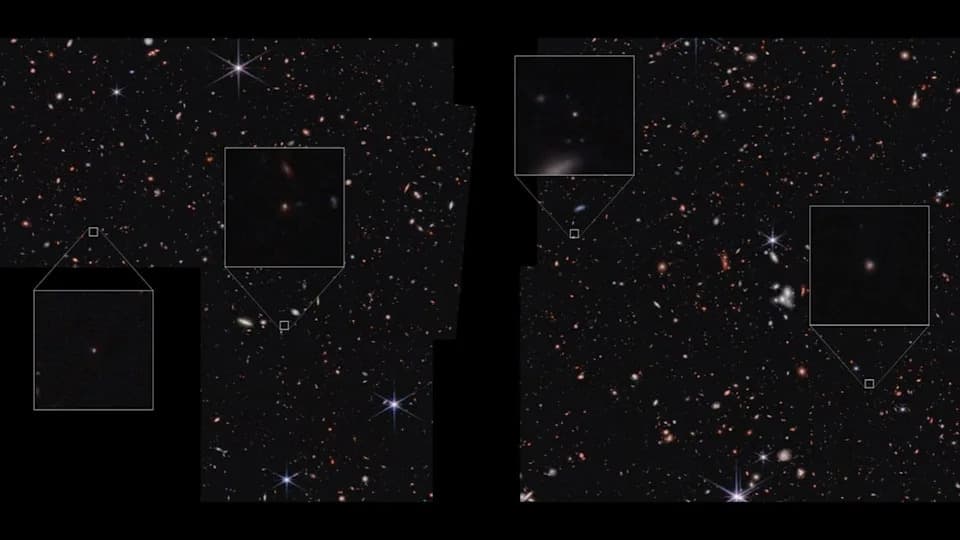
The James Webb Space Telescope recently captured these strange cosmic objects. . | Credit: NASA, ESA, CSA, S. Finkelstein (UT Austin), Image Processing: A. Pagan (STScI)
Strange compact sources captured by NASA's James Webb Space Telescope (JWST) are puzzling astronomers because they combine properties of both stars and galaxies. Researchers have nicknamed these objects "platypuses" for their mixed characteristics: they appear nearly point-like like stars but show narrow emission lines more typical of galaxies.
What the Team Found
Haojing Yan of the University of Missouri and two students visually inspected roughly 2,000 compact JWST targets to look for unusual sources. From that sample they identified nine small objects that are marginally resolved — slightly larger than a point source — so the team describes them as "point-like." Detailed spectroscopy reveals narrow emission lines associated with active star formation rather than the broad emission lines expected from stellar sources.
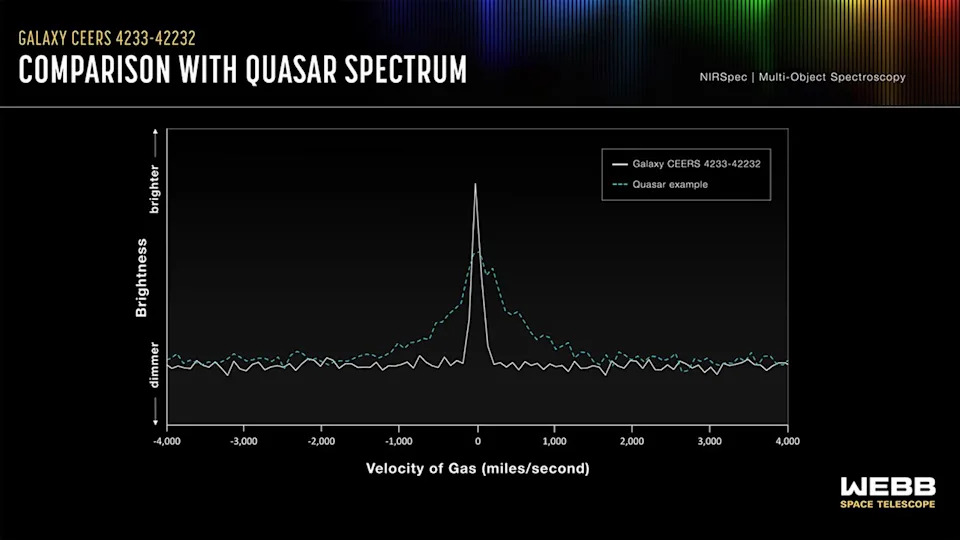
This graphic illustrates the pronounced narrow peak of the spectra that caught researchers’ attention in a small sample of galaxies, represented here by galaxy CEERS 4233-42232. Typically, distant point-like light sources are quasars, but quasar spectra have a much broader shape. | Credit: NASA, ESA, CSA, Joseph Olmsted (STScI)
"If you look at any of the features separately, just putting them together makes a platypus look so odd," Yan said, summarizing why the team adopted the nickname.
Why These Objects Are Unusual
- Not a Clear Quasar Match: The sources are fainter than typical quasars and show spectral profiles narrower than those of known narrow-line quasars. "Our objects are not quasars," Yan said.
- Point-Like but Extended: Known narrow-line active galactic nuclei (AGNs) usually appear as true point sources; these are slightly resolved, suggesting something different.
- Star-Formation Signature: Narrow emission lines point toward active, ongoing star formation. If interpreted as galaxies, their spectra imply extremely young ages — on the order of ≤200 million years.
Possible Interpretations
The team considers two leading explanations, neither definitive:
- A New Subtype of Narrow-Line AGN: The sources could be a previously unrecognized variety of AGN whose compactness and faintness put them outside established categories.
- Extremely Young, Compact Star-Forming Galaxies: Alternatively, the objects could be infant galaxies undergoing concentrated, "inside-out" star formation, a growth mode not commonly observed at this scale. Bangzheng Sun (University of Missouri) noted the narrow lines are "like duckbills are normally seen in ducks," emphasizing their diagnostic power.
Implications and Next Steps
If these sources represent a population of young, compact galaxies, they could offer new insight into how the earliest galaxies assembled their stars. Conversely, if they are a new AGN class, they will expand our understanding of black-hole growth in compact systems. The authors presented their findings at the American Astronomical Society meeting on Jan. 6 and have posted a paper on the arXiv preprint server.
The team plans to search for additional examples in future JWST observations and to obtain deeper spectroscopy and imaging to measure sizes, stellar populations, and any central black-hole activity. For now, the nine objects remain intriguing outliers: "These nine objects are special," Yan said. "They are our platypuses."
Help us improve.