
2025 was a breakthrough year in astronomy: NASA's Perseverance returned the most persuasive signs yet of ancient microbial activity on Mars, and the interstellar Comet 3I/ATLAS passed through our system with familiar comet chemistry. DESI's vast 3D map hints that dark energy may have begun weakening ~4.5 billion years ago, while JWST observations suggest early supermassive black holes may form inside dense gas clouds. The Vera C. Rubin Observatory achieved first light and will deliver massive new data streams.
Top Astronomical Discoveries of 2025: Interstellar Visitors, Mars Clues, Dark Energy Surprises and More

A closeup of "leopard spots" on Mars seen by the Perseverance rover. | Credit: NASA/JPL-Caltech/MSSS
2025 proved to be a landmark year for astronomy, with discoveries that spanned our solar system, the nearby stellar neighborhood and the early universe. From compelling signs of ancient life on Mars to a rare interstellar comet and puzzling clues about dark energy, researchers delivered results that will shape science agendas for years to come.
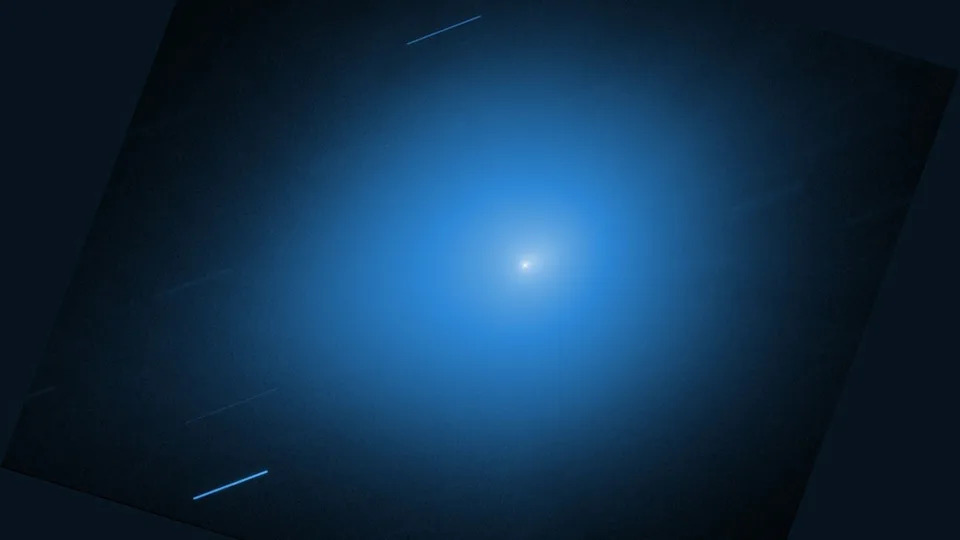
An image of 3I/ATLAS captured by the Hubble Space Telescope on Nov. 30, 2025. The telescope is tracking with the comet, which is why the fixed stars are trails. | Credit: NASA, ESA, STScI, D. Jewitt (UCLA). Image Processing: J. DePasquale (STScI)
Comet 3I/ATLAS: A True Interstellar Visitor
The Chilean station of the Asteroid Terrestrial-impact Last Alert System (ATLAS) spotted Comet 3I/ATLAS on July 1 as it moved through Sagittarius. Its trajectory was severely hyperbolic and its speed unusually high—about 36 miles per second (58 km/s)—indicating an origin in interstellar space. Follow-up observations from both ground and space telescopes show 3I/ATLAS is a natural comet with chemistry broadly similar to solar-system comets but with a somewhat higher carbon-dioxide-to-water ratio and a higher nickel-to-iron proportion. The comet also displayed a genuine "anti-tail"—a sunward-pointing feature that appears to be physical rather than an optical illusion. Astronomers will continue monitoring 3I/ATLAS into 2026 to learn more about how interstellar objects form and evolve.
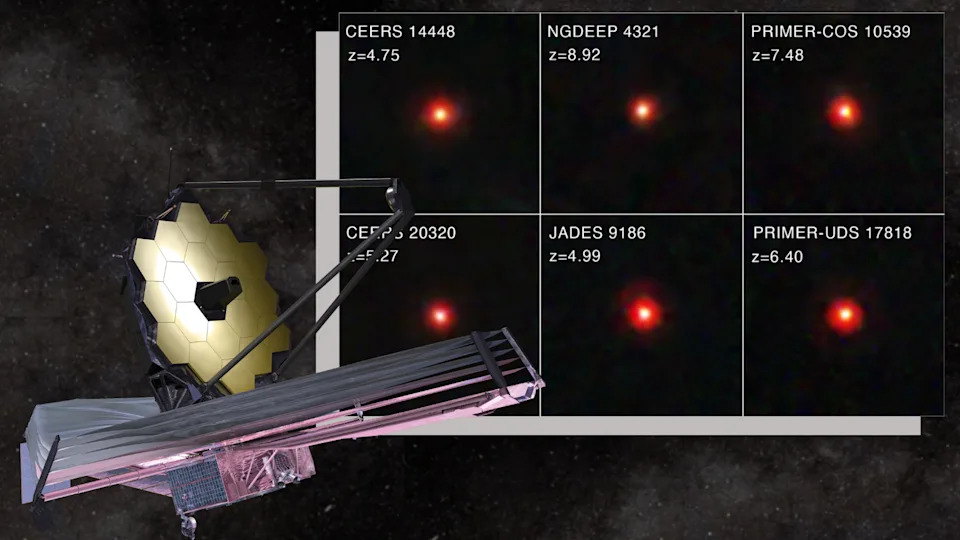
An illustration shows the JWST in space next to its observations of some of the earliest galaxies ever seen, the so-called "little red dots." | Credit: NASA, ESA, CSA, STScI, Dale Kocevski (Colby College)/ Robert Lea (created with Canva)
Strongest Evidence Yet For Ancient Life On Mars
In September, NASA's Perseverance rover reported striking textures—light-red "leopard spots" rimmed with darker material—within a rock in Jezero Crater, along with organic molecules in clay-rich sediments. On Earth, similar patterns can arise from biological processes or extreme alteration; at Jezero the environmental history favors the biological interpretation as a leading explanation. While not a smoking gun, these observations represent the most persuasive evidence to date that microbial life could have existed in Jezero about 3.5 billion years ago.
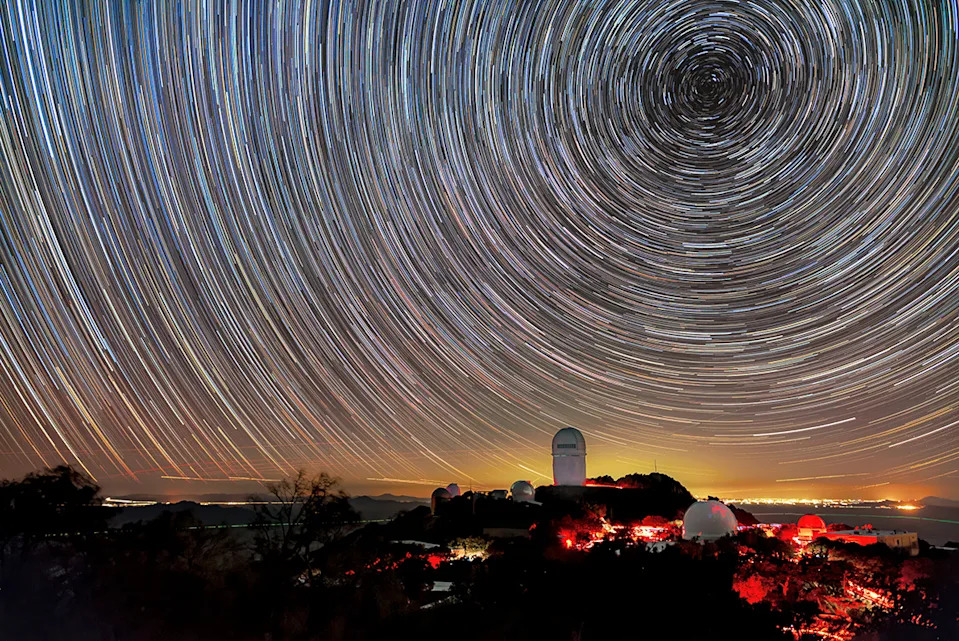
Star trails over the Mayall Telescope, which houses DESI on Kitt Peak in Arizona. | Credit: KPNO/NOIRLab/NSF/AURA/Babak Tafreshi
JWST's 'Little Red Dots' — Nascent Supermassive Black Holes?
Since 2022 the James Webb Space Telescope (JWST) has revealed numerous faint, bright "little red dots" in deep fields. Spectroscopic analyses published in 2025 suggest many of these sources could be rapidly growing, early supermassive black holes—sometimes described as "black holestars"—forming inside massive, dense gas clouds less than a billion years after the Big Bang. Proposed formation channels include the direct collapse of huge gas clouds or the runaway merger of stellar-mass black holes inside obscured clusters. If confirmed, this would revise models of early black-hole growth and the formation of the first galaxies.
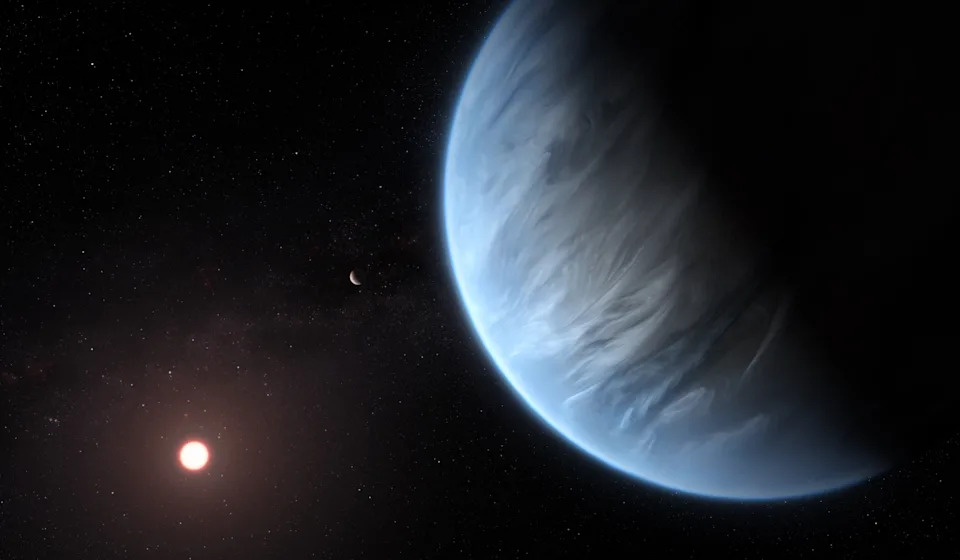
This artist’s illustration shows the planet K2-18 b, its host star and an accompanying planet in this system. K2-18 b is now the only super-Earth exoplanet known to host both water and temperatures that could support life. | Credit: ESA/Hubble, M. Kornmesser
DESI Hints Dark Energy May Be Changing
The Dark Energy Spectroscopic Instrument (DESI) released its first full three-year data set—covering 13.1 million galaxies, 1.6 million quasars and ~4 million stars—and produced an unexpected result: a signal that dark energy may have weakened beginning around 4.5 billion years ago. The DESI analysis also suggests an earlier epoch of stronger-than-expected "phantom" dark energy. These findings are provocative but not yet definitive; independent confirmation and further analysis will be critical because a verified change in dark energy would force a major rethink of cosmology.
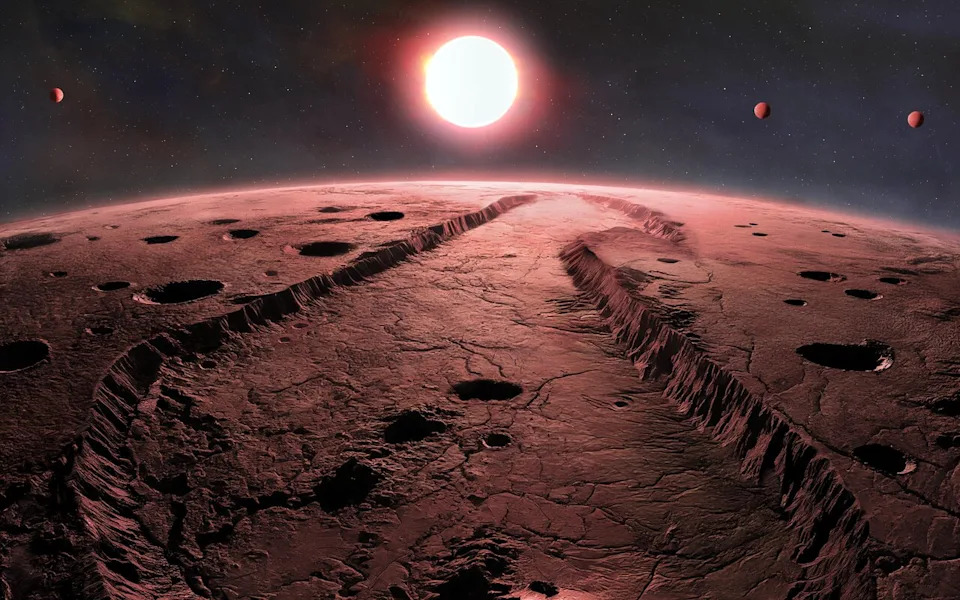
An artist's impression of the Barnard's Star system, from the surface of one of its planets. | Credit: International Gemini Observatory/NOIRLab/NSF/AURA/P. Marenfeld
Possible Biosignature Strengthened On K2-18b
JWST produced stronger evidence in March 2025 for dimethyl sulfide in the atmosphere of the exoplanet K2-18b, a molecule that on Earth is associated with biological activity in oceans. The planet is a candidate "hycean" world—an ocean world with a hydrogen-rich envelope—making dimethyl sulfide a potential biosignature in that context. However, the detection remains contested: the spectroscopic signal is weak and dimethyl sulfide can form abiotically under some conditions, so the claim is still under active debate.
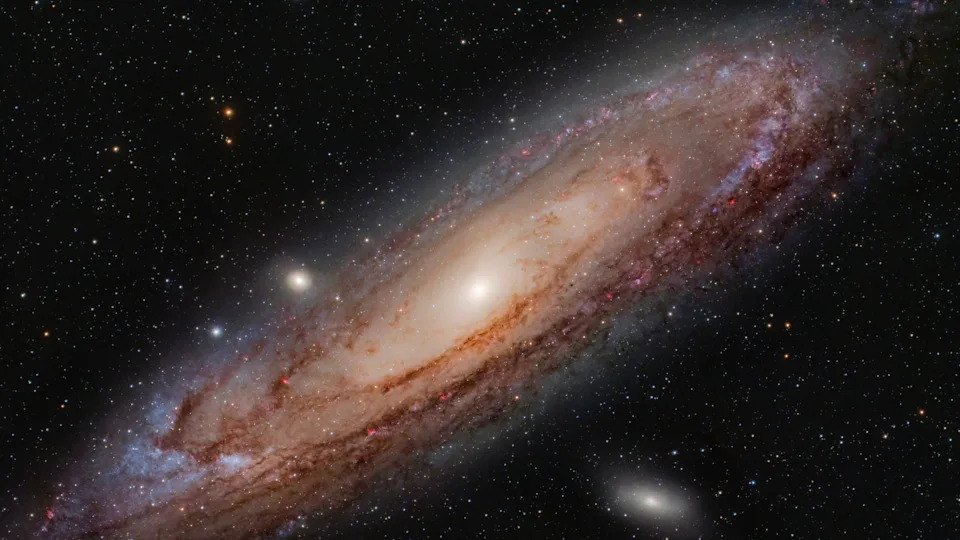
The Andromeda galaxy may avoid an imminent collision with the Milky Way. | Credit: Westend61/Getty Images
Nearby Exoplanet Progress: Barnard's Star and Alpha Centauri
Follow-up studies confirmed a system of four small planets orbiting Barnard's Star, including bodies with masses near one-third and one-fifth that of Earth; none are currently known to lie in the star's habitable zone. In August, JWST produced the most convincing evidence yet for a planet around Alpha Centauri A—a Saturn-mass gas giant expected to follow a highly elliptical orbit, likely influenced by the binary nature of the Alpha Centauri system.
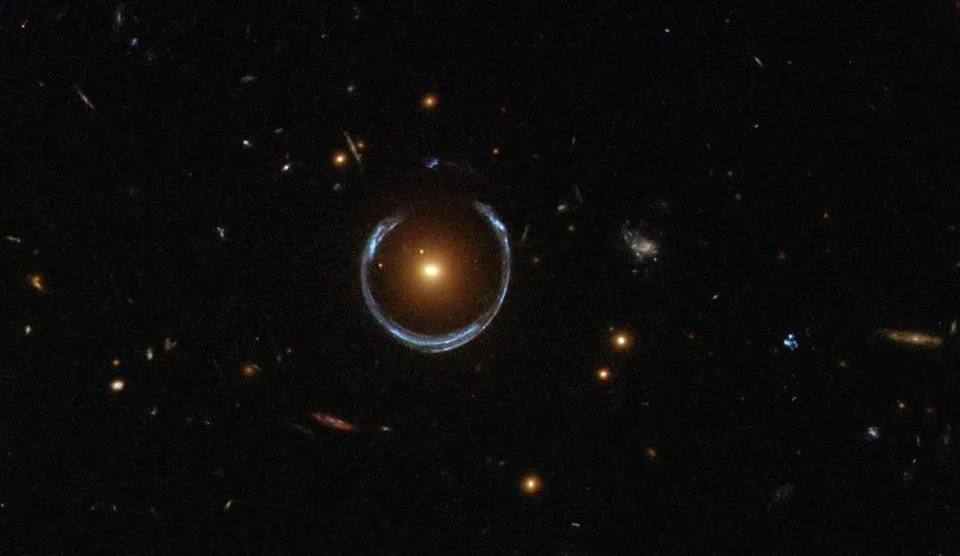
The Cosmic Horseshoe may host the most massive black hole ever measured. | Credit: NASA/ESA
Will The Milky Way And Andromeda Collide?
New simulations that account for the gravitational influence of the Large Magellanic Cloud and the Triangulum Galaxy show a roughly 50/50 chance that the Milky Way and Andromeda will avoid a direct collision in the next 10 billion years. Researchers identify a critical closest-approach distance of 650,000 light years: closer approaches lead to collisions, while more distant flybys can avoid direct contact.
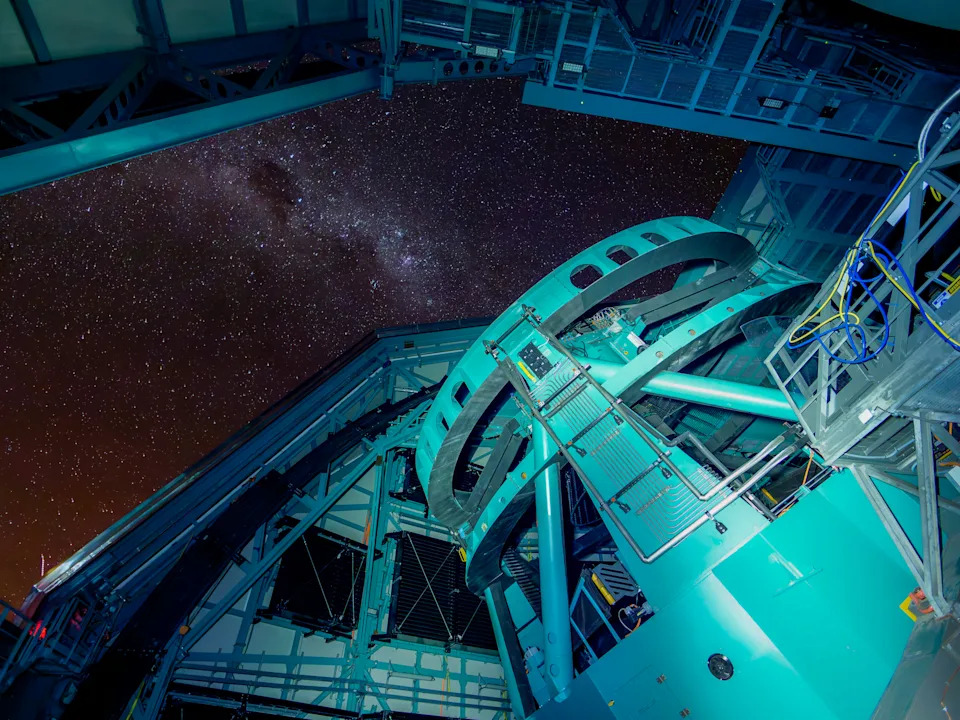
The Rubin Observatory's 8.4-meter telescope is ready for action. | Credit: RubinObs/NSF/DOE/NOIRLab/SLAC/AURA/W. O'Mullane
A Record-Breaking Black Hole And The Rubin Observatory's First Light
Researchers reported a directly measured black hole mass of about 36 billion solar masses at the center of a giant galaxy nicknamed the Cosmic Horseshoe, based on stellar motions around the nucleus. While claims of larger masses exist, this measurement is notable for its direct dynamical basis. And after more than 25 years of planning, the Vera C. Rubin Observatory achieved first light in summer 2025. Its 8.4-meter Simonyi Survey Telescope and 3.2-gigapixel camera will produce roughly 20 TB of data per night, generate ~10 million alerts daily, and accumulate about 60 petabytes over its initial 10-year Legacy Survey of Space and Time—data that promise to fuel a new era of discovery.
Bottom line: 2025 delivered memorable discoveries—from a natural interstellar comet and stronger Martian biosignatures to striking cosmological puzzles—that together expanded our understanding of the cosmos and set clear priorities for follow-up observations in the years ahead.


