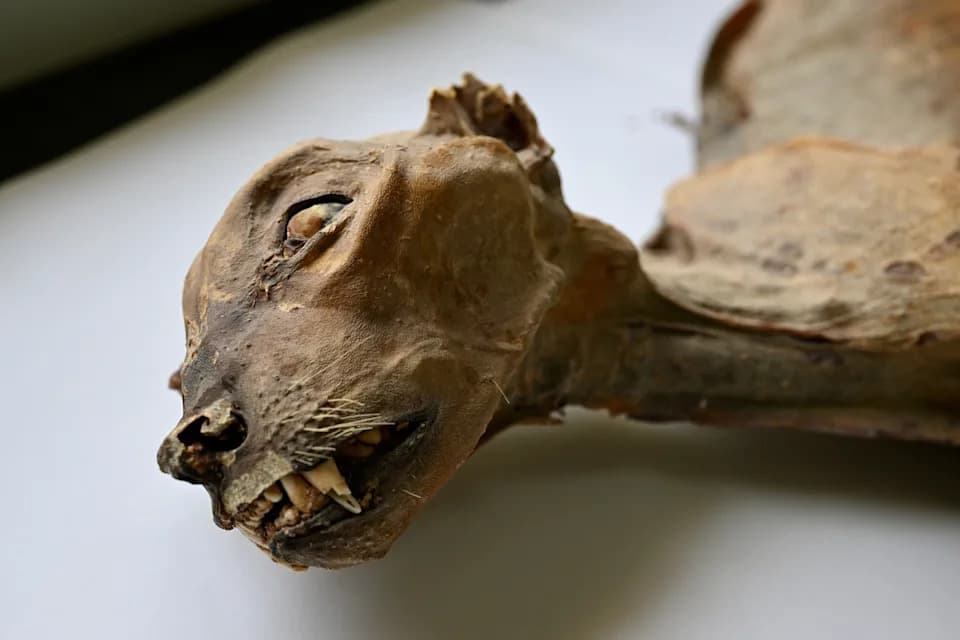
The latest genomic study in Science finds that modern domestic cats most likely descend from North African wildcats and suggests truly domesticated cats reached southwest Asia and Europe only about 2,000 years ago. Researchers analyzed 87 genomes from modern and archaeological specimens (some as old as ~9000 B.C.) from Europe, North Africa and Anatolia. Archaeological finds—like cat remains in Cyprus (~10,000 years ago) and Egyptian depictions (~3,500 years ago)—remain important but may reflect complex, region-specific relationships rather than broad early domestication. Experts emphasize gaps in the genetic record, especially between 2,000–4,000 years ago, and call for more ancient DNA to resolve remaining questions.
Cat Origins Rewritten by DNA: North African Wildcats, and True Domestication Came Later

New genomic evidence is reshaping our understanding of how and when cats became companion animals. A recent study published in Science analyzed genomes from ancient and modern felines and concludes that today's domestic cats most likely descend from North African wildcats, and that truly domesticated cats did not become common in southwest Asia and Europe until roughly 2,000 years ago.
What the study examined
The researchers sequenced and compared 87 genomes drawn from modern cats and archaeological specimens, some dated as early as about 9000 B.C. Samples came from Europe, North Africa and Anatolia (modern Turkey). The genetic patterns led the authors to question the long-standing view that domestic cats spread into Europe during the Neolithic alongside early farming communities.
Key findings
The paper argues that:
- Modern domestic cats most likely trace their ancestry to North African wildcat populations rather than exclusively to Levantine wildcats.
- Animals with domestic-like associations in southwest Asia and Europe before about 2,000 years ago were often European wildcats or hybrids, reflecting ancient crossbreeding rather than full domestication.
- The commonly cited early clues—such as cat burials on Cyprus nearly 10,000 years ago and depictions of cats in Egypt ~3,500 years ago—remain important archaeological evidence but do not necessarily indicate sustained, widespread domestication across Europe and southwest Asia at those times.
Uncertainties and caveats
The study's authors note limitations in the available genomic record. In an accompanying commentary, evolutionary biologist Jonathan Losos (Washington University in St. Louis) highlights a tension between the genetic timeline and artistic or archaeological evidence of cats in parts of Greece and Italy dating back nearly 4,000 years. Losos suggests the discrepancy could reflect a gap in sampled genomes from about 2,000–4,000 years ago.
'Ever sphinxlike, cats give up their secrets grudgingly,' Losos writes, urging that more ancient DNA samples are needed to reconcile genetic and archaeological lines of evidence.
Why this matters
Understanding when and where cats were domesticated helps clarify how humans and animals shaped each other's history. Unlike dogs, which show clear early domestication linked to human settlements, cats appear to have undergone a more gradual, regionally complex process involving commensal interactions, local wildcat populations, and hybridization events.
Today, domestic and feral cats inhabit every continent except Antarctica and may number up to a billion. The new genetic work advances the story of cat domestication while underscoring that more ancient genomes are needed to fill remaining gaps.
Help us improve.