
Advances in sequencing, laboratory robotics and bioinformatics now allow scientists to recover ancient DNA directly from cave sediments, converting cave floors into biological time capsules. At the Geogenomic Archaeology Campus Tübingen, interdisciplinary teams use sedimentary DNA to map who occupied Ice Age Europe, how ecosystems shifted, and how hominins such as Neanderthals and modern humans interacted. The approach detects species without bones, tracks ecological change over millennia, and has yielded DNA as old as ~2 million years. Ongoing sampling campaigns and improved methods promise major discoveries, including cave-bear genomes and deeper insights into ancient microbial communities.
Biological Time Capsules: How Cave Sediment DNA Is Rewriting Human and Neanderthal History

The team at GACT has been analyzing sediments from Hohle Fels cave in Germany. . | Credit: GACT
Over the past two decades, advances in genetics, robotics and computing have transformed our ability to read the distant past. Scientists are no longer limited to bones and teeth: cave sediments themselves preserve fragments of ancient DNA that act as biological time capsules, revealing who lived where and how ecosystems changed over tens of thousands — sometimes millions — of years.
What Sediment DNA Can Tell Us
Researchers can now extract and sequence DNA directly from cave deposits. These traces record animals, plants, microbes and humans that passed through or lived in a cave, even when no bones or artifacts remain. Sedimentary DNA has revealed interbreeding between Neanderthals and modern humans, helped untangle migration patterns and is opening new windows on extinct species and ancient pathogens.
Work at the Geogenomic Archaeology Campus Tübingen (GACT)
At GACT in Tübingen, Germany, an interdisciplinary team — archaeologists, geoscientists, microbiologists, bioinformaticians and ancient-DNA specialists — is developing methods to find and authenticate DNA in sediments. Their fieldwork spans well beyond Germany: recent sampling in Serbia collected several hundred sediment samples, and future campaigns are planned for South Africa and the western United States to test preservation under different climates and time scales.
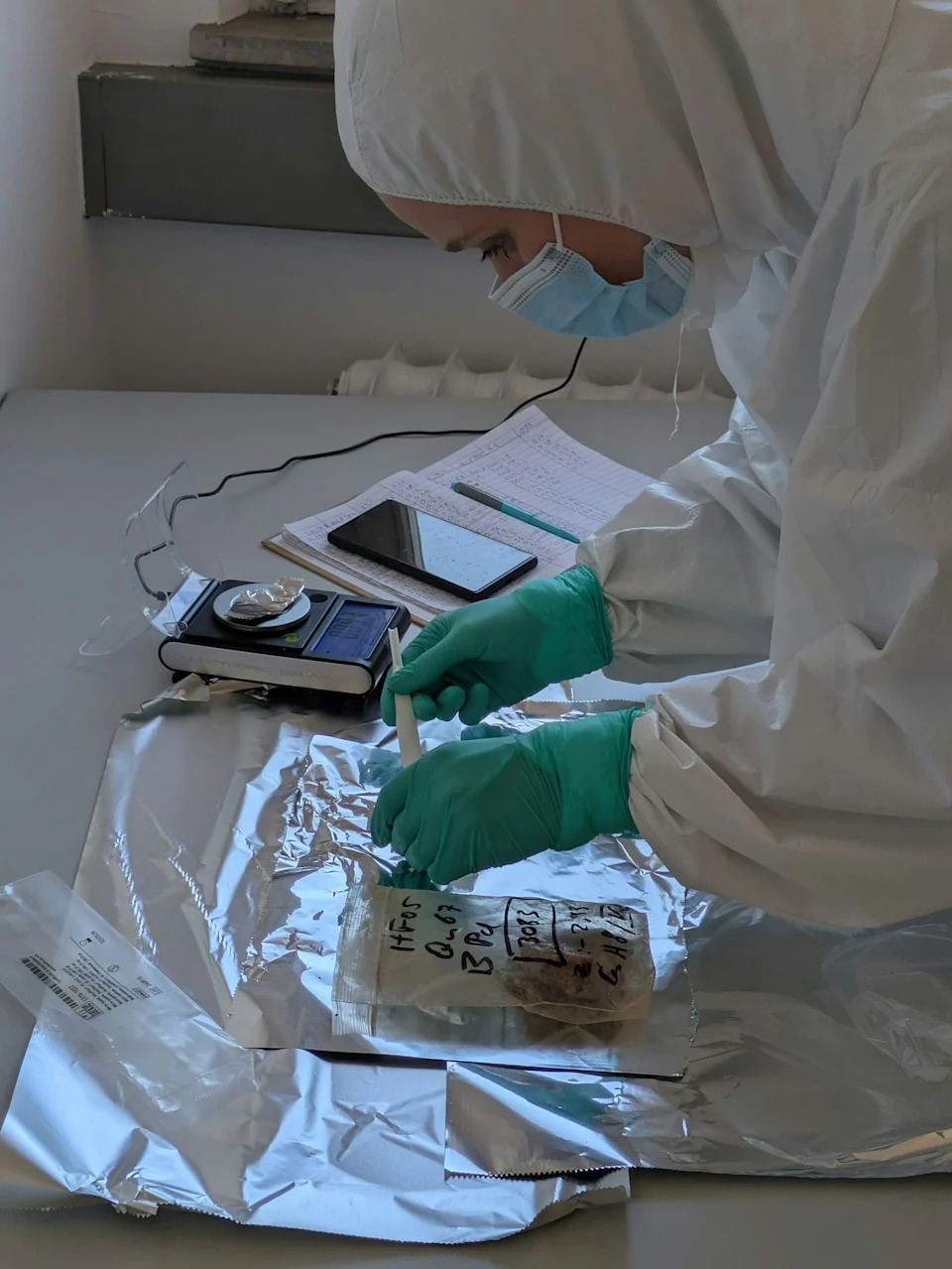
The sediment samples from Hohle Fels are divided up for different analysis methods. Some go to the clean room, some to the geochemical laboratory. | Credit: GACT
A striking example: the team is sequencing DNA from the droppings of a cave hyena that lived in Europe roughly 40,000 years ago. Elsewhere, the oldest sedimentary DNA recovered so far comes from Greenland and dates to about two million years ago, demonstrating the remarkable time depth some deposits can preserve.
Technical Progress and Major Milestones
Paleogenetics has advanced dramatically since 1984, when researchers sequenced the quagga — an early landmark for extinct-animal genomics. Today's next-generation sequencers and laboratory robotics decode vastly more DNA, and powerful bioinformatics pipelines can analyze enormous datasets quickly. Where a single human genome once took years, modern labs can process hundreds in a day. Recognition of the field’s importance was underscored in 2022 when Svante Pääbo received the Nobel Prize in Physiology or Medicine.
Challenges of Sediment DNA
Recovering ancient DNA from cave dust is far from trivial. Authentic molecules are rare, chemically degraded and fragmented. Modern contamination from recent visitors and animals complicates analyses. Detecting genuine ice-age DNA requires ultra-clean labs, robotic extraction protocols, and computational checks for characteristic chemical damage patterns that mark ancient molecules. Each verified identification is therefore a significant achievement.
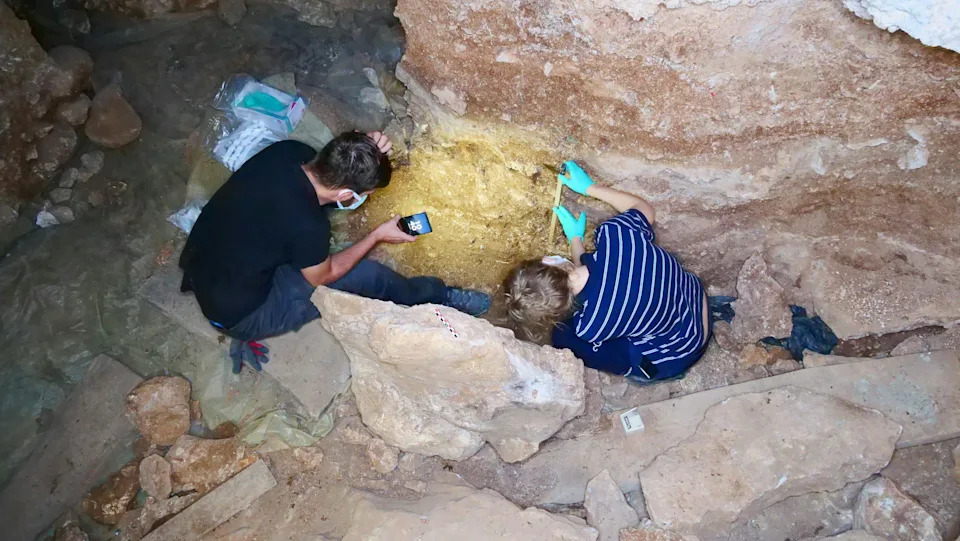
Work underway at a cave site in Serbia. | Credit: GACT
Caves, Culture and Ecology
Much of GACT's work focuses on caves of the Swabian Jura, including UNESCO World Heritage sites such as Hohle Fels, which preserve some of the world’s oldest musical instruments and figurative art. Layered cave deposits — stone tools, ivory, bone and sediments — preserve long-term records of human activity and environmental change.
Sediment DNA can answer questions such as: Did modern humans and Neanderthals occupy the same caves at the same times? Did cave bears and humans compete for shelter? What microbes circulated in those environments and how did human presence alter ecological networks? By tracking changes in human, animal and microbial DNA through stratified layers, researchers can reconstruct extinctions, species turnovers and broader ecosystem shifts with implications for today’s biodiversity challenges.
Outlook
Two years into GACT’s program, hundreds of samples are being processed and each dataset raises new questions. Researchers expect soon to reconstruct the first cave-bear genomes from sediments, identify earlier traces of human presence at new sites and chart ancient microbial communities that thrived in darkness. Whether every secret buried in cave floors will be revealed remains uncertain, but the prospects for major discoveries are high.
In short: cave sediments are rewriting our understanding of past life — offering an archival record that complements bones and artifacts and enlarges the story of humans, Neanderthals and their environments.
This article is adapted from material published by The Conversation under a Creative Commons license.


