New whole-genome data suggest modern housecats trace their ancestry to North Africa and only reached continental Europe about 2,000 years ago, overturning earlier timelines based on mitochondrial DNA. Researchers sequenced 87 genomes from 225 ancient and modern specimens and link early domestic lineages to African wildcats near Tunisia. Phoenician/Punic seafaring and later Roman networks likely transported cats across the Mediterranean; further ancient-DNA work will refine where and when true domestication began.
New Genomes Rewrite Cat History: Ancestors Began in North Africa, Reached Europe Only 2,000 Years Ago

Domestic cats are now found across cities and remote islands worldwide, but exactly where and when humans first formed close relationships with felines has long been debated. A new, large-scale genomic study of ancient cat remains offers a surprising revision to the story: the ancestors of modern housecats likely originated in North Africa and only expanded into continental Europe within the last ~2,000 years.
The research team reconstructed whole genomes from ancient and modern felines to gain higher-resolution insight than earlier mitochondrial studies, which trace only maternal ancestry. By sampling DNA from 225 ancient specimens and several modern wildcats, radiocarbon-dating a subset of samples and assembling 87 genomes in total, the scientists traced the genetic history of cats across more than 10,000 years.
The genomic evidence indicates that felines living in Europe before about 200 BCE were genetically closer to today’s European wildcat (Felis silvestris) than to modern housecats. Those animals likely lived near Neolithic settlements or were hunted for fur and meat, which explains their presence at archaeological sites. Although not fully domesticated, some were valued by people—one Bronze Age cat from Sicily, for example, was buried in a bell-shaped vase.
By contrast, genomes most similar to present-day domestic cats appear only within the last 2,000 years. The earliest clear evidence of an ancestral domestic cat on continental Europe dates to the 1st century CE, during the early Roman Empire. The study therefore challenges earlier claims—based on mitochondrial DNA—that domestic cats dispersed from the eastern Mediterranean 6,500–10,000 years ago.
North African roots and Mediterranean dispersal
The researchers found that early domestic lineages were genetically closest to African wildcats living around Tunisia today, suggesting a North African origin for the ancestors of modern housecats. The authors propose that maritime trading cultures—Phoenicians and Punic seafarers—moved cats across the Mediterranean to places such as Sardinia and southern Iberia. Later, Roman trade and military networks likely accelerated cats’ spread into central and northern Europe.
The team also identified links between North African cats and a puzzling wildcat population in Sardinia, supporting the idea that human maritime activity helped shape feline distributions during the first millennium BCE and CE.
Comparisons and complementary findings
Other ancient-DNA studies align with a multiwave model of cat movements. Separate research indicates domestic cats reached East Asia roughly 1,400 years ago along trade routes such as the Silk Road, while older small cat remains in that region were affiliated with local leopard cats—species that frequently interacted with Neolithic settlements but were not fully domesticated.
“Cats are still mysterious, and they’re giving up their mysteries one whisker at a time,” says Leslie Lyons, a feline geneticist who reviewed the research.
“No such early migration occurred,” says Jonathan Losos, an evolutionary biologist, commenting on previous mitochondrial-based migration hypotheses. He notes that whole genomes provide a more complete picture and can overturn inferences drawn from maternal-only DNA.
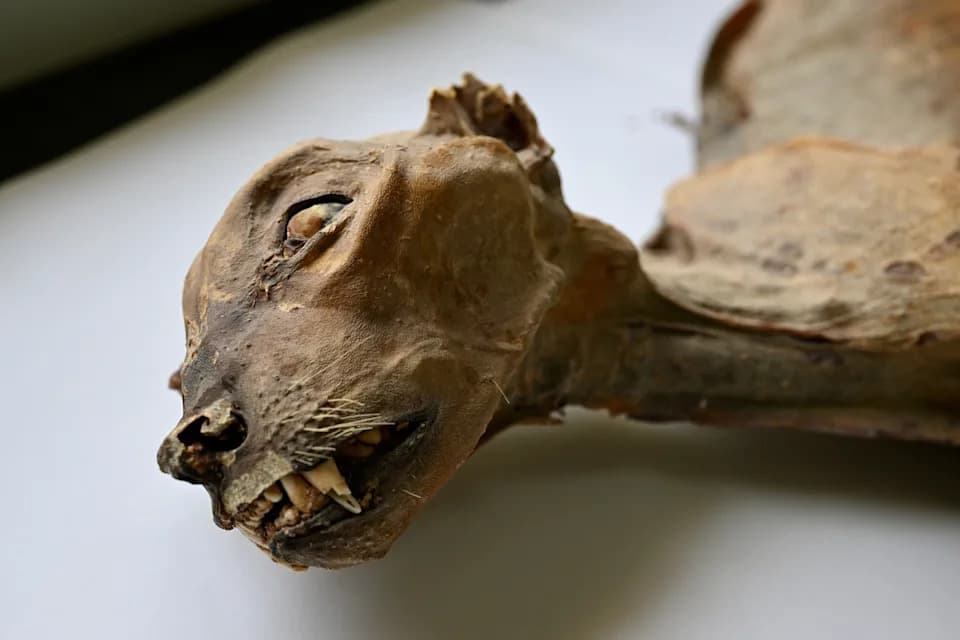
Claudio Ottoni, the study’s senior author and a paleogeneticist, emphasizes that whole-genome analyses combine ancestry signals from many ancestors and so offer much greater resolution than mitochondrial evidence alone. The research team plans further sampling across North Africa—including carefully targeted studies of mummified cats from Egypt—to better pinpoint when and how full domestication occurred.
Why the late arrival matters
That domestic cats appear in Europe relatively late highlights how effectively felines adapted to human environments once urban and maritime niches expanded. The Roman-era rise of towns, granaries and long-distance trade likely created abundant rodent-rich environments ideal for cats to thrive alongside people, enabling rapid dispersal once domestic lineages arrived.
Although ancient cat bones are comparatively rare and often difficult to assign confidently to domestic or wild populations, integrating archaeology with whole-genome data provides a clearer framework for interpreting the past. Future ancient-DNA work—especially from North African contexts older than 2,000 years—will be critical to resolving the earliest chapters of cat domestication.
Key takeaways: a large genomic study assembled 87 ancient and modern cat genomes; results point to North African origins for modern domestic cats; domestic lineages reached mainland Europe only within the last ~2,000 years; Phoenician/Punic maritime networks and Roman expansion likely facilitated spread; further ancient-DNA sampling (including Egyptian mummies) is planned to refine the timeline.
Help us improve.