JWST detected three distant sources in early 2025 that may be "dark stars" — enormous, ancient objects powered by dark matter annihilation rather than fusion. These bodies would be metal-poor, strongly redshifted, and could reach masses from ~10,000 to 10 million solar masses. One candidate shows a strong helium absorption feature compatible with dark-star models, but alternative explanations (massive early stars or compact galaxies) remain viable; better spectral data and more theoretical work are required.
When Darkness Shines: JWST Spots Three Candidates for Mysterious "Dark Stars"

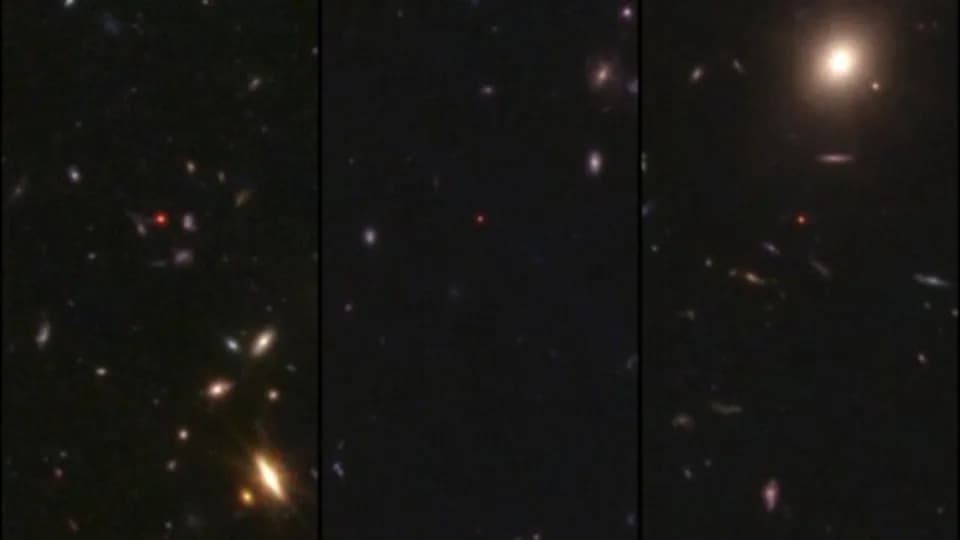
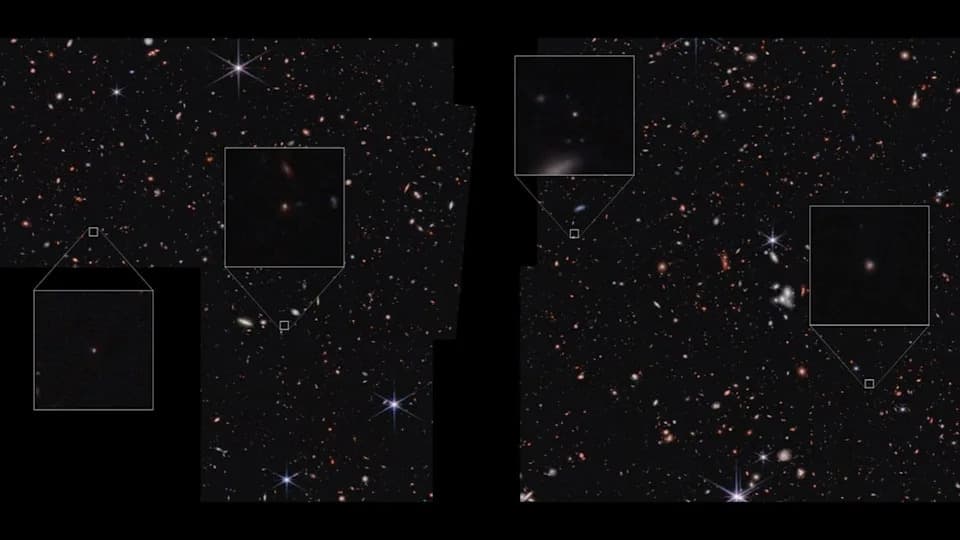
In early 2025 astronomers using the James Webb Space Telescope (JWST) reported three very distant, unusually bright objects that may be examples of so-called "dark stars." The name is misleading: these objects are not "dark" in the usual sense and they differ from ordinary, fusion-powered stars. The label instead highlights a distinctive energy source — dark matter annihilation — and their huge physical sizes, which make classification challenging.
Dark matter is a form of matter that we infer from gravitational effects but cannot detect directly with ordinary telescopes. Most models predict dark matter consists of electrically neutral particles, and some suggest those particles are their own antiparticles. When particle meets antiparticle, they annihilate and release energy. If a high density of such dark matter particles collects inside an early protostellar cloud, their annihilations could inject heat into the gas and slow or prevent the usual gravitational collapse that triggers nuclear fusion. That is the basic idea behind a "dark star."
How a dark star would work
In the standard picture of the first stars, primordial hydrogen and helium collapsed under gravity until central temperatures and pressures ignited fusion. In the dark-star scenario, dark matter annihilation provides an alternative heating mechanism that can maintain an extended, cooler, but still luminous object. Because the luminosity comes from continued access to annihilating dark matter rather than fusion, dark stars could remain bright for long periods, growing to enormous sizes while having cooler surface temperatures than typical fusion-powered stars.
What astronomers would look for
Predicted observational signatures include:
- High redshift: dark stars would be ancient and therefore their light would be strongly redshifted into the infrared.
- Low metallicity: forming from primordial hydrogen and helium, they should show little or no heavier elements ("metals").
- Very large radii and high luminosity: cooler surface temperatures but vastly larger surface areas could make them extremely luminous despite low surface brightness per unit area.
- Distinct spectral features: because dark matter heating does not fuse helium into heavier elements the same way fusion does, some models predict a relatively high helium abundance or specific helium absorption signatures.
JWST candidates and the helium clue
Recent JWST observations uncovered several unexpectedly bright, very high-redshift sources. A team analyzing this data identified three objects whose properties are broadly consistent with supermassive dark-star models (masses potentially in the ~10,000 to 10 million solar-mass range, depending on growth histories). One candidate in particular shows a helium absorption feature that could indicate an unusually high helium abundance — a potential "smoking gun" for dark-star physics if confirmed.
Implications if confirmed
If dark stars exist, they could change our view of early stellar evolution and the growth of the first massive black holes. Lower-mass dark stars might transition into ordinary stars when their local dark matter supply is exhausted and fusion ignites. Supermassive dark stars could collapse directly into massive black holes at the end of their lives, providing an efficient route to produce the supermassive black holes observed very early in cosmic history — objects that are otherwise difficult to explain with standard models.
Why skepticism remains
The dark-star interpretation is not yet widely accepted. Alternative explanations include unusually massive, fast-accreting ordinary stars or compact, bright early galaxies. Current spectral and imaging data are insufficient to decisively distinguish between these scenarios. Observational challenges include limited signal-to-noise at extreme redshift, uncertainties in model predictions, and degeneracies between size, temperature, and composition when interpreting spectra.
What comes next
Confirming dark stars will require deeper, higher-resolution spectra, additional candidate detections across different fields, and improved theoretical predictions of dark-star spectra and evolution. Future JWST programs, next-generation telescopes, and complementary observations (for example, of the environments and host halos of these objects) will be essential to test the hypothesis and explore its consequences for dark matter and early black-hole formation.
By Alexey A. Petrov, University of South Carolina
Help us improve.