The James Webb Space Telescope has produced a vivid infrared image of the compact star cluster Westerlund 2 in the Gum 29 nebula, about 20,000 light-years away. Webb's NIRCam and MIRI data reveal sculpted dust walls, glowing PAH emission, and filaments of gas shaped by young massive stars. Astronomers report a population of brown dwarfs down to roughly 10 Jupiter masses, offering new clues about low-mass object formation and the impact of massive stars on planet-forming material.
James Webb Reveals 'Failed Stars' in Vibrant Westerlund 2 Cluster — New Infrared Portrait
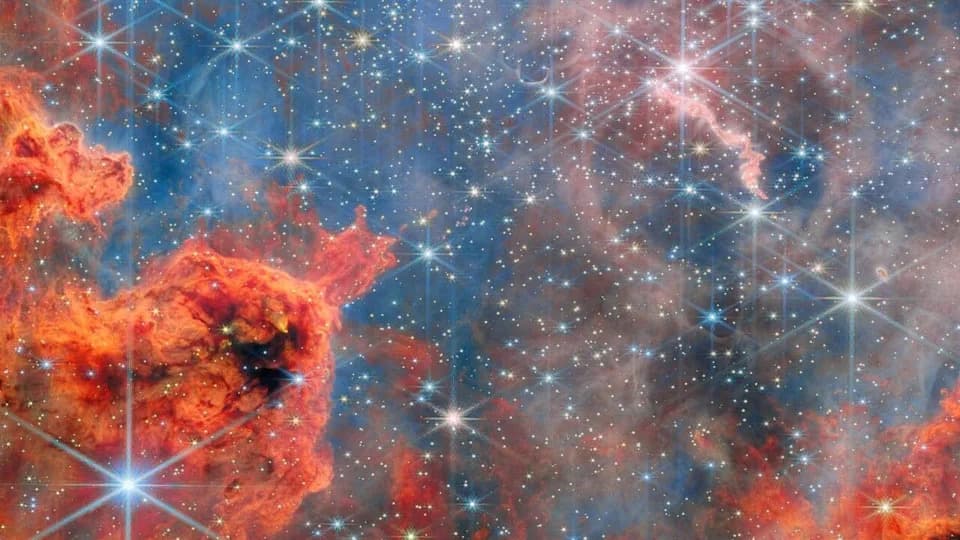
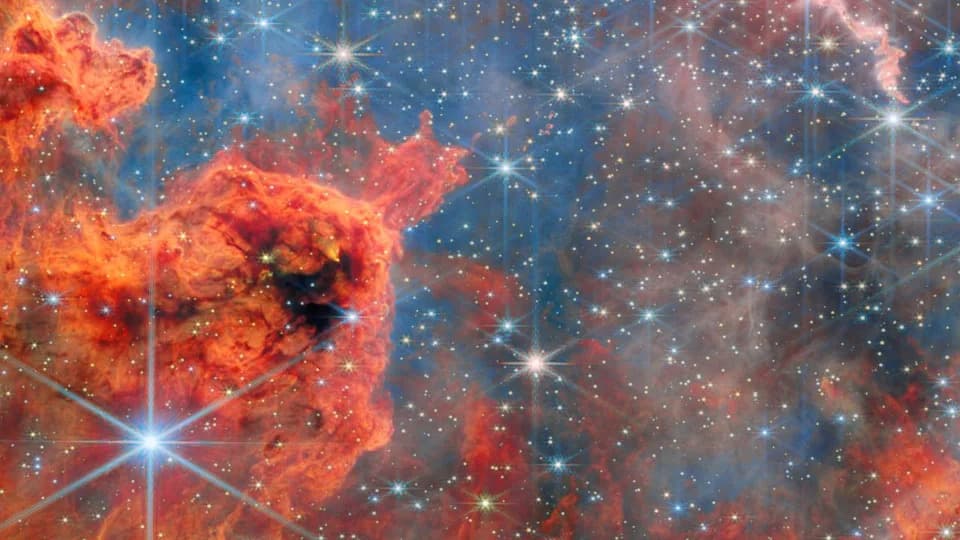
The Westerlund 2 star cluster is a nursery of young stars and 'failed stars' alike. | Credit: ESA/Webb, NASA & CSA, V. Almendros-Abad, M. Guarcello, K. Monsch, and the EWOCS team.
Bordered by orange and brown veils of gas and dust and studded with glittering points of light, a new infrared portrait from the James Webb Space Telescope unveils the compact star cluster Westerlund 2 embedded in the Gum 29 nebula.
A Young, Dense Stellar Nursery
Westerlund 2 lies roughly 20,000 light-years from Earth in the constellation Carina. The cluster occupies a relatively small region — about 6 to 13 light-years across — and hosts roughly 3,000 stars. Seen at an age of approximately 2 million years, it contains some of the Milky Way's hottest, most luminous and most massive young stars, whose intense radiation sculpts the surrounding dust and gas.
Webb's Infrared View: Instruments and Features
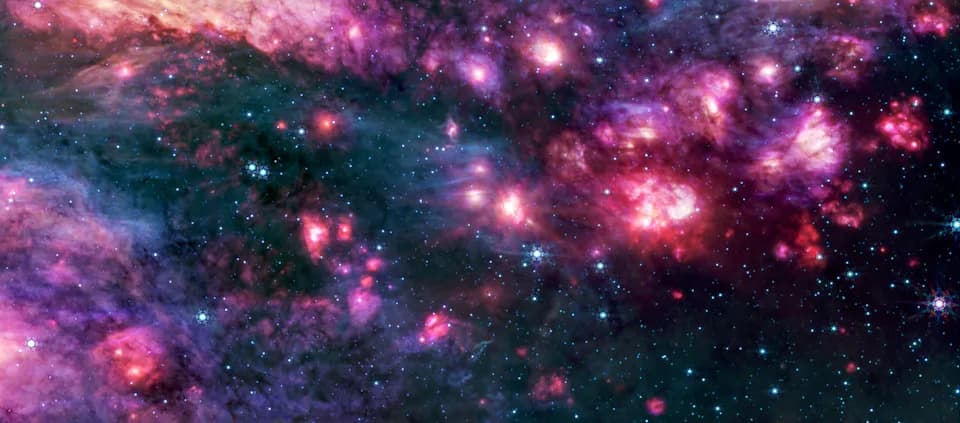
The image is a composite of data from Webb's Near-Infrared Camera (NIRCam) and the Mid-Infrared Instrument (MIRI). Compared with earlier Hubble imagery that combined visible and near-infrared light, Webb's deeper infrared sensitivity highlights newly formed, still-enshrouded stars, glowing PAH emission from heated dust and cooler material traced by methane-sensitive bands.
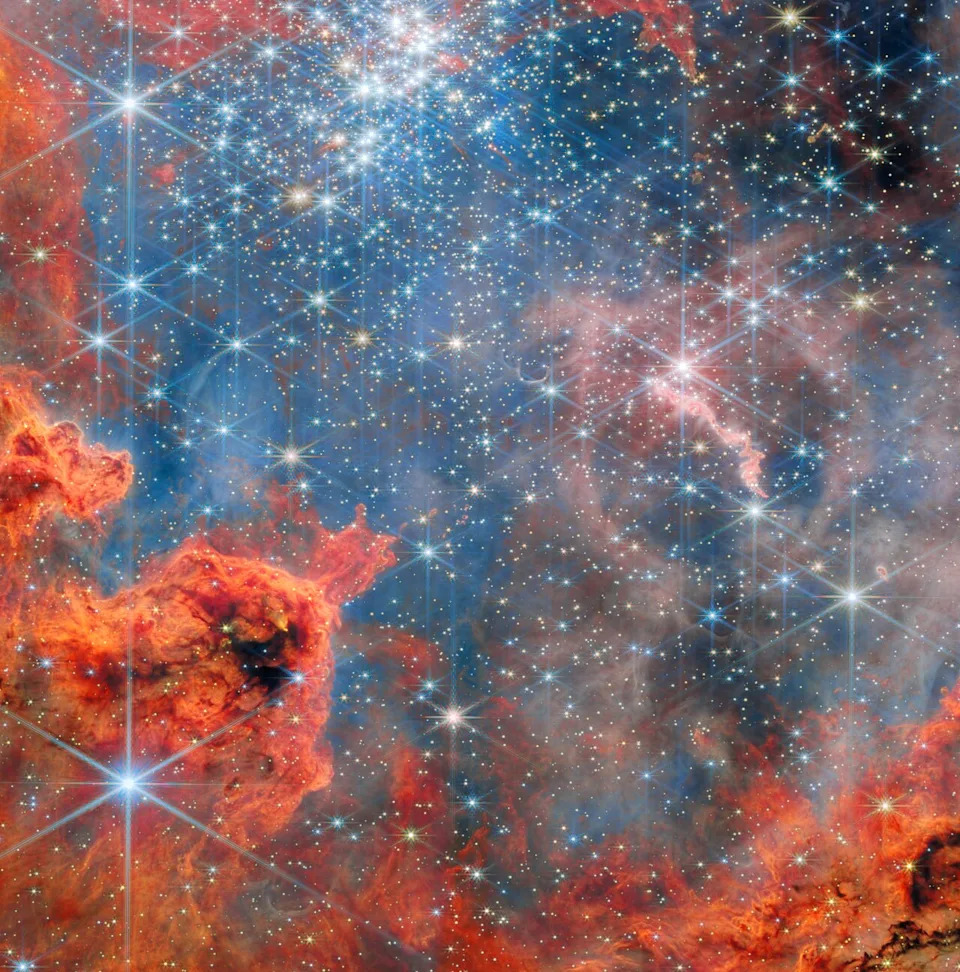
A full-size view of Westerlund 2 | Credit: Credit: ESA/Webb, NASA & CSA, V. Almendros-Abad, M. Guarcello, K. Monsch, and the EWOCS team
Bright nearby stars produce distinctive eight-pronged diffraction patterns from the telescope optics, while orange and red regions mark gas and dust excited by stellar radiation. Blue and pink filaments thread the scene, appearing as flows and illuminated edges where radiation and winds are reshaping the nebula.
Discovery: Brown Dwarfs — 'Failed Stars'
Using infrared bands sensitive to polycyclic aromatic hydrocarbons (PAHs) and methane, astronomers identified a population of brown dwarfs in and around Westerlund 2 — objects that bridge planets and stars. Some of these brown dwarfs have estimated masses near 10 times that of Jupiter. Brown dwarfs generally range from about 10 to 90 Jupiter masses and lack sufficient mass to sustain stable hydrogen fusion in their cores.
These detections offer a rare glimpse into low-mass object formation in a massive, crowded cluster environment and may shed light on the early stages of stellar evolution and the properties of planet-forming disks influenced by nearby massive stars.
Source: European Space Agency (ESA) and James Webb Space Telescope observations shared Dec. 19, 2025.
For more striking space imagery and context, Webb's observations of Westerlund 2 complement previous Hubble views and continue to refine our picture of how massive stars shape their natal clouds and trigger subsequent generations of star formation.
Help us improve.