The James Webb Space Telescope imaged Sagittarius B2 — a massive molecular cloud near the Milky Way's center — in mid‑infrared with MIRI. Sgr B2 contains an estimated 3–10 million solar masses, spans about 150 light‑years, and lies roughly 26,000 light‑years away. Despite holding only ~10% of the central gas, it forms ~50% of the region's stars. Red, chemically rich clumps in the MIRI image may help explain this unusual efficiency; detailed studies of stellar ages and masses will probe the underlying mechanisms.
James Webb Reveals Massive, Puzzling Sagittarius B2 — A Stellar Factory Under Scrutiny
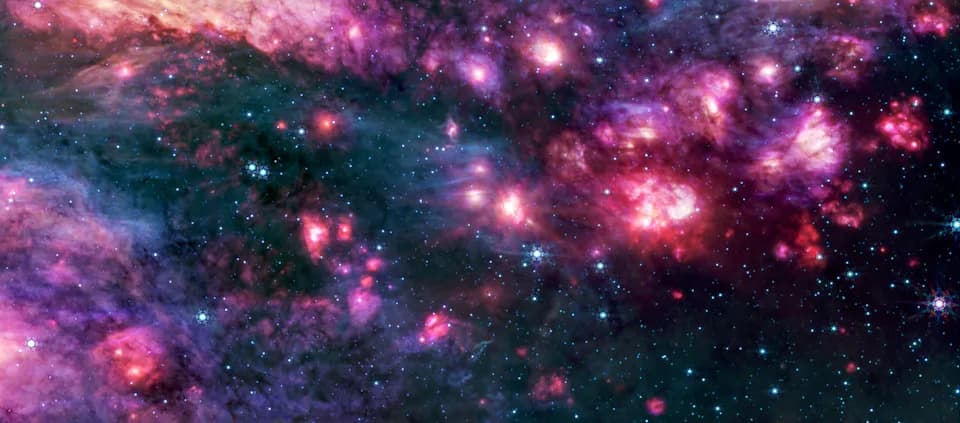
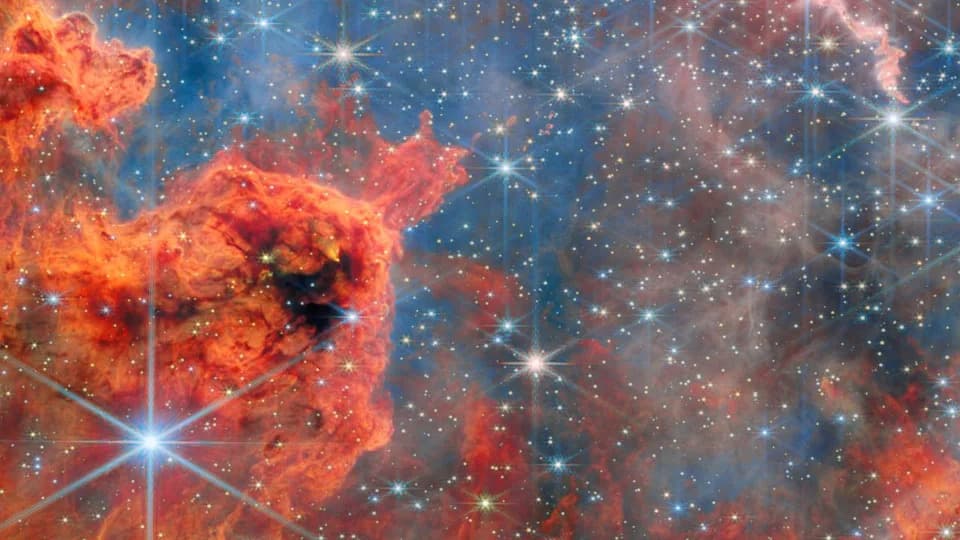
JWST's view of the Sagittarius B2 region in near-infrared light. | Credit: NASA, ESA, CSA, STScI, Adam Ginsburg (University of Florida), Nazar Budaiev (University of Florida), Taehwa Yoo (University of Florida); Image Processing: Alyssa Pagan (STScI)
Quick Facts
What It Is: Sagittarius B2 (Sgr B2) molecular cloud
Where It Is: About 26,000 light‑years from Earth, in the constellation Sagittarius
When It Was Shared: Sept. 24, 2025
Stars form inside molecular clouds — cold, dense regions rich in molecules and dust. One of the Milky Way's most prodigious star factories is Sagittarius B2 (Sgr B2), a colossal molecular complex that sits a few hundred light‑years from the Galaxy's central supermassive black hole and appears to produce an outsized share of stars in the galactic center.
Sgr B2 is enormous: its mass is estimated between 3 million and 10 million times that of the Sun, and it spans roughly 150 light‑years across. Although it contains only about 10% of the gas in the central region, observations suggest it is responsible for roughly 50% of new star formation there — a surprising efficiency that astronomers are eager to understand.
A team used the James Webb Space Telescope (JWST) to probe Sgr B2, capturing a dramatic mid‑infrared image with JWST's Mid‑Infrared Instrument (MIRI). In this wavelength range, warm dust, heated gas and the brightest young stars glow, making MIRI especially sensitive to the dense clumps where stars are forming.
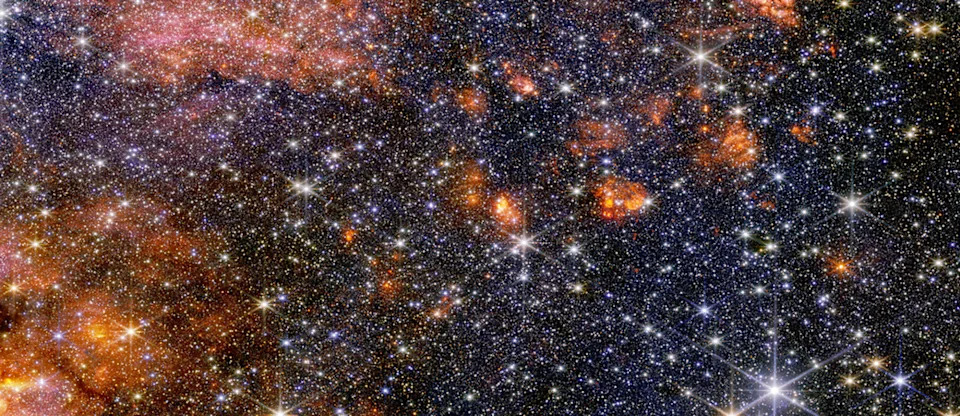
JWST's view of the Sagittarius B2 region in near-infrared light | Credit: NASA, ESA, CSA, STScI, Adam Ginsburg (University of Florida), Nazar Budaiev (University of Florida), Taehwa Yoo (University of Florida); Image Processing: Alyssa Pagan (STScI)
In the MIRI image, dense knots of dust and gas shine in shades of pink, purple and red, while surrounding dark lanes are not empty—thick dust blocks the mid‑infrared light from behind them. A companion near‑infrared view from JWST's Near‑Infrared Camera (NIRCam), taken at the same time, shows many more stars because stellar emission is stronger at near‑infrared wavelengths.
Notably, redder clumps on the right side of the MIRI view correspond to a chemically rich subregion previously identified by radio and millimeter telescopes. This chemically complex zone may be a clue to Sgr B2's unusually high star‑formation efficiency: complex chemistry can trace dense, shielded environments where massive star formation is favored.
Follow‑up studies that measure the masses and ages of stars inside Sgr B2 will be crucial. By comparing stellar demographics, gas densities and chemical content, astronomers hope to determine why Sgr B2 punches above its weight in forming stars and what that tells us about star formation near galactic centers.
Why This Matters
Sgr B2 offers a nearby laboratory for understanding extreme star formation in dense, chemically rich environments — conditions that may resemble those in other galactic centers and in the early universe.
For more striking images, see our Space Photo of the Week archives.
Help us improve.