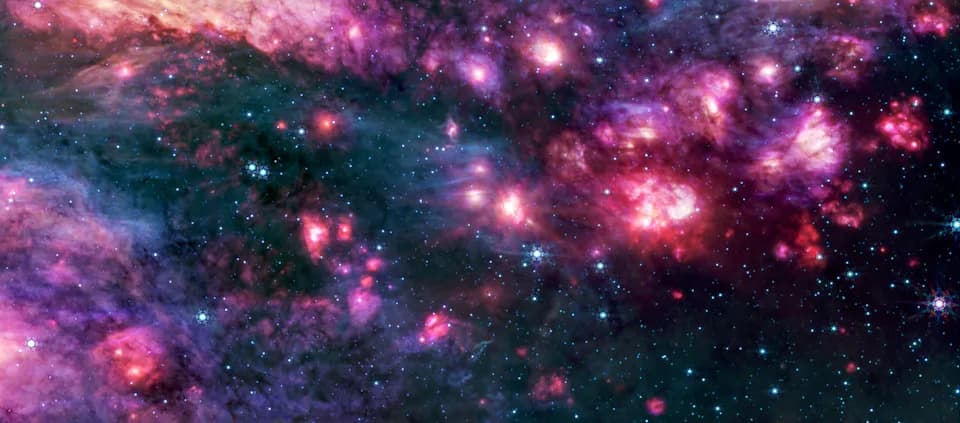
JWST has produced a detailed infrared image of Westerlund 2 in the Gum 29 region of the Carina Nebula, highlighting bright white‑blue massive stars and revealing the cluster's faintest members. For the first time in this region, astronomers have identified the full population of brown dwarfs down to roughly 10 times the mass of Jupiter. The cluster spans about 6–13 light‑years and lies roughly 20,000 light‑years away. This complete census helps scientists test whether intense radiation alters the efficiency of forming low‑mass objects compared with quieter star‑forming regions.
JWST Reveals Hidden Brown Dwarfs in Westerlund 2 — White‑Blue Stars Light Up the Carina Nebula
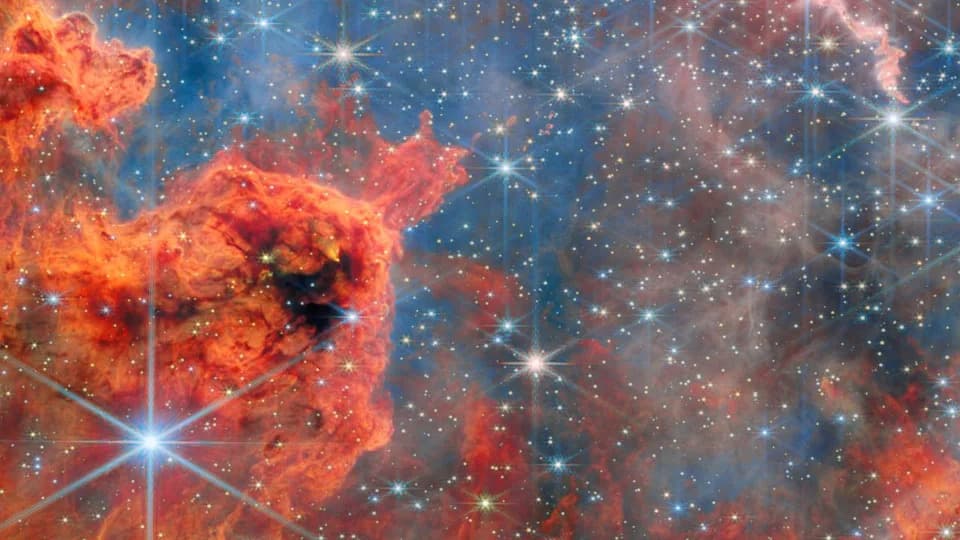
This stellar nursery located in the Carina Nebula is a key focal point for astronomers. . | Credit: ESA/Webb, NASA & CSA, V. Almendros-Abad, M. Guarcello, K. Monsch and the EWOCS team
The James Webb Space Telescope (JWST) has captured a striking new view of the young star cluster Westerlund 2, tucked inside the Gum 29 stellar nursery in the Carina Nebula. The image spotlights brilliant white‑blue massive stars and, for the first time in this region, the cluster's faintest members: a full population of brown dwarfs.
What JWST Found
Westerlund 2 spans roughly 6 to 13 light‑years and includes some of the hottest and most massive stars in the Milky Way. While Hubble highlighted the region in a 2015 image celebrating its 25th anniversary, JWST's greater sensitivity provides a different perspective — revealing far fainter objects that earlier telescopes struggled to detect.
Using JWST's infrared instruments, astronomers have for the first time identified the full census of brown dwarfs in this young, massive cluster, including objects with masses as low as about 10 times that of Jupiter. These brown dwarfs formed like stars from collapsing gas clouds but never gained enough mass to sustain long‑term hydrogen fusion.
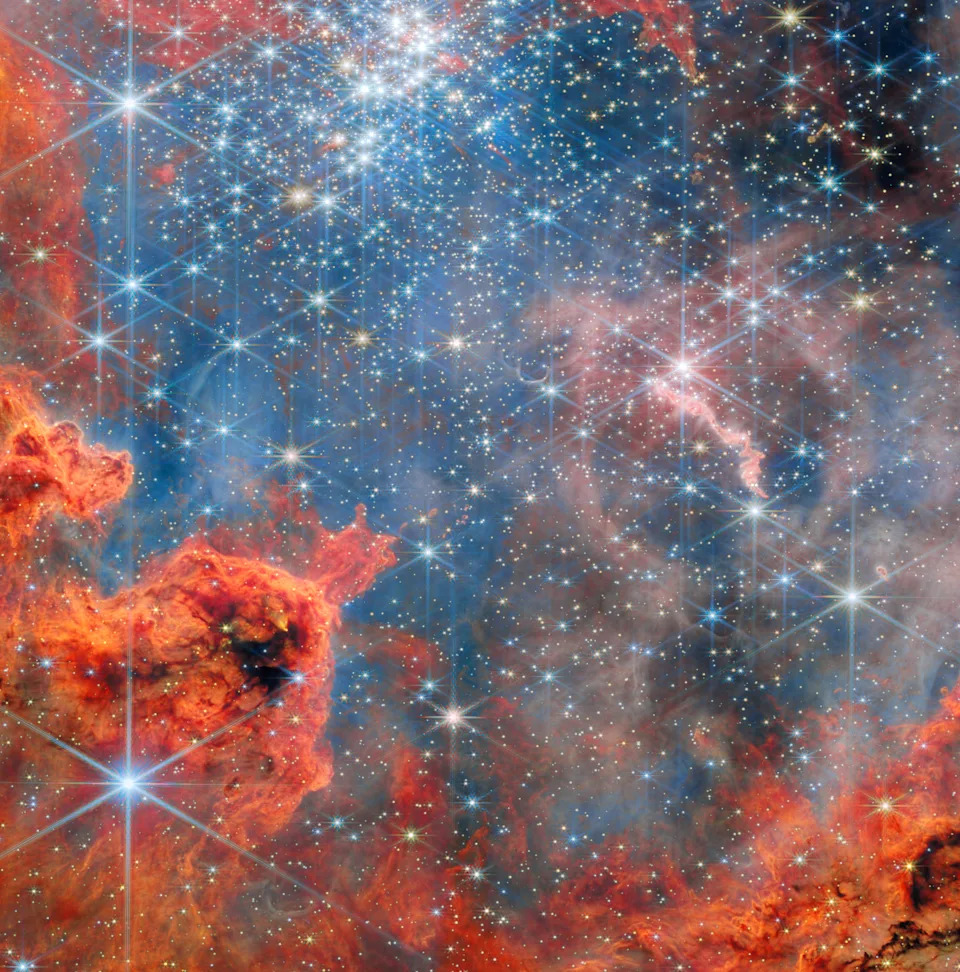
Faint brown dwarf stars can be seen in this image from the James Webb Space Telescope. | Credit: ESA/Webb, NASA & CSA, V. Almendros-Abad, M. Guarcello, K. Monsch and the EWOCS team
Why This Matters
Finding brown dwarfs in such an intense, radiation‑rich environment is important because it helps researchers test how well low‑mass objects can form when exposed to strong stellar radiation and winds. A complete census of stars and substellar objects in Westerlund 2 lets astronomers directly compare this extreme nursery to quieter star‑forming regions and determine whether the local environment alters the relative mix of stars, brown dwarfs and planetary‑mass objects that form there.
The Carina Nebula lies in the constellation Carina, at a distance of roughly 20,000 light‑years from Earth. JWST's observations of Westerlund 2 therefore offer a valuable laboratory for studying the physics of star and brown dwarf formation under extreme conditions.
Bottom line: JWST’s deep infrared imaging has revealed both the brilliant massive stars and the faint, elusive brown dwarfs in Westerlund 2, improving our understanding of how low‑mass objects form in harsh stellar nurseries.
For readers who want to learn more, look up JWST mission resources and recent papers on star formation and brown dwarf populations for technical details and images.
Help us improve.