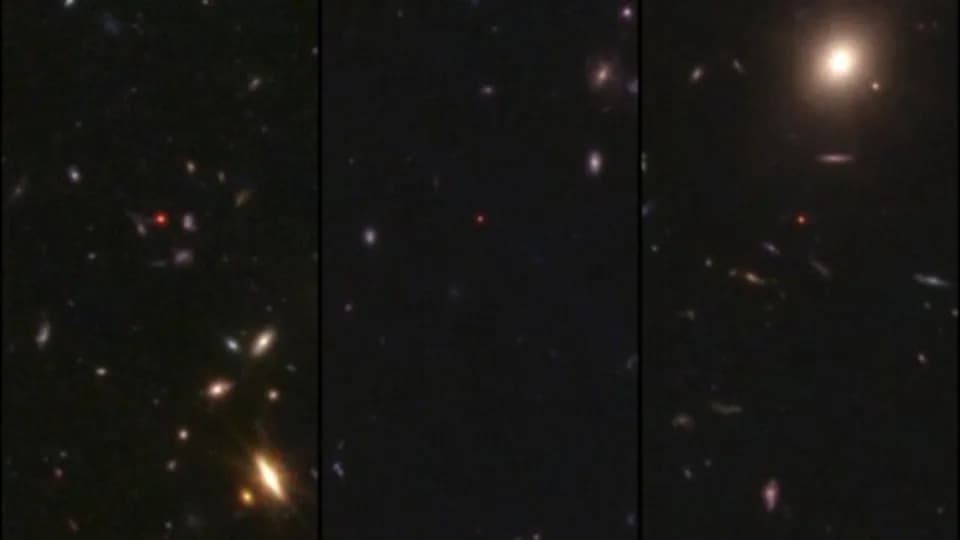
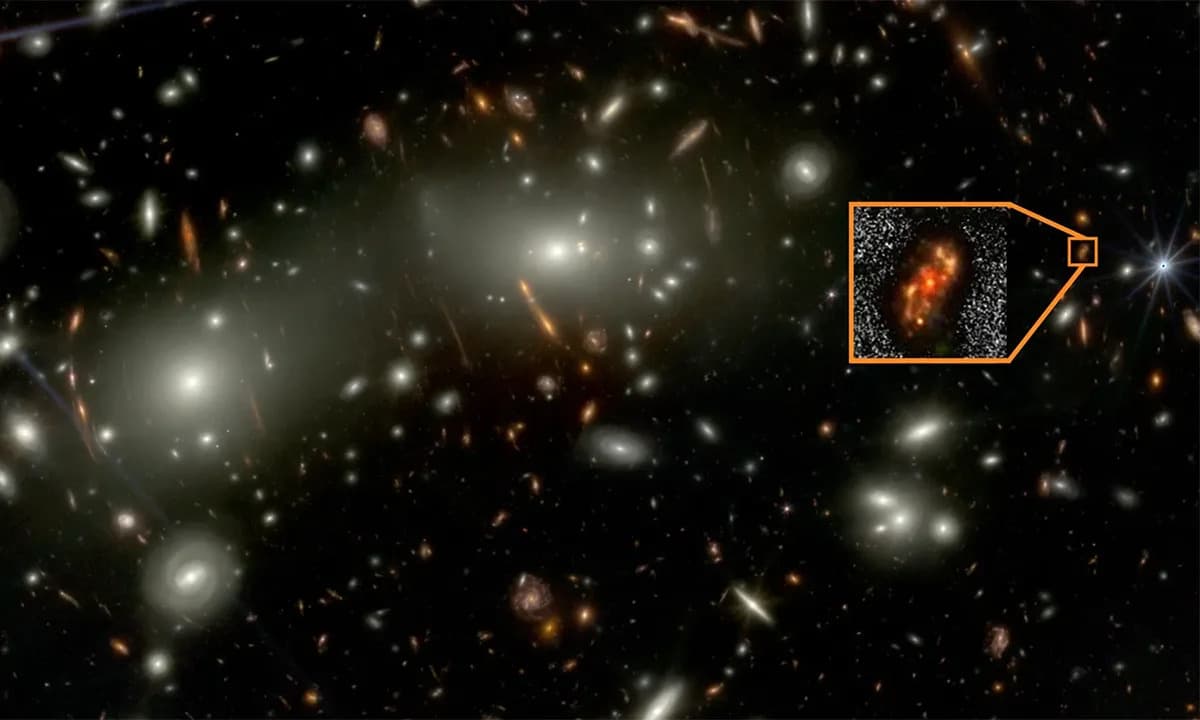
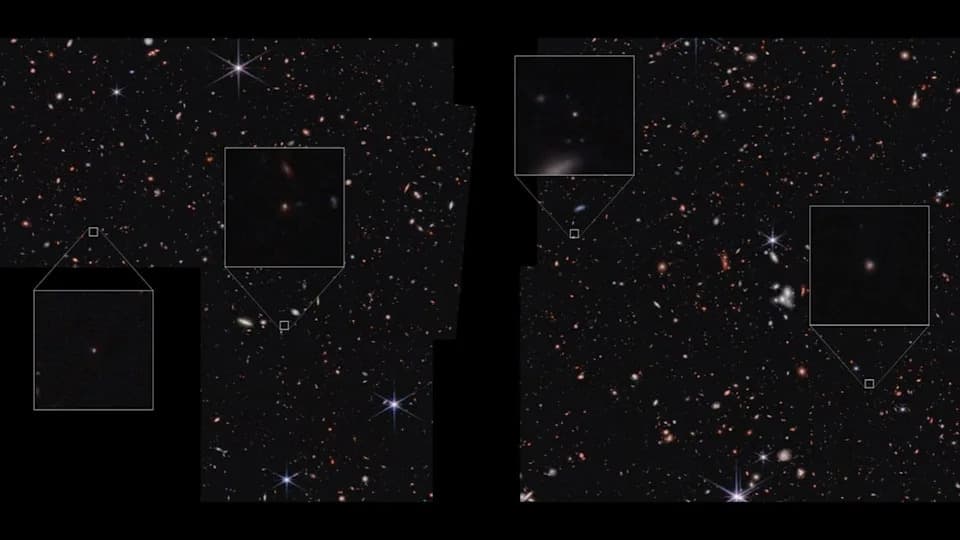
Using JWST, astronomers have identified SXDF-NB1006-2, a luminous young galaxy that formed when the universe was under 500 million years old. Although its visible stars look only 1–2 million years old, the galaxy is in an intense starburst, forming stars at about 165 solar masses per year. Observations show gas being expelled at over 310 mi/s (500 km/s), well above the galaxy’s escape velocity, and excess heavy elements suggest an older hidden stellar population. These outflows could deplete the galaxy’s gas in a few hundred million years and lead it to evolve into a massive quiescent galaxy.
JWST Finds Starburst 'Toddler' Galaxy Blasting Gas into Space

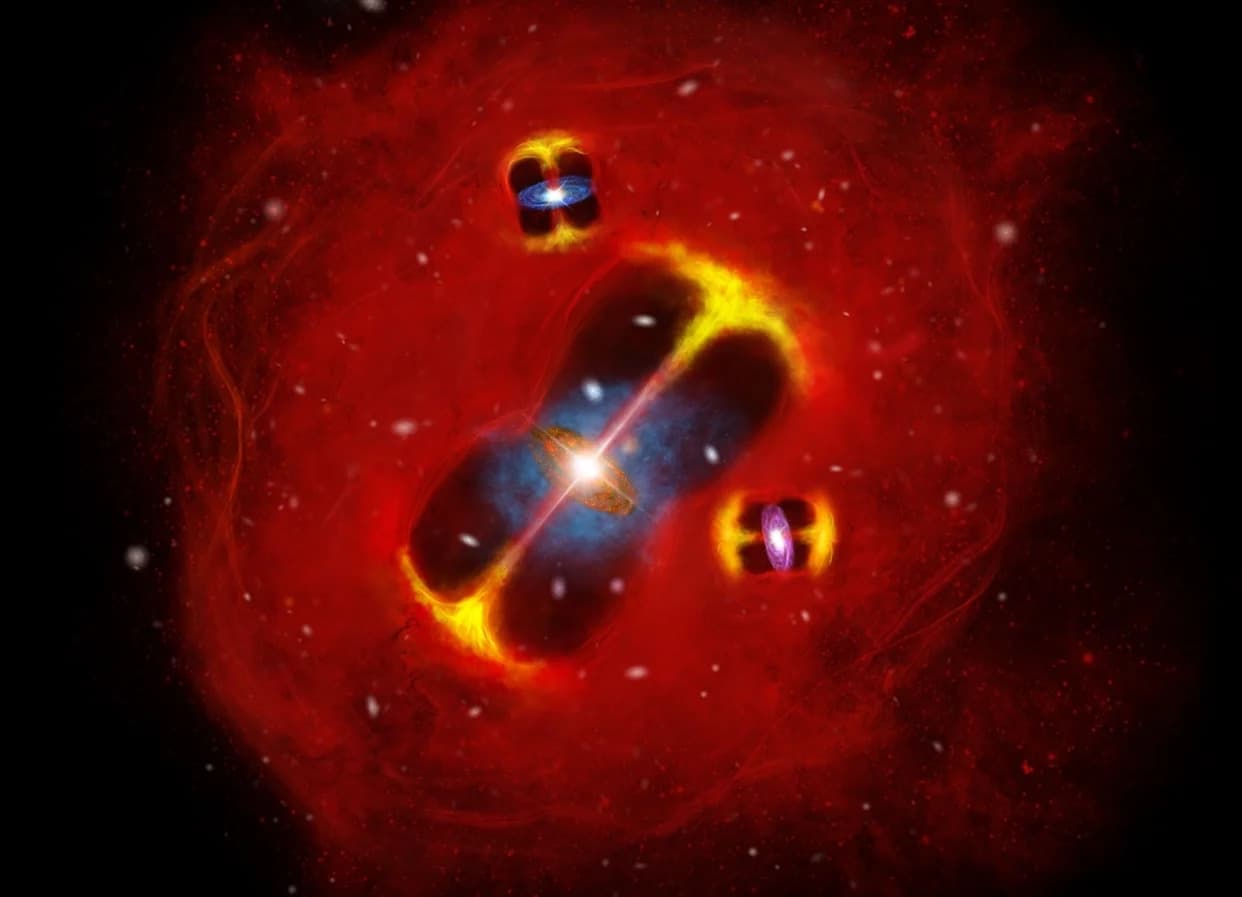
An international team using the James Webb Space Telescope (JWST) has identified a luminous young galaxy, SXDF-NB1006-2, that formed when the universe was less than 500 million years old. The discovery, reported in an October paper in Monthly Notices of the Royal Astronomical Society, reveals a galaxy undergoing an intense starburst while ejecting gas at speeds high enough to escape its gravity.
Because of its extreme distance, we see SXDF-NB1006-2 as it appeared shortly after it formed: its brightest stellar population appears to be only about 1–2 million years old. Yet even at that infancy the galaxy is forming stars at roughly 165 solar masses per year—more than sixteen times the current rate of the Milky Way—making it unusually bright and blue.
Rapid star formation produces many massive, short-lived stars. Those stars drive powerful outflows through intense radiation and winds and end their lives as supernovae, which together heat the galaxy and push large amounts of gas outward. In SXDF-NB1006-2 the team measured gas moving at more than 310 miles per second (500 km/s), roughly three times the galaxy's escape velocity. That implies a significant fraction of the gas will be lost to intergalactic space and not return to fuel future star formation.
Surprisingly, the galaxy contains more heavy elements (metals) than expected for such a young stellar population. Because elements heavier than helium are produced by earlier generations of stars, this points to an underlying, older stellar population that is likely hidden behind the glare of newly formed stars.
The long-term consequence of these strong outflows is gas depletion. At current rates, SXDF-NB1006-2 could exhaust most of its usable gas in a few hundred million years. It will not disappear—low-mass, long-lived stars will remain, and some star formation may continue—but the era of vigorous stellar production will end and the galaxy's growth will slow dramatically.
The authors propose that bursty, gas-blowing early galaxies like SXDF-NB1006-2 may evolve into the massive quiescent galaxies we observe in the nearby universe: systems that built up large stellar masses early and then largely ran out of fuel. More broadly, JWST is revealing that many early galaxies are brighter and larger than some simple growth models predicted, offering new puzzles about how the first massive galaxies assembled while leaving the overall Big Bang framework intact.
Help us improve.