JWST and Chandra have identified a protocluster containing at least 66 candidate galaxies and a mass of roughly 20 trillion Suns, dating to about one billion years after the Big Bang. The system shows mature cluster features — a hot gas halo and centrally peaked X-ray emission — challenging standard models of how quickly large-scale cosmic structures form. Published in Nature, the discovery adds to other Webb-era surprises and may prompt revisions to cosmological theories.
Surprising Discovery: Massive Galaxy Protocluster Forming Just 1 Billion Years After the Big Bang
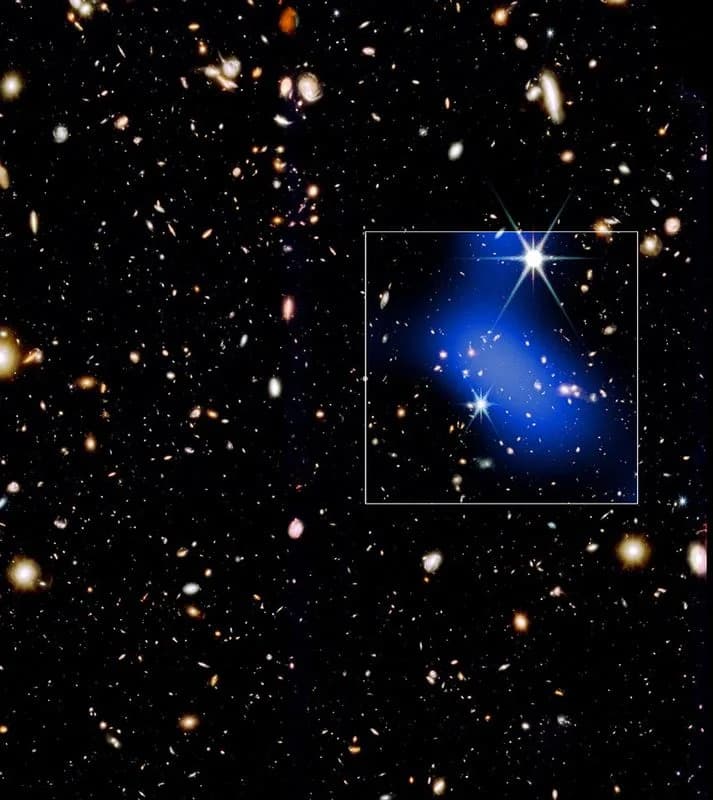
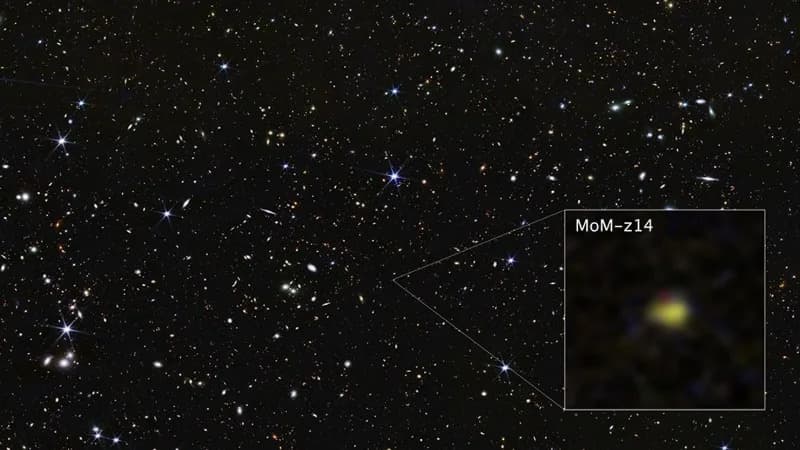
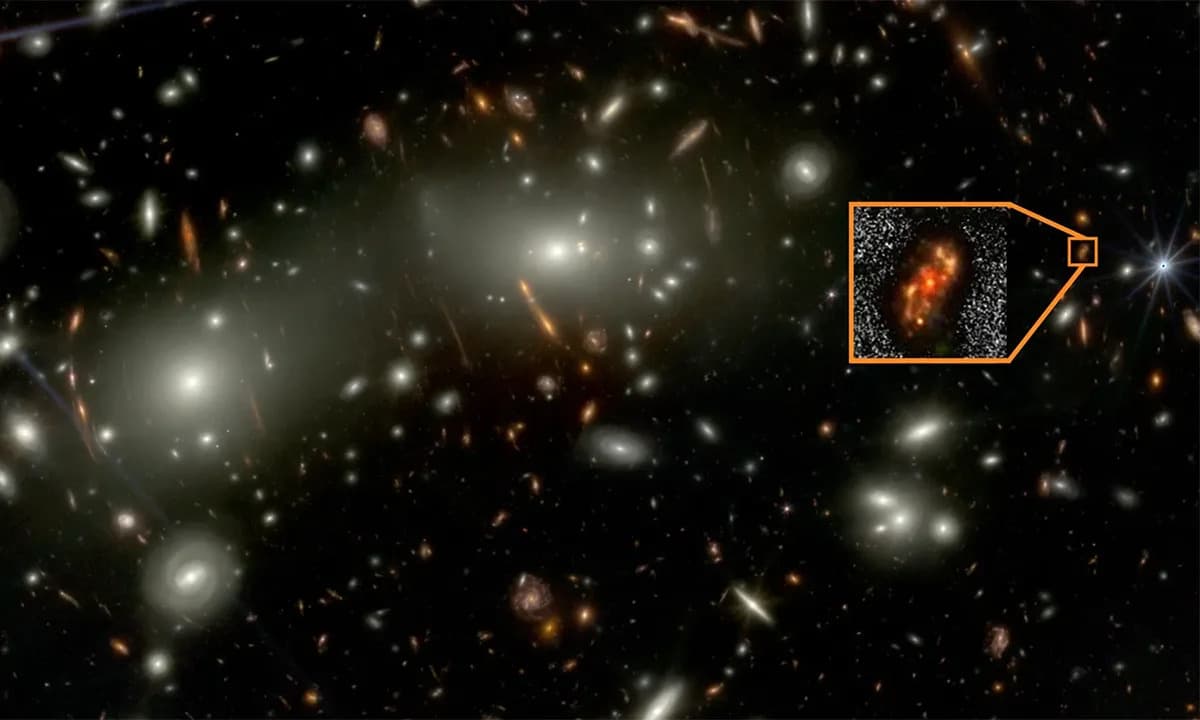
A developing galaxy cluster dating to about 1 billion years after the Big Bang is shown in this handout image released on January 28, 2026. The white box marks the field of view of the Chandra X-ray Observatory data (blue) that is overlaid on an infrared image from the James Webb Space Telescope showing the location of galaxies. NASA Chandra/STScI, Bodgan et al./Handout via REUTERS.
Observations from NASA's James Webb Space Telescope (JWST) and the Chandra X-ray Observatory reveal a massive galaxy protocluster that began assembling roughly one billion years after the Big Bang — far earlier than most cosmological models predict.
Researchers report the emerging system contains at least 66 candidate member galaxies and has a total mass equivalent to about 20 trillion Suns. The structure shows multiple hallmarks of a mature galaxy cluster, including a halo of superheated gas and a centrally peaked X-ray brightness profile.
Observations and Evidence
The candidate galaxies were identified in deep infrared images from JWST, while Chandra detected extended X-ray emission consistent with hot intracluster gas. Together, these multiwavelength observations indicate the system is not merely a loose association of galaxies but a gravitationally bound, evolving cluster — often called a protocluster.
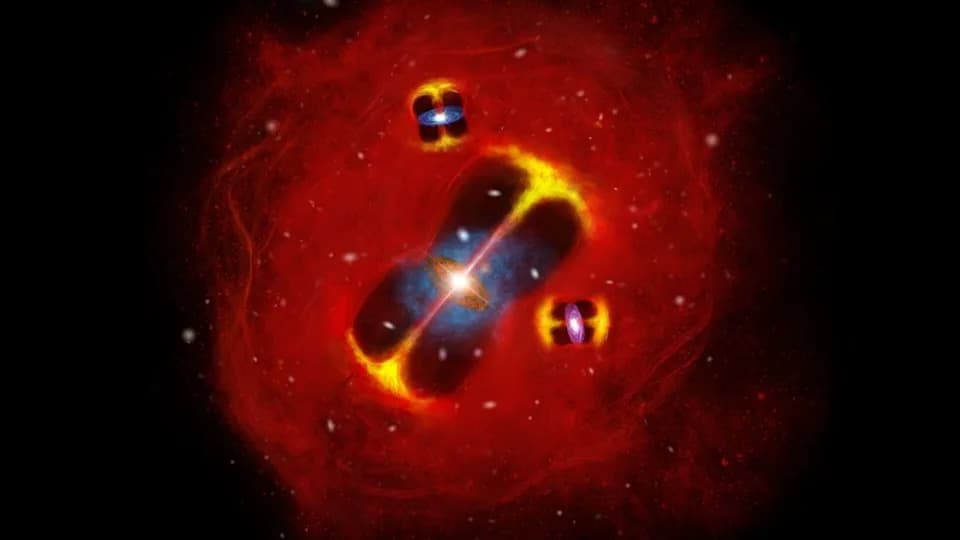
"A galaxy cluster is, as the name suggests, an assembly of galaxies, typically hundreds to several thousands. These galaxies are embedded in a halo of hot gas heated to millions of degrees, and the whole system is bound together by dark matter," said Akos Bogdan of the Harvard & Smithsonian Center for Astrophysics, lead author of the study published in Nature.
Why This Is Surprising
Under standard cosmological models, structures of this mass and density should not have had enough time to assemble when the universe was about one billion years old (roughly 7% of its current age). Until now, the earliest comparable cluster-like systems had been observed at roughly three billion years after the Big Bang.
"Our findings provide further evidence for a more rapid growth of cosmic structure than is predicted by current cosmological models," said co-author Gerrit Schellenberger of the Center for Astrophysics. "Combined with other Webb-era surprises — unusually luminous early galaxies and supermassive black holes already in place 500 million years after the Big Bang — these results suggest key parts of our understanding may be incomplete."
Context and Implications
Dark matter — which does not emit or reflect light and is inferred from gravitational effects — is believed to provide the scaffolding for cluster formation, accounting for roughly 85% of the universe's matter. The new observations imply either that structure growth proceeded faster than expected or that refinements to models (or assumptions about the early universe) may be needed.
Published in Nature, the study demonstrates the power of combining JWST's infrared sensitivity with Chandra's X-ray capabilities to probe the infant universe. Follow-up observations and theoretical work will be required to confirm the system's total mass and to explore how such a large structure could have formed so quickly.
In brief: JWST found the candidate galaxies; Chandra confirmed the hot X-ray–emitting gas. The discovery adds to a growing set of Webb-era findings that are reshaping astronomers' view of early cosmic history.
Help us improve.