Priyamvada Natarajan told Davos attendees that black hole physics — rooted in Einstein's relativity — not only explains extreme cosmic objects but also underlies technologies like GPS. She and collaborators propose that some of the universe's first supermassive black holes formed by the direct collapse of pristine gas clouds, creating very large seeds tens to hundreds of thousands of solar masses. Recent JWST and Chandra observations, including UHZ1 and the Infinity Galaxy, provide evidence consistent with these predictions and help explain billion-solar-mass black holes less than a billion years after the Big Bang.
James Webb Finds Clues to How the Universe’s First Supermassive Black Holes Formed
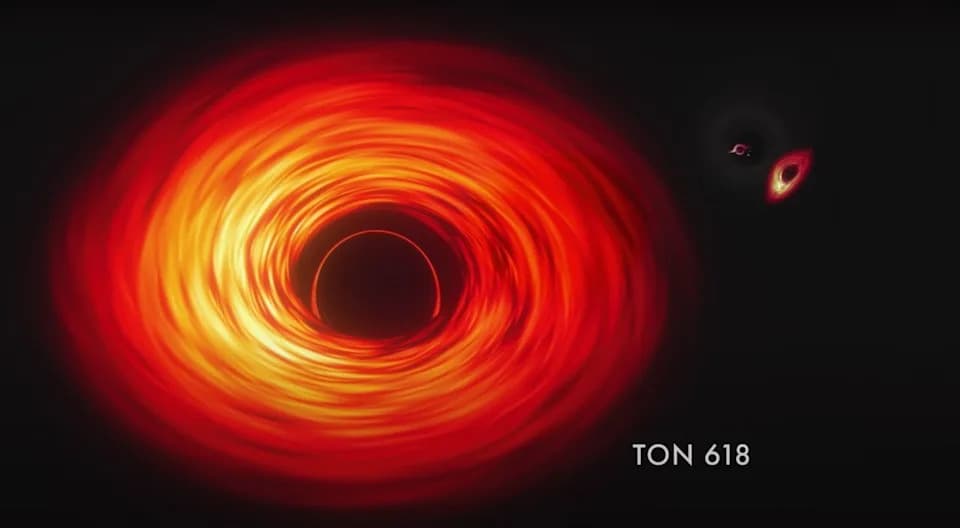
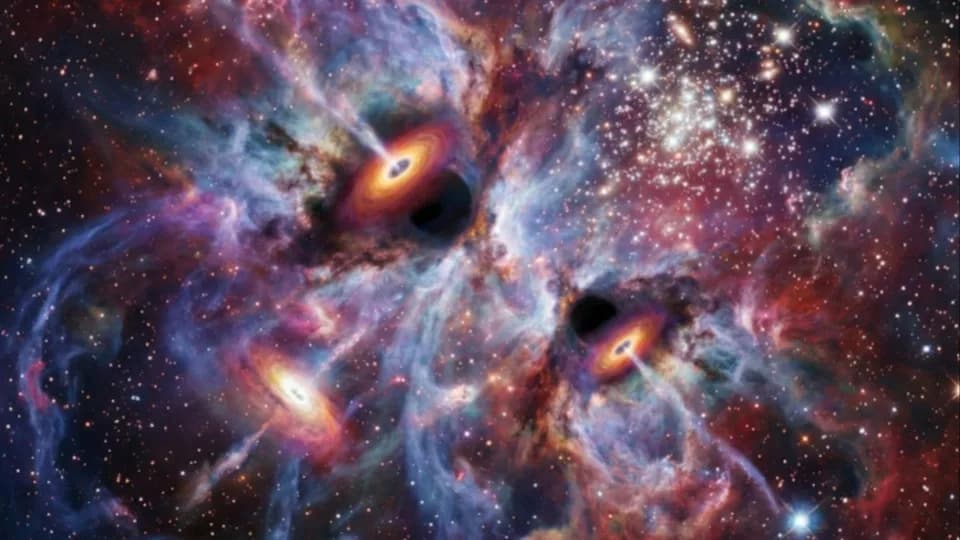
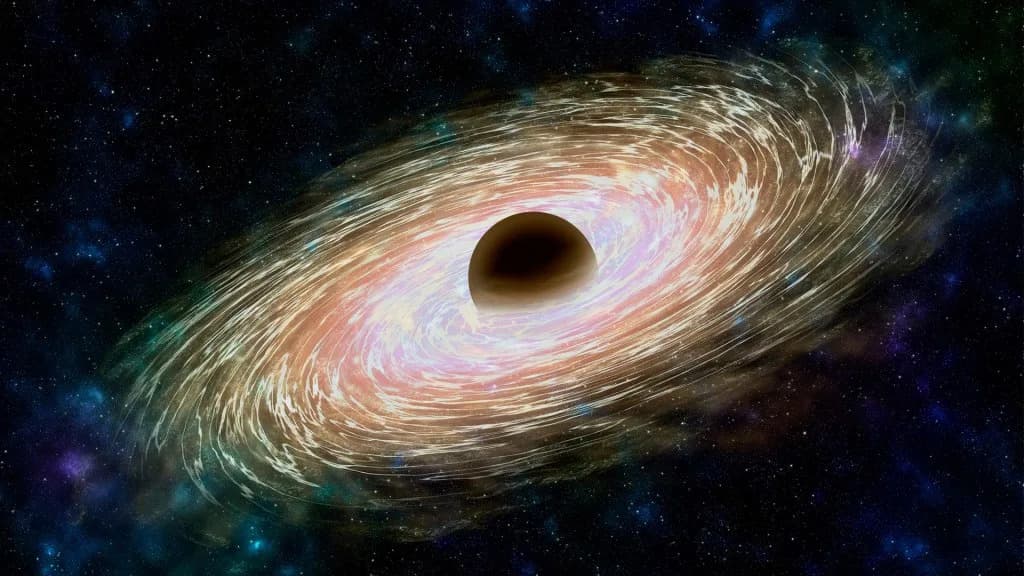
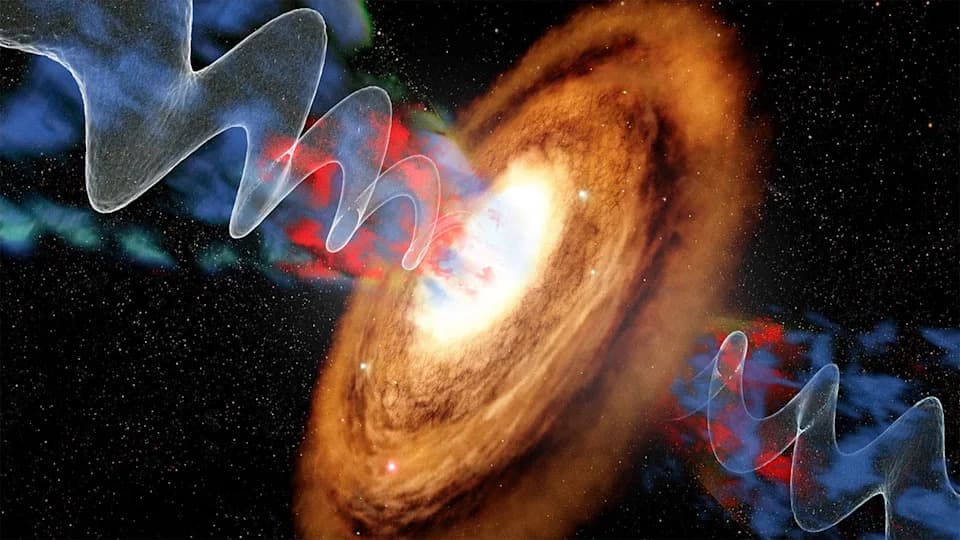
An illustration of a supermassive black hole with a mass billions of times that of the sun. . | Credit: NASA
Black holes remain invisible to direct sight, yet their influence extends from shaping entire galaxies to underpinning modern technologies and deepening our sense of cosmic perspective.
That was the core message delivered by theoretical astrophysicist Priyamvada Natarajan of Yale University at the World Economic Forum in Davos. Natarajan — whose work focuses on cosmology, gravitational lensing and black hole physics — traced how decades of theoretical research transformed black holes from mathematical curiosities into central players in astrophysics, with practical consequences for everyday life.
"Black holes have a very intimate relationship with each and every one of you," she told the Davos audience. "You got here to Davos because the same equations that govern and explain black holes actually guide GPS."
The equations she referred to come from Albert Einstein's theory of general relativity, which describes how mass and energy curve space and time. Although black holes are the theory's most extreme solutions, the same relativistic mathematics is crucial for computing tiny differences in clock rates between Earth and orbiting satellites. Clocks aboard GPS satellites tick slightly faster than identical clocks on the ground because they are farther from Earth's gravitational field; without correcting for these effects, navigation errors would accumulate rapidly.
For much of the 20th century, black holes were treated largely as theoretical solutions without clear observational proof. That changed in the 1960s with the identification of Cygnus X-1, a powerful X-ray source that became the first broadly accepted black hole candidate. Since then, astronomers have found that most large galaxies — including the Milky Way — host central supermassive black holes whose masses correlate closely with properties of their host galaxies.
New Puzzle: Massive Black Holes Very Early In Cosmic History
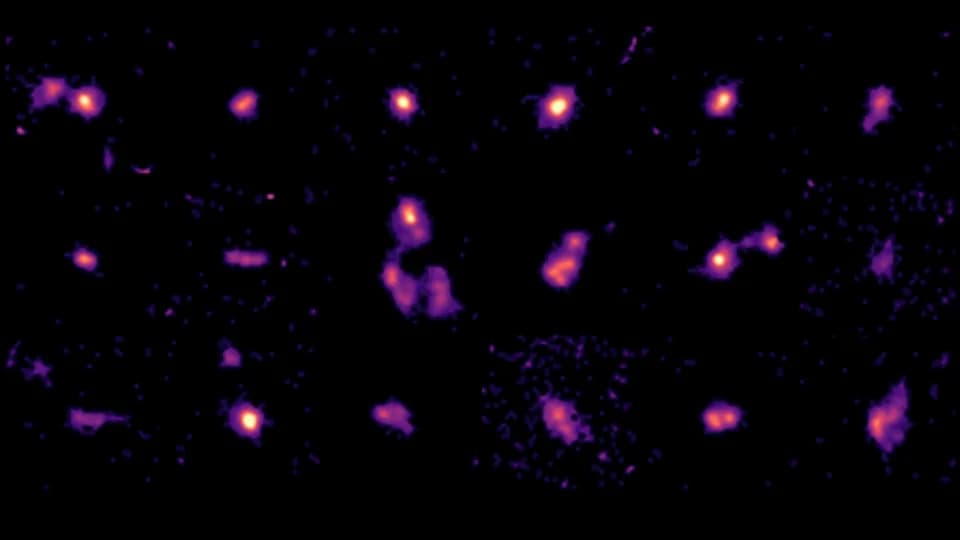
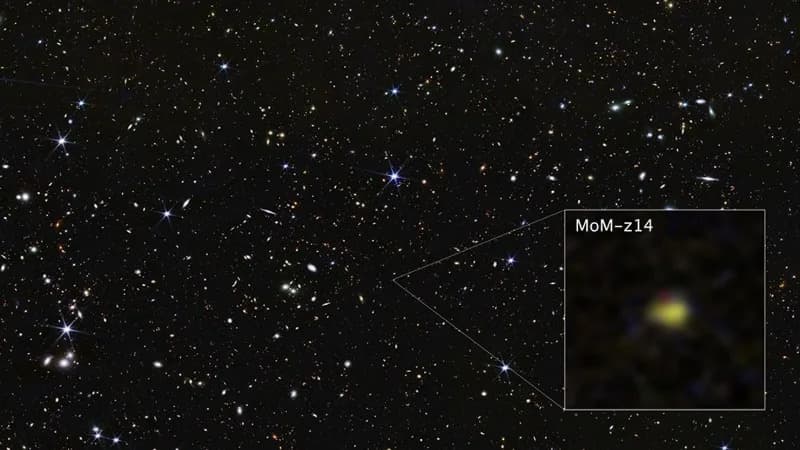
A surprising discovery over the last decade is that supermassive black holes already existed when the universe was only a few hundred million years old. Their rapid growth and enormous masses conflict with simple models where black holes form as small remnants of collapsed stars and grow slowly by accreting matter. Explaining billion-solar-mass black holes less than a billion years after the Big Bang is one of modern astrophysics' most persistent puzzles.
Direct-Collapse Seeds: A Possible Solution
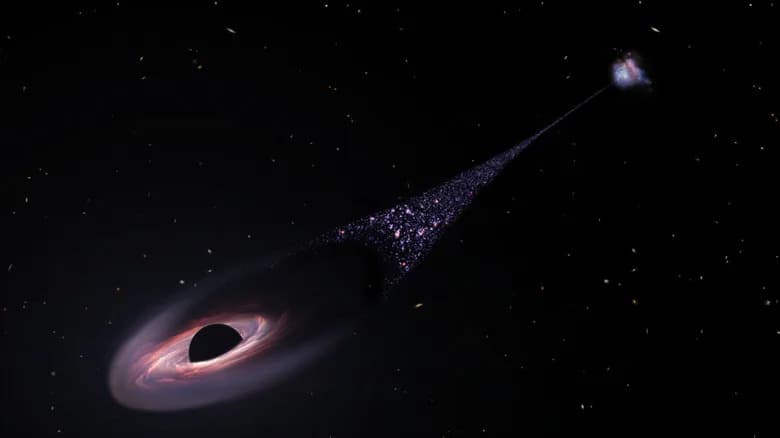
Natarajan and collaborators have proposed a pathway that bypasses early star formation: under special primordial conditions, pristine gas clouds could avoid fragmentation and collapse nearly intact into very large black holes. These direct-collapse black holes would create seeds of tens of thousands to hundreds of thousands of solar masses within a few hundred million years after the Big Bang — large enough to reach billion-solar-mass sizes within the observed timeframes.
The team predicted more than a decade ago that such objects would leave distinctive observational signatures accessible to next-generation instruments like the James Webb Space Telescope (JWST) and the Chandra X-ray Observatory. Recent observations are beginning to match those forecasts.
Evidence From JWST: UHZ1 And The "Infinity Galaxy"
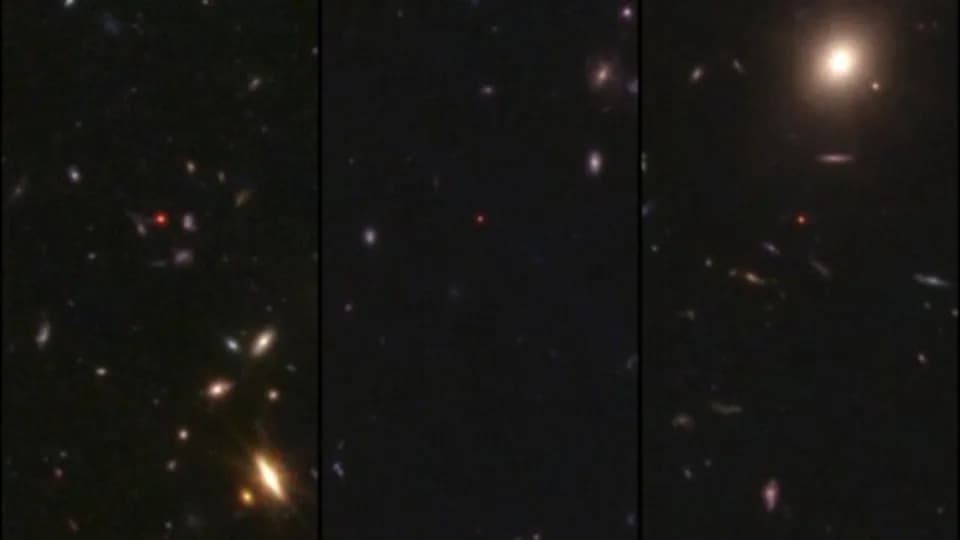
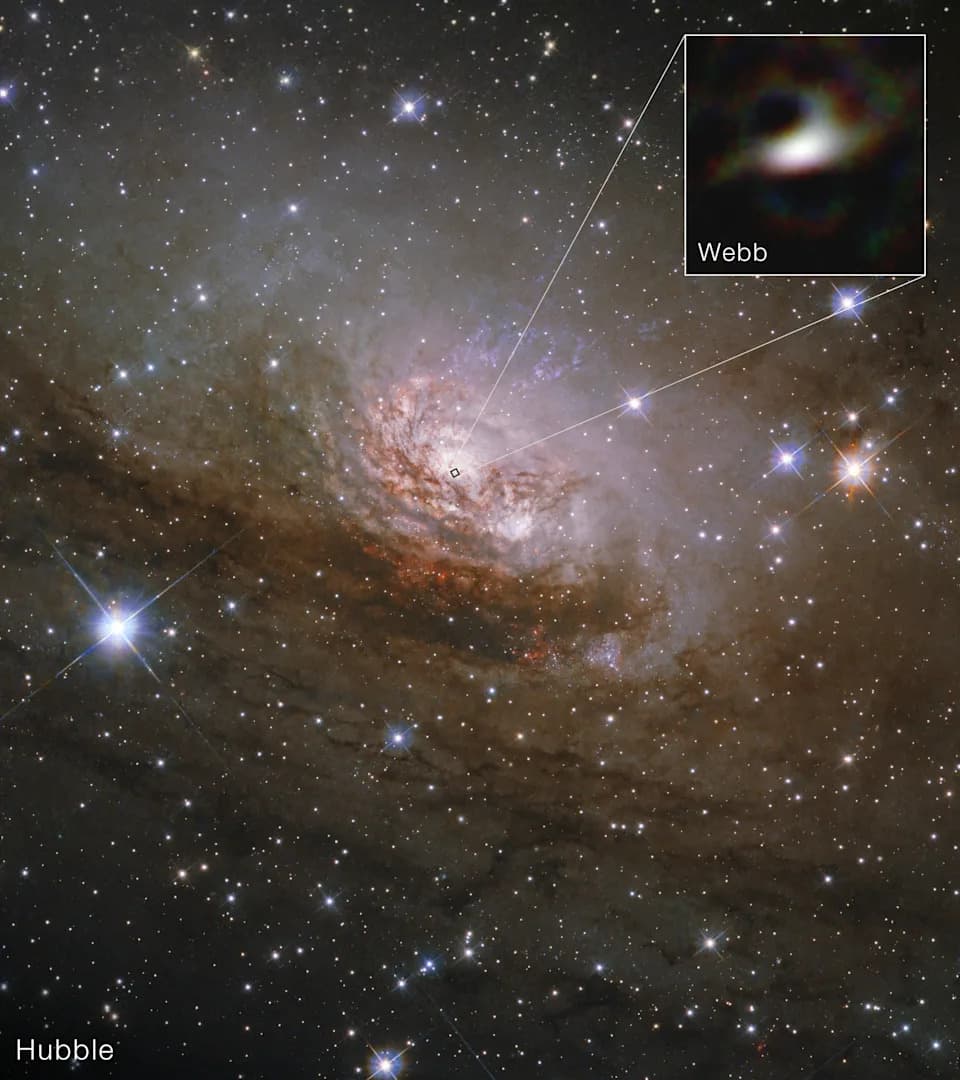
One notable case, UHZ1, shows evidence of an accreting supermassive black hole just 470 million years after the Big Bang, with a mass on the order of ~10 million solar masses. Another compelling system — nicknamed the Infinity Galaxy — features two compact galactic nuclei encircled by ring-like structures likely produced by a head-on collision between disk galaxies. Between those nuclei lies a supermassive black hole suspended in a large reservoir of gas, a configuration consistent with formation by the direct collapse of dense, turbulent gas triggered by the collision.
"It's a thrill," Natarajan said, "to be around and, within one career lifetime, to have had the fortune of making predictions that were testable, have been tested, and have been validated."
Beyond the technical achievement, Natarajan emphasized the broader philosophical impact: studying cosmology and black holes fosters a sense of cosmic humility and helps us reconstruct the story of our origins by looking back in time.
As JWST and other observatories continue to probe the early universe, astronomers will refine models of how the first massive black holes formed and grew. Whether direct collapse is the dominant pathway or one of several routes, the combination of theory and observation is rapidly illuminating a question that once seemed nearly intractable.
Help us improve.