Scientists led by Pieter van Dokkum report the first confirmed runaway supermassive black hole, with a mass of about 20 million suns and moving at roughly 2.2 million mph (~980 km/s). Initially spotted in a 2023 Hubble image, the object was confirmed when JWST imaging revealed a characteristic supersonic bow shock. The paper argues the SMBH was likely ejected by a gravitational-wave recoil "velocity kick," though three-body interactions remain possible. The finding is important for understanding SMBH dynamics and remains subject to peer review.
First Confirmed 'Runaway' Supermassive Black Hole — 20 Million Suns Fleeing Its Galaxy at ~2.2 Million MPH
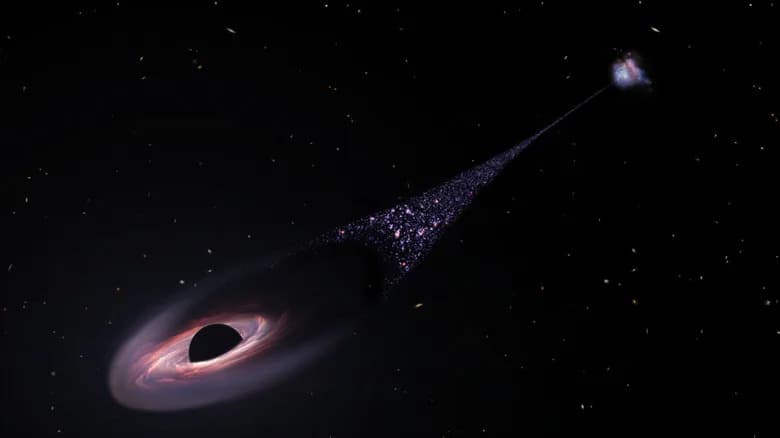
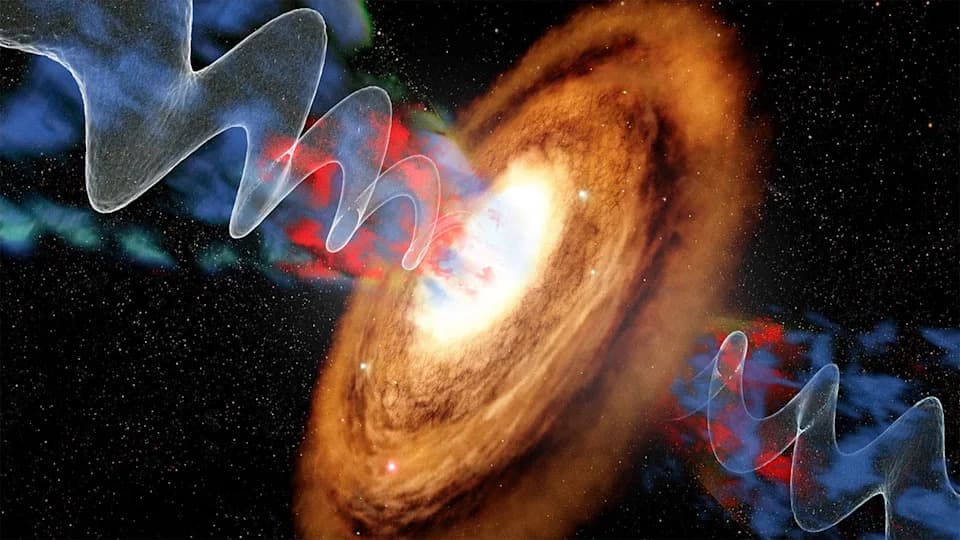
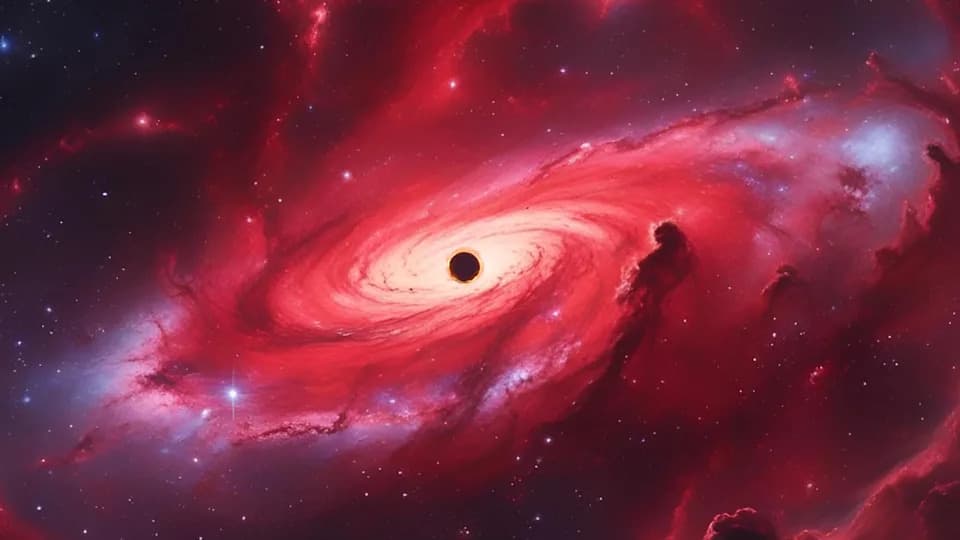
Artist's impression of a runaway black hole - NASA, ESA, Leah Hustak (STScI)
Researchers led by Yale astronomer Pieter van Dokkum report the first confirmed detection of a "runaway" supermassive black hole (SMBH). The object is estimated to have a mass of about 20 million solar masses and is receding from its host galaxy at roughly 2.2 million miles per hour (≈980 km/s), leaving a long wake of gas and newly formed stars in its path.
How it was found
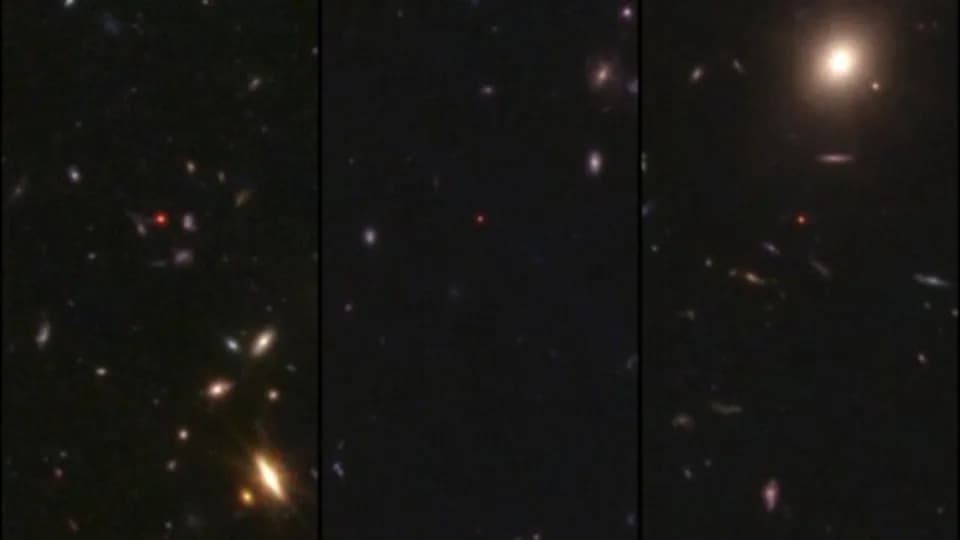
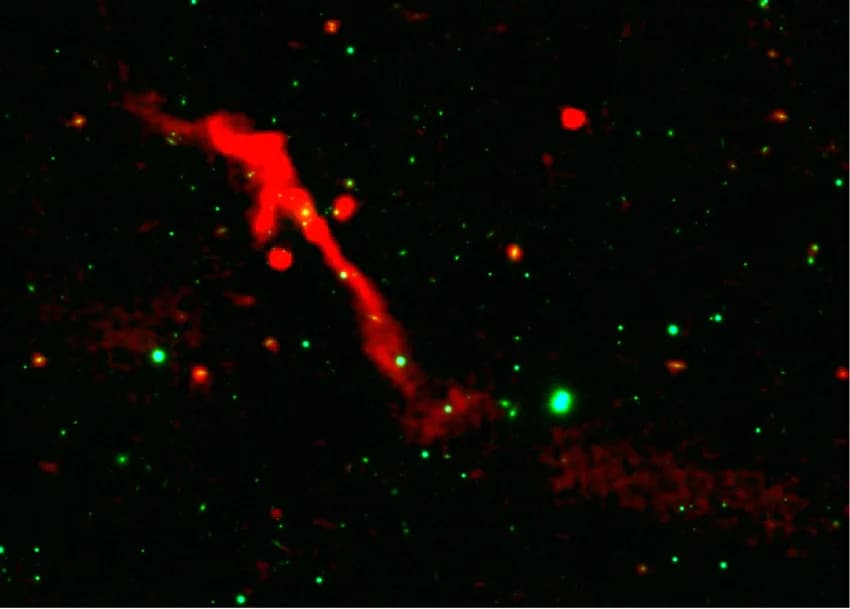
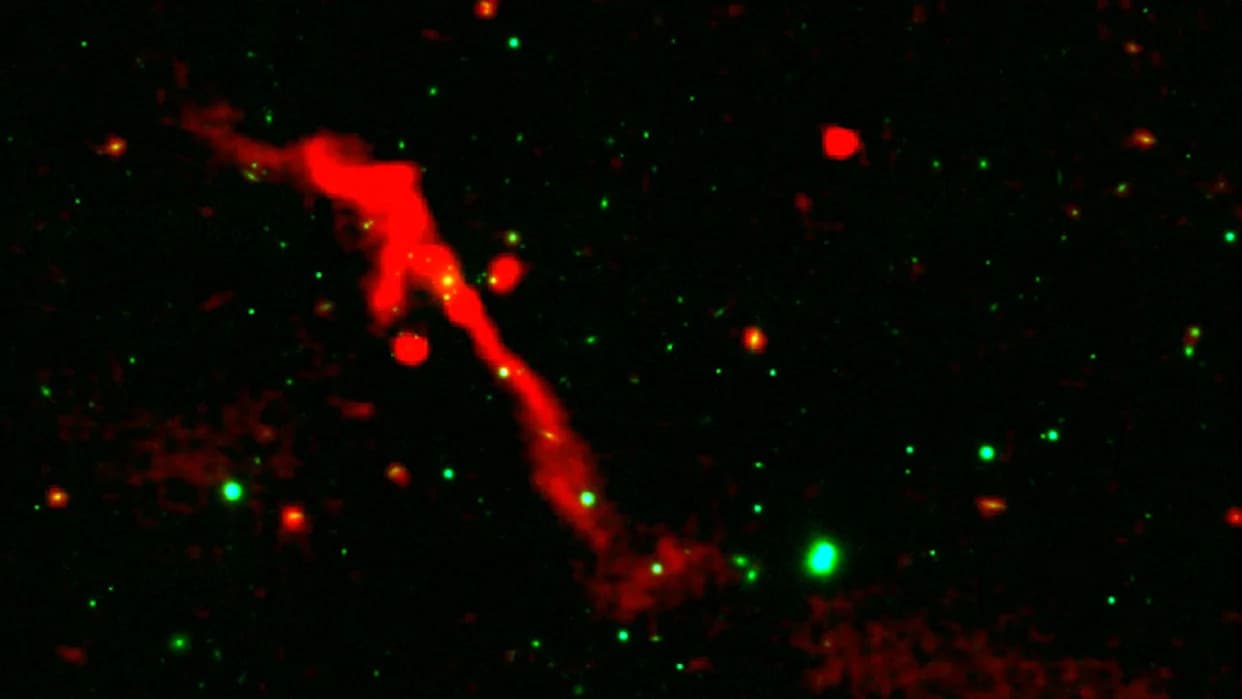
The candidate was first flagged in 2023 from a Hubble Space Telescope image, where a thin linear feature extending from a galaxy's center suggested something unusual. The team published an initial report in The Astrophysical Journal Letters that year describing the unusual trail and its likely origin.
JWST confirmation
To test their hypothesis the researchers used the James Webb Space Telescope (JWST). JWST's high-resolution imaging revealed a distinct bow shock at the object's leading edge — a classic sign of a supersonic body plowing through ambient gas. That bow-shock signature provides strong, direct evidence that the SMBH is moving rapidly away from the galaxy and interacting with surrounding material.
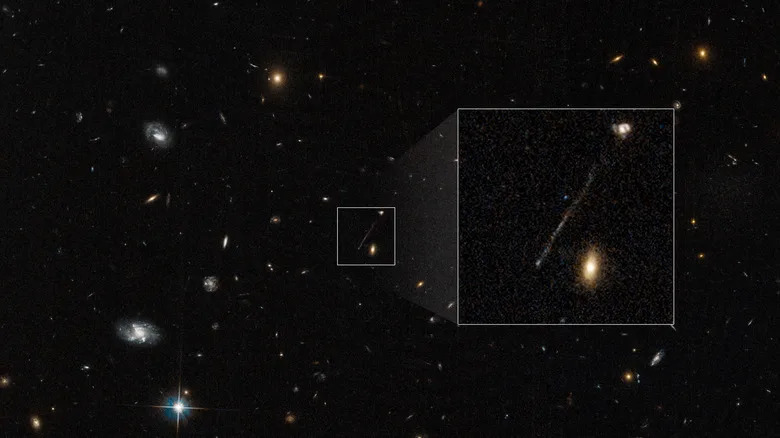
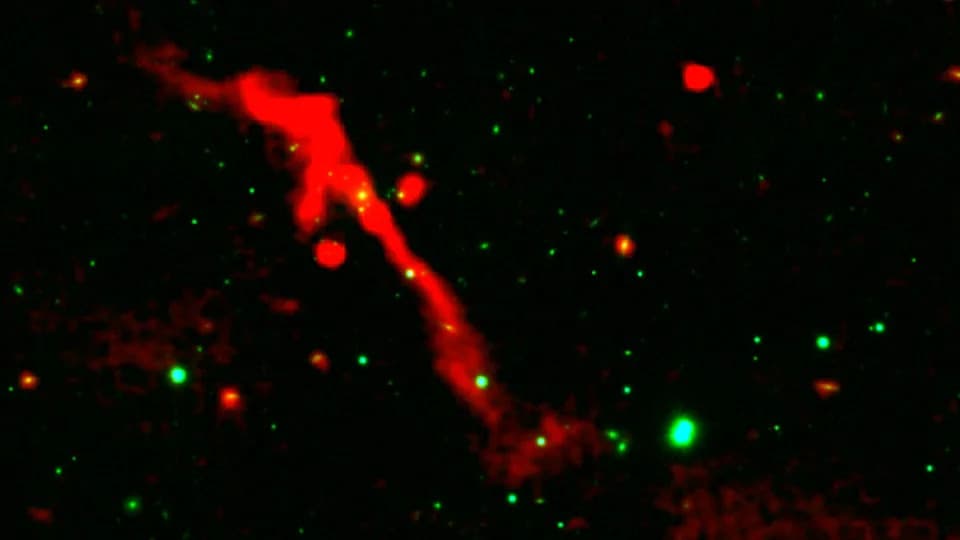
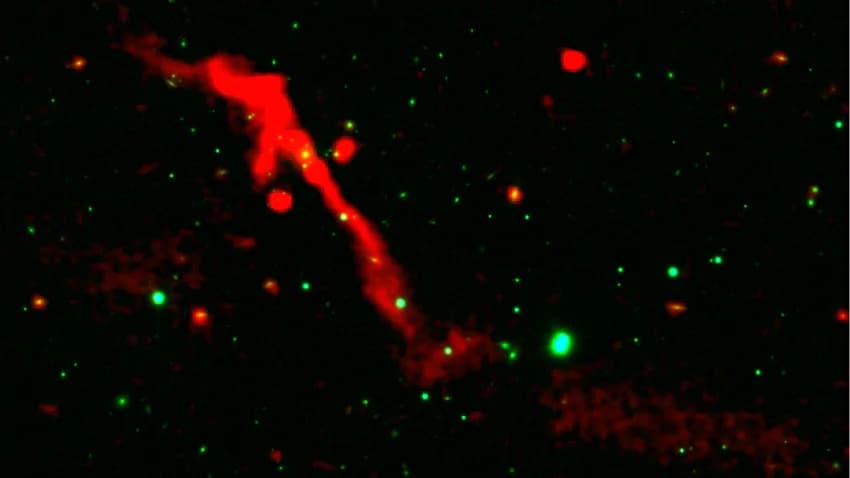
Hubble Space Telescope image of RCP28, with runaway supermassive black hole trail magnified - NASA, ESA, Pieter van Dokkum (Yale); Image Processing: Joseph DePasquale (STScI)
"We interpret the feature as a very massive black hole that was ejected from the galaxy, leaving a trail of gas and newly formed stars in its wake," van Dokkum told Live Science.
What could have ejected it?
The December 2025 paper, uploaded to arXiv, argues the SMBH was likely given a "velocity kick" — most plausibly by gravitational-wave recoil that followed the coalescence of two supermassive black holes. Alternatively, a chaotic three-body interaction among multiple SMBHs could have flung one out of the system. In either case, strong gravitational interactions alter orbits and can eject a black hole at very high speed.
Context and implications
Supermassive black holes remain a major open question in astrophysics: astronomers are confident most large galaxies host SMBHs, but how they form and grow so massive so quickly is still debated. A confirmed runaway SMBH gives astronomers a rare laboratory to study SMBH dynamics, gravitational-wave recoil effects, and how ejection events can influence galaxy evolution.
The team notes several other candidate displaced SMBHs — for example, a massive black hole reported in the dwarf galaxy MaNGA 12772-12704, offset by about 1 kiloparsec — but van Dokkum's group currently reports the only JWST-confirmed case. The result is significant but remains subject to peer review.
Source: Paper by Pieter van Dokkum et al., "JWST Confirmation of a Runaway Supermassive Black Hole via its Supersonic Bow Shock," uploaded to arXiv (December 2025); initial candidate reported in 2023 Hubble observations and an ApJ Letters communication.
Help us improve.