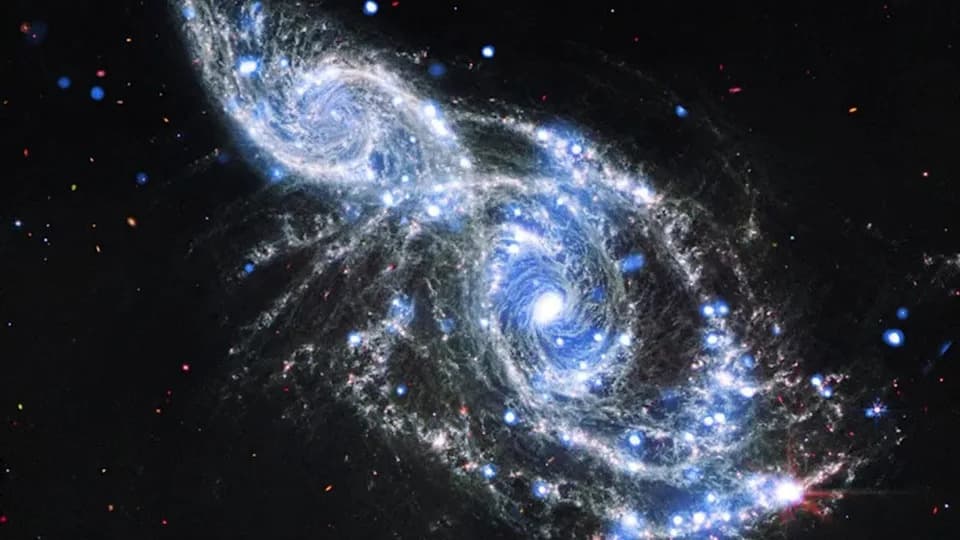
The James Webb Space Telescope found that roughly 87% of the hot-dust infrared emission near a supermassive black hole in the Circinus Galaxy originates from dust lining the inner surface of the torus, not from dusty outflows. Webb observations from July 2024 and March 2025 — using the NIRISS Aperture Masking Interferometer — produced twice-sharper, high-contrast infrared images that resolved the emission's origin. These results, published in Nature Communications, offer a new observational benchmark for studying active galactic nuclei.
Webb Reveals Source of Infrared Light Around Nearby Supermassive Black Hole
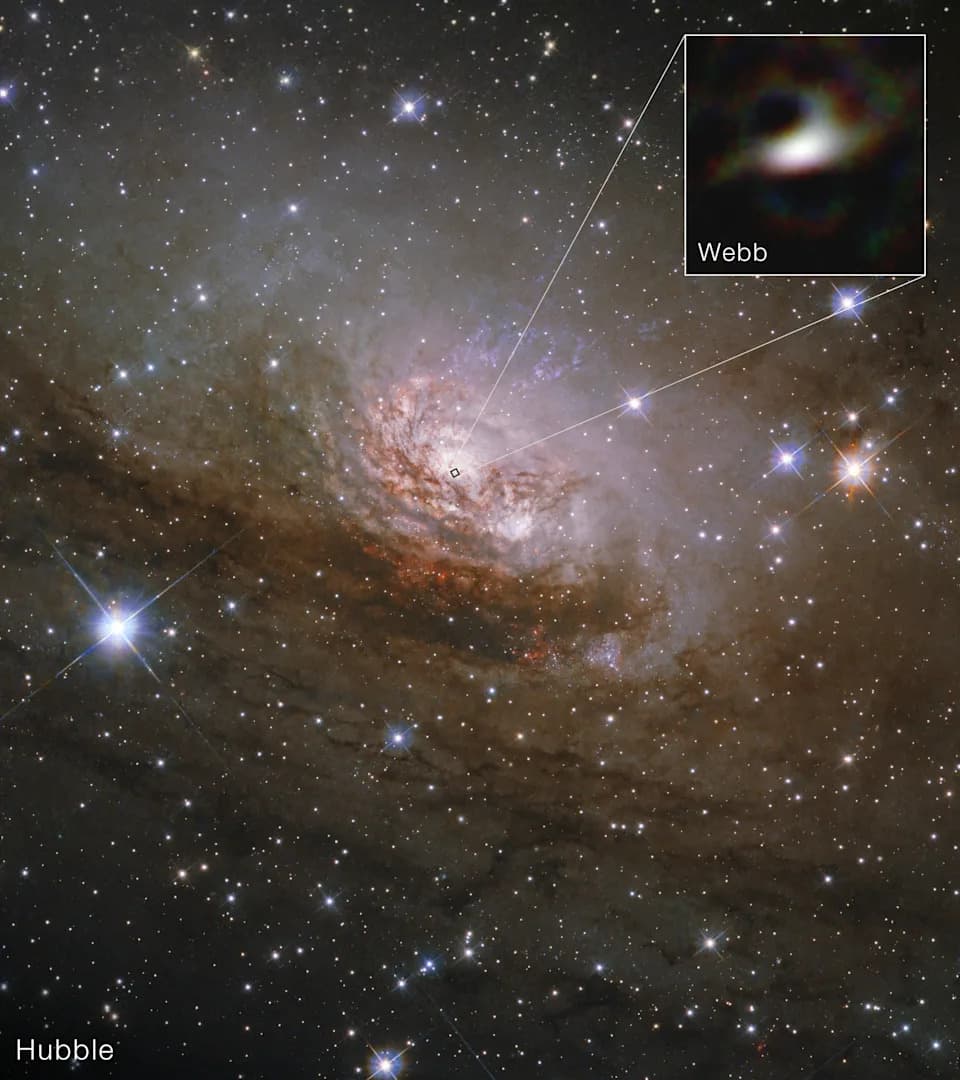
NASA’s Hubble Space Telescope image shows a full view of the Circinus galaxy. The inset image, from the James Webb Space Telescope, is the sharpest image of the black hole's surroundings ever taken by the telescope.
The James Webb Space Telescope has pinpointed where nearly all the infrared emission near a supermassive black hole in the Circinus Galaxy originates, overturning earlier ideas that dusty outflows were the main source.
Key Discovery
New Webb observations taken in July 2024 and March 2025 and published in the Jan. 13 issue of Nature Communications show that about 87% of the hot-dust infrared emission comes from dust very close to the black hole — specifically the heated inner surface, or "funnel," of the torus that surrounds the accreting core. Less than 1% of the measured infrared light is attributable to hot, dusty outflows.
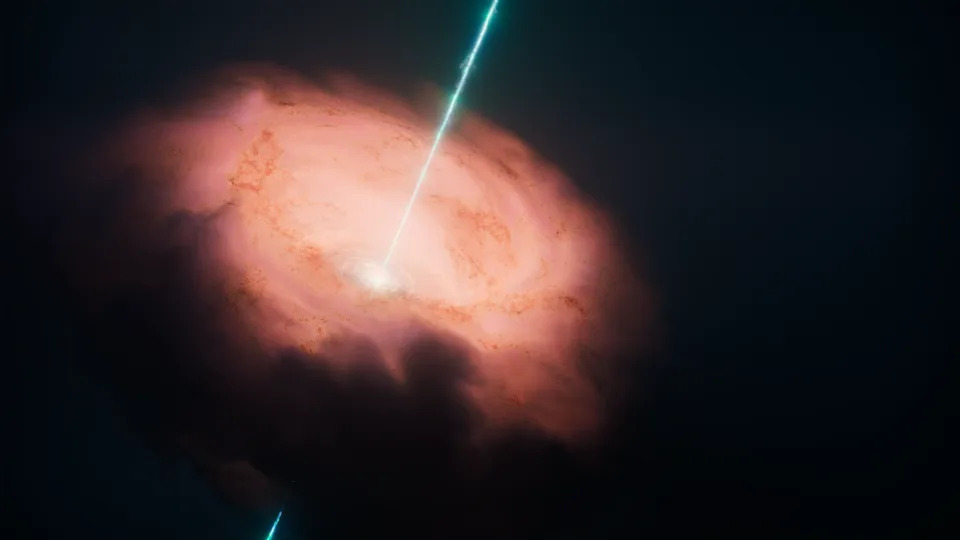
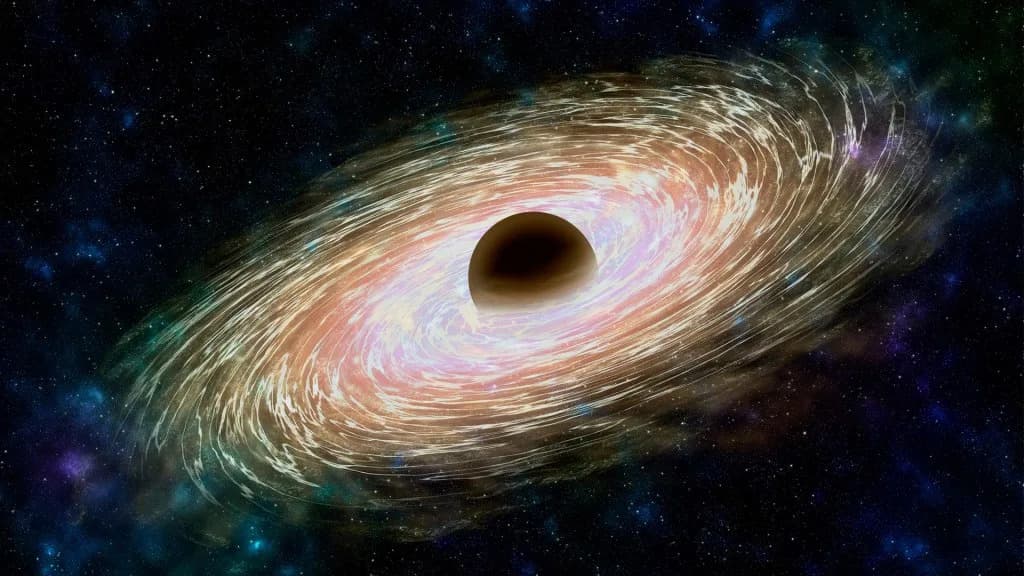
The illustration of the black hole in the Circinus galaxy shows how the black hole is brightest closest to the center, a finding from NASA’s James Webb Space Telescope. The beam shooting out represents a jet stream of energized material from the black hole.
How Webb Made This Possible
These measurements relied on Webb's Near-Infrared Imager and Slitless Spectrograph (NIRISS) used in its Aperture Masking Interferometer (AMI) mode. AMI provides higher-contrast, higher-resolution infrared data — the team reports it produced images roughly twice as sharp for this study — allowing astronomers to separate compact emission near the black hole from more extended galactic dust.
What This Means
The results indicate that, at least for the Circinus Galaxy's active nucleus, most infrared output originates in a compact, dusty structure feeding the black hole rather than in material blown away by outflows. That finding provides a new observational template for interpreting infrared signals from other active galaxies, though researchers caution that different systems may behave differently.
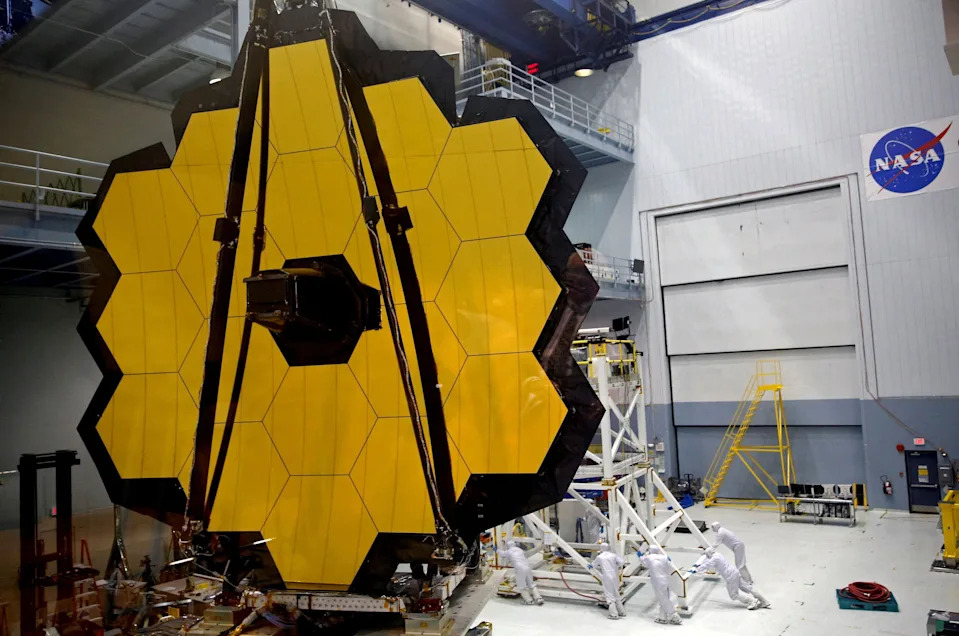
The James Webb Space Telescope Mirror is seen during a media unveiling at NASA’s Goddard Space Flight Center at Greenbelt, Maryland November 2, 2016.REUTERS/Kevin Lamarque/File Photo
"Although Circinus is a prototypical active galaxy, the family of active galaxies are very broad. We need to study all the different stages of active galaxies to make a general statement," said lead author Enrique Lopez Rodriguez (University of South Carolina).
Related Research
A separate study published Jan. 5 in Nature Astronomy used NICER X-ray observations from the International Space Station together with MeerKAT radio data to show that black holes can alternate between powerful jets and wide winds — a kind of energetic tug of war that redistributes matter and energy around the black hole.
Why It Matters
Understanding where infrared emission originates helps astronomers reconstruct the immediate environment of supermassive black holes — the structure of the torus and accretion flow — and improves models of how these objects grow and affect their host galaxies. Webb's high-contrast imaging mode opens a path to surveying more active galactic nuclei with similar precision.
Source: Findings reported in Nature Communications (Jan. 13) and related work in Nature Astronomy (Jan. 5). Data were collected by the James Webb Space Telescope (NIRISS AMI). The Circinus Galaxy lies about 13 million light-years away.
Help us improve.