A large pooled analysis of 3,737 cognitively healthy adults (10,343 MRI scans; 13,460 memory tests) links age-related episodic memory decline to tissue loss across multiple brain regions rather than damage to a single area. Associations strengthen after age 60 and are most pronounced in people whose brains shrink faster. APOEε4 carriers show accelerated decline but follow similar overall trajectories, suggesting early, multi-region interventions may help preserve memory.
10,000 Brain Scans Reveal Why Episodic Memory Worsens With Age — And What Might Help

Human brain dissolving into squares
Episodic memory — the ability to recall specific events from our past — commonly deteriorates with age. A new large-scale analysis led by researchers at the University of Oslo offers the most detailed picture yet of how structural brain changes across the lifespan relate to that decline.
Study Overview
The investigators pooled longitudinal data from 3,737 cognitively healthy adults, combining 10,343 MRI scans and 13,460 memory assessments drawn from multiple long-running cohorts. Their integrated approach allowed them to map brain-structure changes and memory performance across many decades.
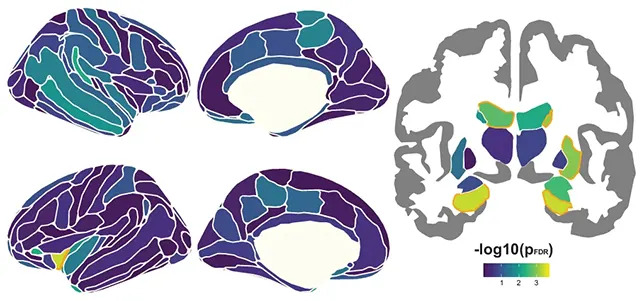
The researchers looked for links between brain structural changes and memory decline. (Vidal-Piñeiro et al.,Nat. Commun., 2025)
Key Findings
Reductions in brain tissue volume across multiple regions were associated with poorer episodic memory. While the hippocampus — a region long implicated in memory — was important, memory decline did not hinge on a single area. Instead, a distributed pattern of shrinkage across several brain regions better explained individual differences in episodic memory performance.
The relationship between brain atrophy and memory grew stronger with age, becoming markedly clearer after about age 60. People whose brains were shrinking faster than average showed the steepest declines in episodic memory.

Audition now for ScienceAlert's Casting Call
Carriers of the APOEε4 gene — a well-known genetic risk factor for Alzheimer’s disease — experienced more rapid tissue loss and steeper memory decline than noncarriers. Importantly, however, the overall time course and pattern of decline were similar for carriers and noncarriers, suggesting shared underlying mechanisms.
"Cognitive decline and memory loss are not simply the consequence of aging, but manifestations of individual predispositions and age-related processes enabling neurodegenerative processes and diseases," said Alvaro Pascual-Leone of the Marcus Institute for Aging Research (Harvard Medical School), commenting on the study.
Implications
These results suggest that episodic memory decline is intertwined with normal aging via broad structural vulnerability rather than being driven solely by one region or one gene. For treatments and prevention, the findings imply that multi-target approaches addressing several brain regions — and started early in the aging process — may be more effective than single-target strategies. Because APOEε4 carriers and noncarriers share similar trajectories, many interventions are likely to benefit both groups.
What Comes Next
The study points toward more personalized risk profiling (combining genetics, brain imaging, and cognitive testing) to identify individuals at higher risk earlier. Future work will be needed to test which interventions (lifestyle, pharmacologic, cognitive training, or multimodal combinations) can slow structural decline and preserve episodic memory.
Publication: The full analysis was published in Nature Communications.
Help us improve.