Researchers report that noninvasive auditory stimulation at 40Hz can mobilize toxic Alzheimer’s-linked proteins from the brain into cerebrospinal fluid (CSF) in aged rhesus monkeys, an effect that persisted for weeks after treatment ended. The study, led by scientists at the Chinese Academy of Sciences and published in PNAS, strengthens earlier mouse findings and raises the possibility of a low-cost physical therapy to complement existing Alzheimer’s approaches.
Study Design and Key Findings
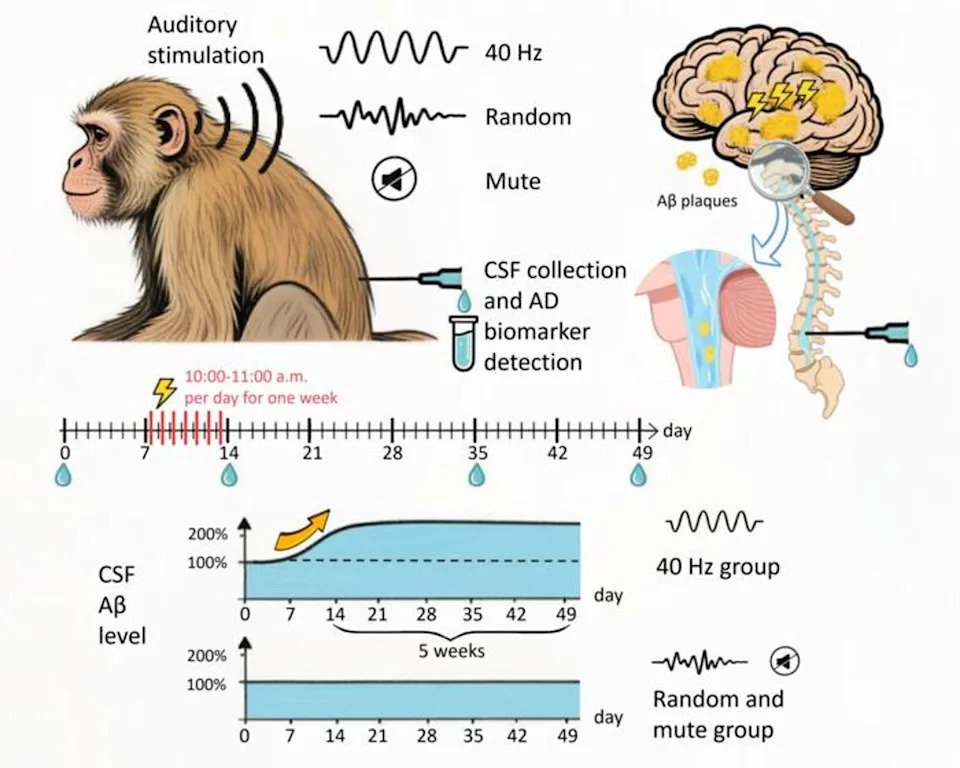
The team tested nine rhesus macaques aged 26–31, animals that had developed widespread spontaneous amyloid-β (Aβ) protein clusters in their brains—closely mirroring a hallmark of human Alzheimer’s disease. One cohort received one hour of 40Hz auditory stimulation each day for seven consecutive days.
Illustration of 40Hz auditory stimulation of aged monkeys (KIZ)
After the week-long intervention, concentrations of key Aβ proteins in the animals’ CSF rose to roughly three times baseline (an increase the authors report as more than 200%). Importantly, elevated CSF Aβ levels were still detectable when measured five weeks after the treatment ended, indicating a sustained effect.
What This Suggests
These results are consistent with prior mouse studies and suggest that rhythmic 40Hz stimulation may promote movement or clearance of toxic amyloid proteins from brain tissue into CSF. Because the approach is noninvasive and inexpensive compared with some antibody-based therapies, it could offer a complementary treatment route—if translated safely and effectively to humans.
Limitations and Next Steps
While findings in primate models are encouraging, several important caveats remain. The study measured increased Aβ in CSF, which likely reflects mobilization rather than immediate removal of brain deposits—long-term clinical benefit is unproven. Safety, optimal dosing, mechanism of action, and whether similar effects occur in people with Alzheimer’s disease require careful clinical trials. The authors call for more research to determine efficacy, durability, and any potential side effects in humans.
Bottom Line: 40Hz auditory stimulation produced a rapid and sustained rise in CSF Aβ in aged macaques, supporting further investigation of rhythmic sound stimulation as a noninvasive adjunct strategy to target Alzheimer’s pathology.