
In 2025 scientists captured extraordinary deep‑sea images and footage, including the first in‑situ video of a colossal squid and the formal identification of a new nudibranch family, Bathydevius caudactylus. Expeditions exposed long‑lived Antarctic benthic communities after an iceberg calving and documented rich biodiversity in deep submarine canyons off Chile and Argentina. Researchers also recorded striking animals such as an anglerfish, a siphonophore at 1,250 meters, and a translucent telescope octopus.
Six Otherworldly Deep‑Sea Discoveries of 2025 — New Species, Colossal Squid Footage and Alien Antarctic Communities

A large sponge, a cluster of anemones, and other life is seen nearly 230 meters deep at an area of the seabed that was very recently covered by the George VI Ice Shelf in Antarctica. Sponges can grow very slowly, sometimes less than two centimeters a year, so the size of this specimen suggests this community has been active for decades, perhaps even hundreds of years.ROV SuBastian/Schmidt Ocean Institute
The deep ocean continues to surprise us. In 2025, researchers captured spectacular images and footage of previously unseen and rarely observed life — from a newly identified nudibranch family to the first in‑situ video of a colossal squid. Below are six of the most striking discoveries that reveal how much of the deep sea remains unexplored.
1. A Long‑Mystery Nudibranch Identified
For more than 20 years, scientists at the Monterey Bay Aquarium Research Institute occasionally recorded a small, translucent animal drifting in the ocean's "midnight zone." The gelatinous creature uses a hood around its head to trap prey and bears detachable tentacles; both its hood and tail are dotted with bioluminescent blue‑green spots. In 2025 researchers determined the organism is not an alien worm but a nudibranch (sea slug) from an entirely new family, formally named Bathydevius caudactylus.
ROV SuBastian/Schmidt Ocean Institute
2. First Ever In‑Situ Footage Of A Colossal Squid
Colossal squids have been known to science for about a century and can reach up to 23 feet in length, but they had never been filmed alive in their natural habitat — until Schmidt Ocean Institute scientists recorded the first video at roughly 2,000 feet (about 600 meters) down in the remote South Atlantic. The individual on camera was a juvenile, roughly one foot long, offering rare behavioral insight into this elusive group.
3. Antarctic Seabed Reveals Long‑Lived Communities
After an iceberg the size of Chicago calved from the George VI Ice Shelf on January 13, Schmidt Ocean Institute researchers aboard Falkor (too) explored the newly exposed seabed. They documented a vibrant assemblage of anemones, sea spiders, icefish, octopuses and large sponges — some specimens that may represent species new to science. Because sponges can grow very slowly (sometimes under 2 cm per year), the size of the sponge observed at nearly 230 meters implies the community persisted for decades or even centuries beneath the ice.
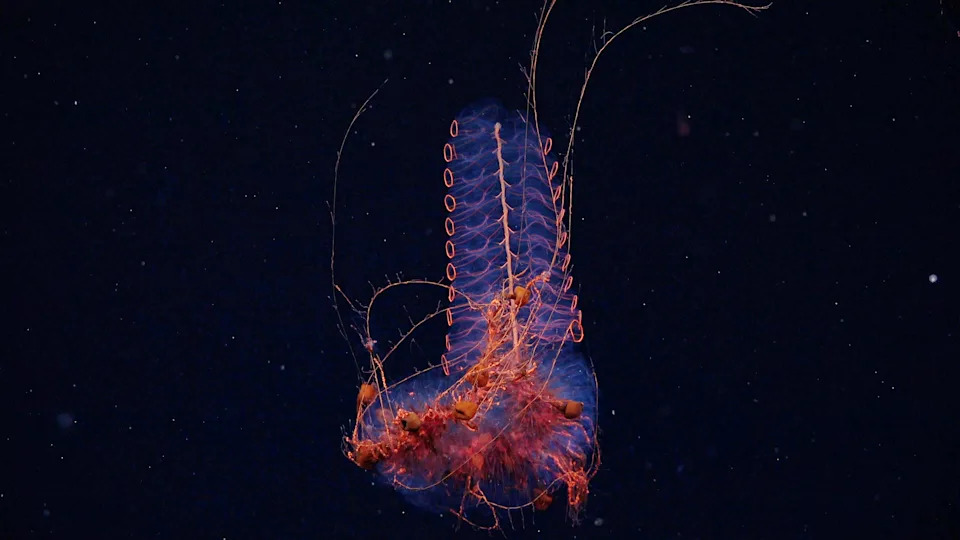
A siphonophore documented at 1,250 meters deep in the Mar del Plata Canyon.ROV SuBastian/Schmidt Ocean Institute (CC BY-NC)
“There was a sense of going into a complete unknown,” said Sasha Montelli, co‑chief scientist on the expedition and researcher at University College London.
4. Rich Biodiversity In Submarine Canyons Off Chile And Argentina
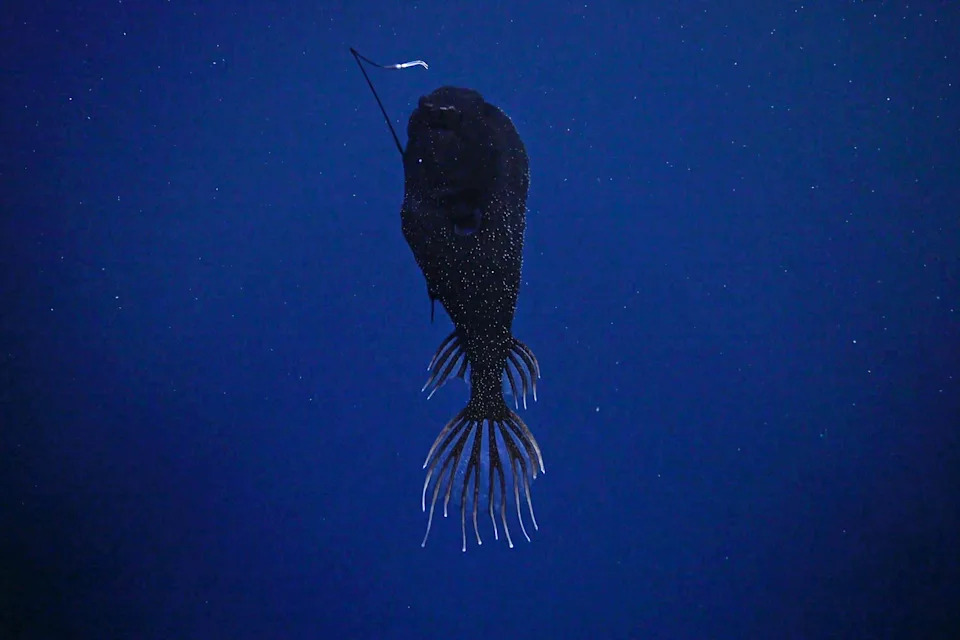
On missions investigating methane seeps off Chile and deep canyons off Argentina, ROV surveys revealed dramatic, nutrient‑rich habitats carved by strong currents. These flows funnel sediments and food like a moving buffet, supporting predators and delicate drifters. One striking image captured an anglerfish in the dark canyon; researchers are still working to identify its exact species.
5. Color, Camouflage And Delicate Drifters
A delicate siphonophore was filmed at about 1,250 meters in the Mar del Plata Canyon. Two opposing currents — a warm, salty flow from the tropics and a cold Antarctic stream — converge in that region, creating exceptionally high biodiversity. Many deep animals display peachy‑pink colors because red light does not penetrate far; that coloration is effectively invisible at depth and acts as camouflage.
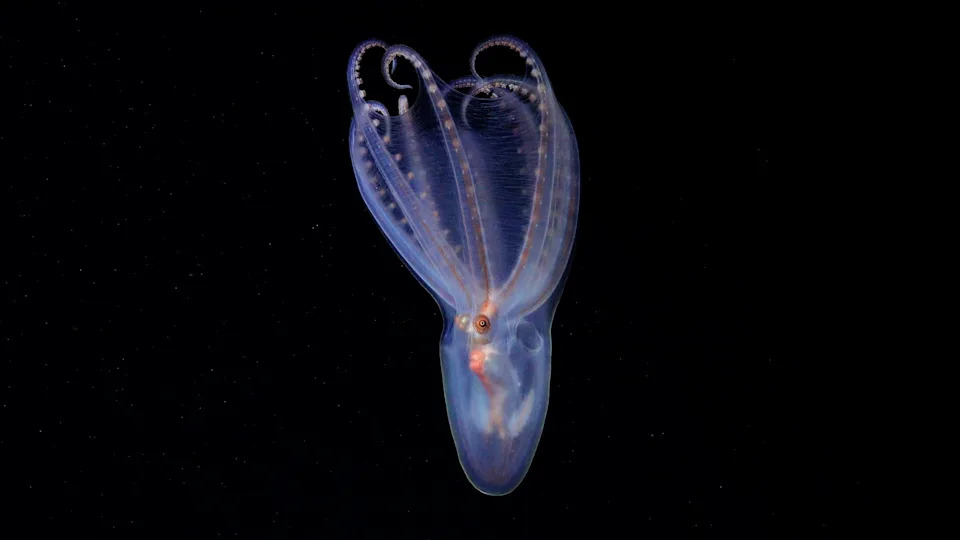
A translucent telescope octopus floats in the deep sea.ROV SuBastian/Schmidt Ocean Institute (CC BY-NC)
6. A Translucent Telescope Octopus With A Pop‑Culture Twist
One of the most memorable photographs from the year shows a translucent telescope octopus floating upside down in a deep Argentine canyon. Its posture and expression prompted an affectionate comparison to Lady Cassandra from Doctor Who, a lighthearted cultural reference that highlights just how alien deep‑sea life can appear to human eyes.
Credits: Many images and observations described here were captured by ROV SuBastian and researchers from the Schmidt Ocean Institute and the Monterey Bay Aquarium Research Institute.


