SETI researchers used nearly daily observations from the Allen Telescope Array to measure how interstellar gas distorts radio pulses from PSR J0332+5434. They found scintillation-induced timing delays of tens of nanoseconds — small but important for pulsar timing arrays hunting low-frequency gravitational waves. The work also gives SETI a way to distinguish genuine extraterrestrial signals from Earth-based interference by identifying expected scintillation signatures.
How SETI Used a Pulsar's 'Twinkle' to Sharpen Cosmic Clocks — And Why It Matters

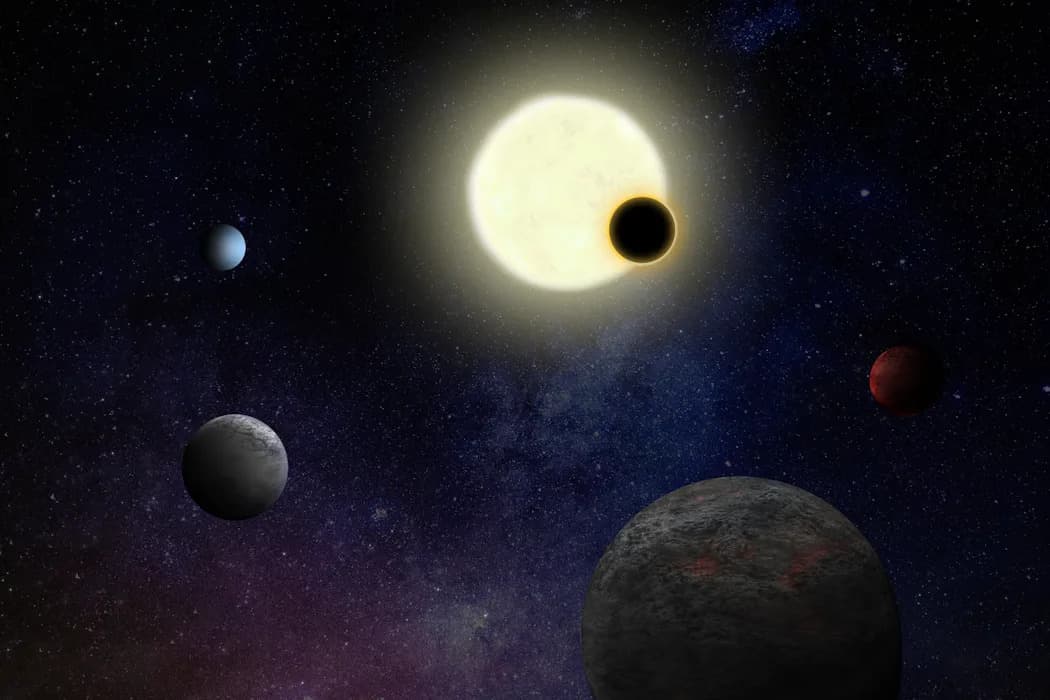
When viewed from Earth, pulsars appear as flickering stars. | Credit: MARK GARLICK/SCIENCE PHOTO LIBRARY via Getty Images
Researchers at the SETI Institute have learned to interpret the faint "twinkle" in radio pulses from a distant pulsar, revealing how interstellar gas subtly distorts signals as they cross the galaxy. Their measurements quantify tiny timing shifts that matter for ultra-precise experiments that treat pulsars as cosmic clocks.
What The Team Did
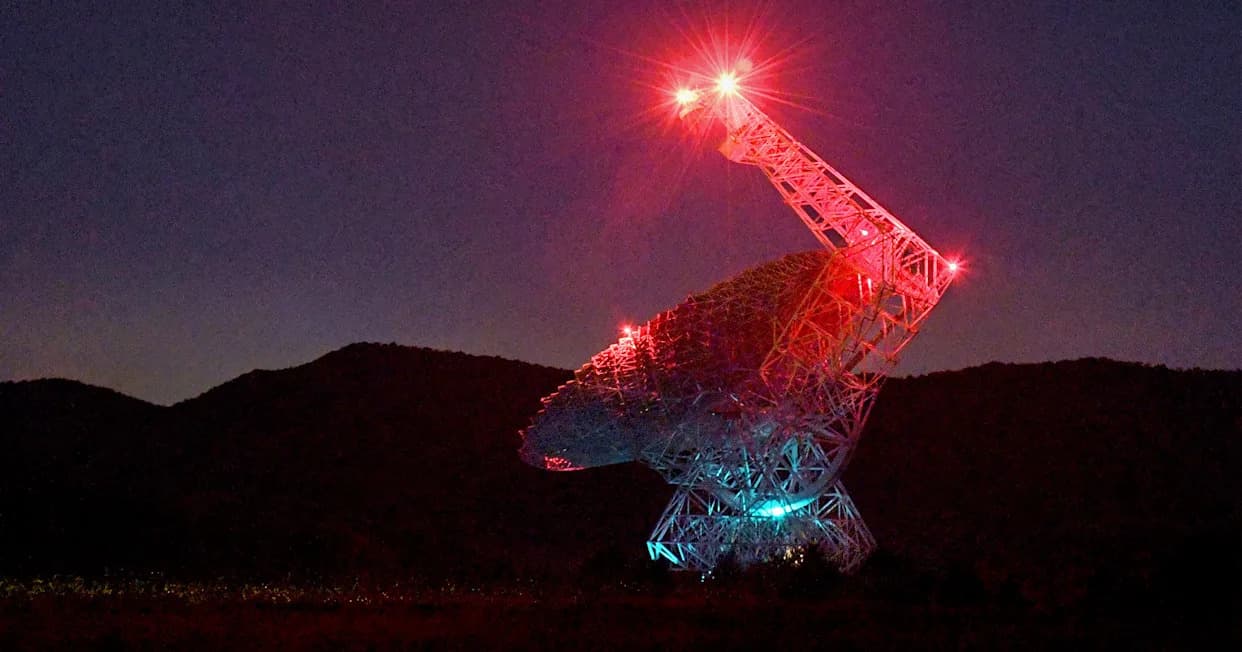
Beginning in late February 2023, a SETI team led by Grayce Brown carried out an almost daily observing campaign that ran for 10 months using the Allen Telescope Array in California. They focused on PSR J0332+5434, a fast-spinning neutron-star remnant located more than 3,000 light-years away and the brightest pulsar visible to the array. Across nearly 400 observations, the team tracked changes in the pulsar's scintillation pattern — the radio equivalent of stellar twinkling — evolving over hundreds of days.
How Scintillation Affects Timing
As radio beams sweep from the pulsar's magnetic poles toward Earth, they pass through regions of ionized gas (mainly free electrons). Those clouds bend and scatter the radio waves, producing patches of brighter and dimmer reception across frequencies. Because the Earth, the pulsar and the intervening material are all in relative motion, these patches drift and change, slightly shifting the arrival times of pulses by tens of nanoseconds.
"Pulsars are wonderful tools that can teach us much about the universe and our own stellar neighborhood," said Grayce Brown of the SETI Institute. "Results like these help not just pulsar science, but other fields of astronomy as well, including SETI."
Why Tens Of Nanoseconds Matter
Although delays on the order of tens of nanoseconds are imperceptible to humans, they are significant for experiments that rely on pulsars as ultra-precise clocks. Pulsar timing arrays (PTAs) search for low-frequency gravitational waves by looking for correlated deviations in pulse arrival times across many pulsars. If interstellar-induced delays are not modeled and corrected, they can mask or even mimic the faint timing signatures PTAs are trying to detect.
Benefits For SETI And Future Observations
Beyond improving gravitational-wave searches, the study provides a practical tool for SETI: noticeable scintillation patterns indicate a signal that has traversed interstellar space rather than originating on or near Earth. As Brown explained to The Debrief, knowing the expected scintillation signature for this line of sight helps investigators decide whether a candidate signal is likely extraterrestrial or terrestrial interference.
The observations were part of a broader program that monitored roughly 20 pulsars after a pilot phase in late 2022. The team did not find a repeating cycle in the scintillation changes during this campaign, but they note that observing campaigns that last longer than a year could further refine models and improve corrections for interstellar distortion.
The study was published on Dec. 10, 2025, in The Astrophysical Journal.
Help us improve.