Pandora, launched Jan. 11, 2026 on a SpaceX Falcon 9 from Vandenberg, is a compact NASA exoplanet observatory built to confront stellar contamination that hampers transit spectroscopy. The mission targets the "transit light source effect," where starspots and active regions can mimic planetary atmospheric signals, including water vapor. By conducting long, repeated observations (24-hour sessions and >200 hours per target across ~10 visits), Pandora characterizes stellar variability and, when paired with JWST transit spectra, will give far more reliable measurements of exoplanet atmospheres.
Pandora Launched: A Small Telescope Tackling Stellar Noise to Sharpen Exoplanet Atmosphere Discoveries
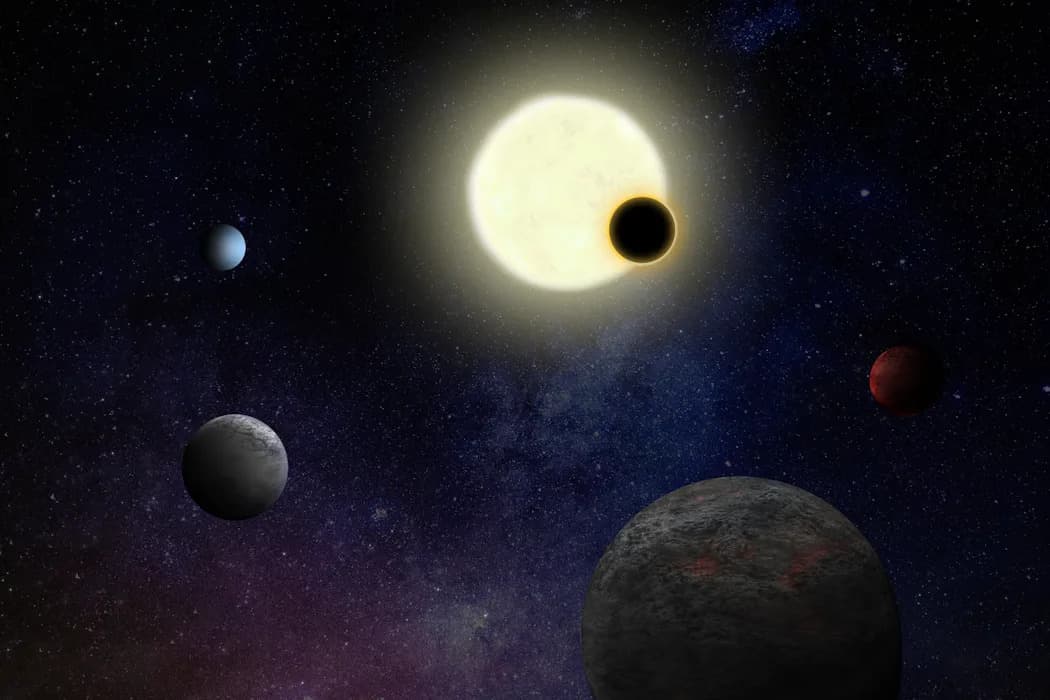
A new NASA mission will study exoplanets around distant stars.European Space Agency,CC BY-SA
On Jan. 11, 2026, I watched with a mix of concern and excitement from Vandenberg Space Force Base in California as a SpaceX Falcon 9 rocket carried NASA’s new exoplanet observatory, Pandora, into orbit.
Exoplanets—planets that orbit stars beyond our Sun—are notoriously difficult to observe. From Earth they appear as faint points of light next to host stars that are millions to billions of times brighter. That contrast makes it hard to isolate the light that has interacted with a planet’s atmosphere. Pandora is designed to work alongside and complement the James Webb Space Telescope (JWST) by characterizing the host stars themselves, so astronomers can interpret planetary signals with far greater confidence.
A primary technique for probing exoplanet atmospheres is transit spectroscopy: when a planet passes in front of its star, a sliver of starlight filters through the planet’s atmosphere and carries telltale absorption features. Like holding a glass of wine up to a candle, the filtered light can reveal fine details about composition—water vapor, hydrogen, clouds, and potentially biosignatures. This method became a powerful tool for exoplanet studies in the early 2000s.
Analogy: Trying to read that filtered light correctly requires a stable candle. If the candle flickers, your judgment can be wrong.
Beginning around 2007, astronomers increasingly recognized that stellar variability—particularly starspots (cooler, magnetically active patches) and bright active regions—can corrupt transit measurements. In 2018–2019, then-Ph.D. student Benjamin V. Rackham, astrophysicist Mark Giampapa and I published a series of papers outlining how such stellar features can seriously bias inferred planetary atmospheres. We named this problem the "transit light source effect."
Most stars are spotted and variable. The changing pattern of spots and active regions alters the spectrum and apparent color of the star during transits, and some stars even show water vapor and other absorbers in their own atmospheres—often concentrated in active regions. Those stellar signals can masquerade as planet-based features, producing false positives for molecules like water.
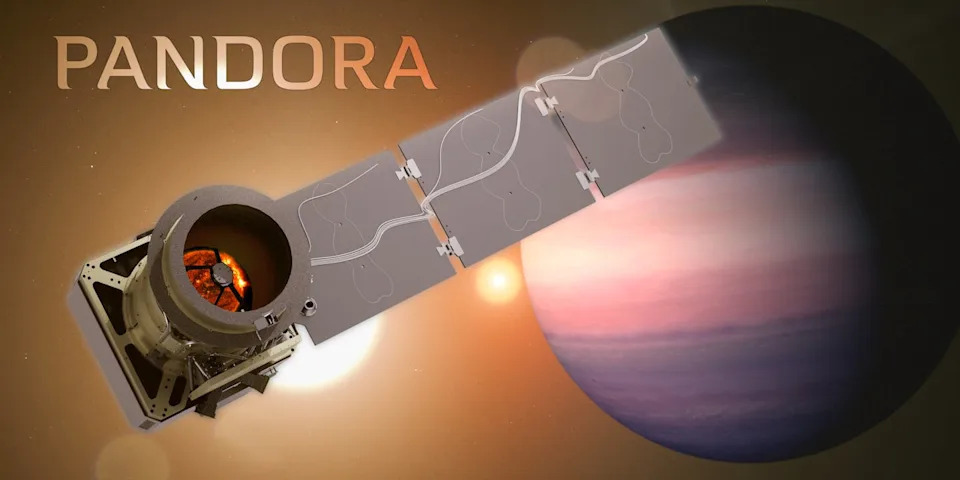
Artist’s concept of NASA’s Pandora Space Telescope.NASA's Goddard Space Flight Center/Conceptual Image Lab,CC BY
Pandora emerged after an email from NASA in 2018. Two scientists at NASA’s Goddard Space Flight Center, Elisa Quintana and Tom Barclay, proposed an unconventional plan: build a focused space telescope quickly and affordably to confront stellar contamination and support JWST. The idea was ambitious because space missions are normally complex and take many years to develop.
To achieve that goal we kept the design deliberately simple and accepted somewhat higher technical and programmatic risk. Pandora is smaller than JWST and collects less light, but it does a task Webb cannot: long-duration, repeat monitoring of host stars with both visible and infrared cameras. By staring at a star for continuous 24-hour stretches, Pandora will measure subtle changes in brightness and color as active regions rotate into and out of view and spots evolve.
Operationally, Pandora will revisit each target roughly 10 times over a year, devoting more than 200 hours to each star. While JWST rarely observes the same planet repeatedly with identical instrument setups and seldom provides extended stellar monitoring, Pandora’s repeated, long-baseline observations will make it possible to quantify how stellar variability affects transit spectra. Pandora will also observe transits directly; combining its stellar characterization with Webb’s high-sensitivity spectra will significantly improve the accuracy of exoplanet atmosphere retrievals.
After launch, Pandora entered a low Earth orbit with an orbital period of roughly 90 minutes. Blue Canyon Technologies, the mission’s primary builder, is conducting thorough systems and functional tests. About a week after launch, control of the spacecraft will transfer to the University of Arizona’s Multi-Mission Operation Center in Tucson, where the science teams will begin regular operations.
By pairing a focused, agile observatory that monitors stellar variability with powerful general-purpose facilities like JWST, Pandora reduces a critical source of uncertainty in exoplanet atmospheric studies and strengthens the search for potentially habitable worlds.
Author: Daniel Apai, Professor of Astronomy, Planetary Sciences, and Optical Sciences, University of Arizona. This article is republished from The Conversation.
Help us improve.