After 21 years and contributions from over two million volunteers, SETI@Home reduced a 12+ billion-event archive from Arecibo to a shortlist of 100 candidate radio signals. A Max Planck supercomputer and manual inspection narrowed the pool to ~1,000 promising sources before the final 100 were selected for follow-up with China’s FAST telescope. No definitive extraterrestrial transmissions have been confirmed, but two 2025 papers document the methods, sensitivity limits, and lessons that will improve future searches.
SETI@Home Narrows 21-Year Search to 100 Top Signals — FAST Now Following Up

A starry sky above the Arecibo Observatory in Puerto Rico. | Credit: University of Central Florida
After a 21-year citizen-science effort, researchers have reduced more than 12 billion candidate radio events to a shortlist of 100 top signals for follow-up observation. The work began with SETI@Home analyzing data from the Arecibo Observatory (1999–2020) and now continues with targeted checks using China's Five-hundred-meter Aperture Spherical Telescope (FAST).
Launched in 1999, SETI@Home invited the public to run free software that used spare cycles on personal computers to sift through radio data recorded by Arecibo in Puerto Rico. Although Arecibo collapsed in 2020 after a cable failure, the distributed-computing project amassed an enormous archive — more than 12 billion flagged events — thanks to more than two million volunteers across 100 countries.
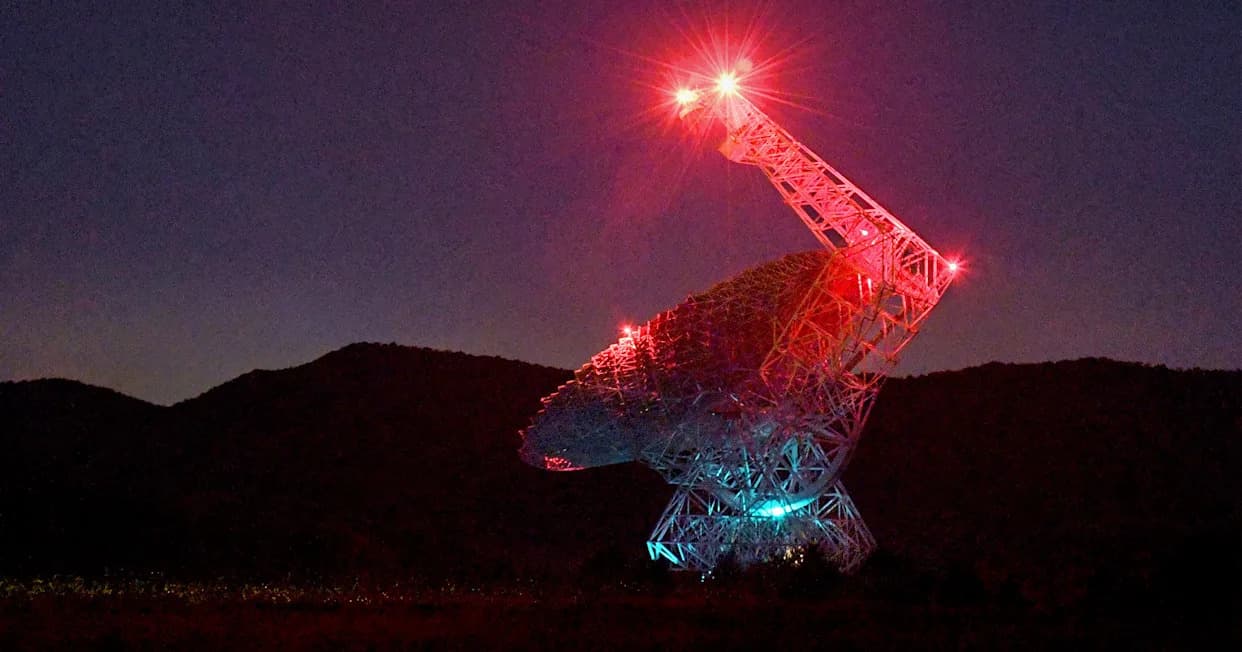
Researchers have now winnowed that enormous dataset through successive filtering steps. Using a supercomputer provided by the Max Planck Institute for Gravitational Physics, the team eliminated billions of false positives and Earth-based radio interference, narrowing the list to about one million candidate events. The most promising ~1,000 sources were inspected manually, producing a final shortlist of 100 signals that are undergoing follow-up with FAST, currently the world’s largest single-dish radio telescope.

Damage to the 305-meter telescope at Arecibo Observatory, after its collapse on Dec. 1, 2020. | Credit: Michelle Negron, National Science Foundation
The search focused largely on the neighborhood of the 21-centimeter radio wavelength — the frequency astronomers use to map hydrogen gas — because it is a natural “waterhole” where an engineered transmission might be deliberately placed to increase detectability. So far, none of the 100 candidates provide definitive evidence of transmissions from extraterrestrial intelligence.
"If we don't find ET, what we can say is that we established a new sensitivity level. If there were a signal above a certain power, we would have found it," said computer scientist and SETI@Home co-founder David Anderson. He added that the collaboration has identified procedural lessons that should guide future sky surveys.
"We are, without doubt, the most sensitive narrow-band search of large portions of the sky, so we had the best chance of finding something," said astronomer and SETI@Home project director Eric Korpela. "So yeah, there's a little disappointment that we didn't see anything."
Results and methods appear in two papers published in 2025 in The Astronomical Journal, where the team details their processing pipeline, candidate-selection criteria, and recommendations for future surveys. Advances in computing power and analysis techniques since 1999 mean that follow-up searches by FAST and other observatories will be faster and more sensitive — and the SETI community emphasizes that a missed detection remains possible.
While the 100 shortlisted signals are intriguing, they are not conclusive. The real value of the project, researchers say, lies in the improved sensitivity thresholds, the open dataset, and the lessons learned about how to run large-scale, reproducible searches for technosignatures. The hunt for extraterrestrial intelligence continues, now aided by better tools and international collaboration.
Help us improve.