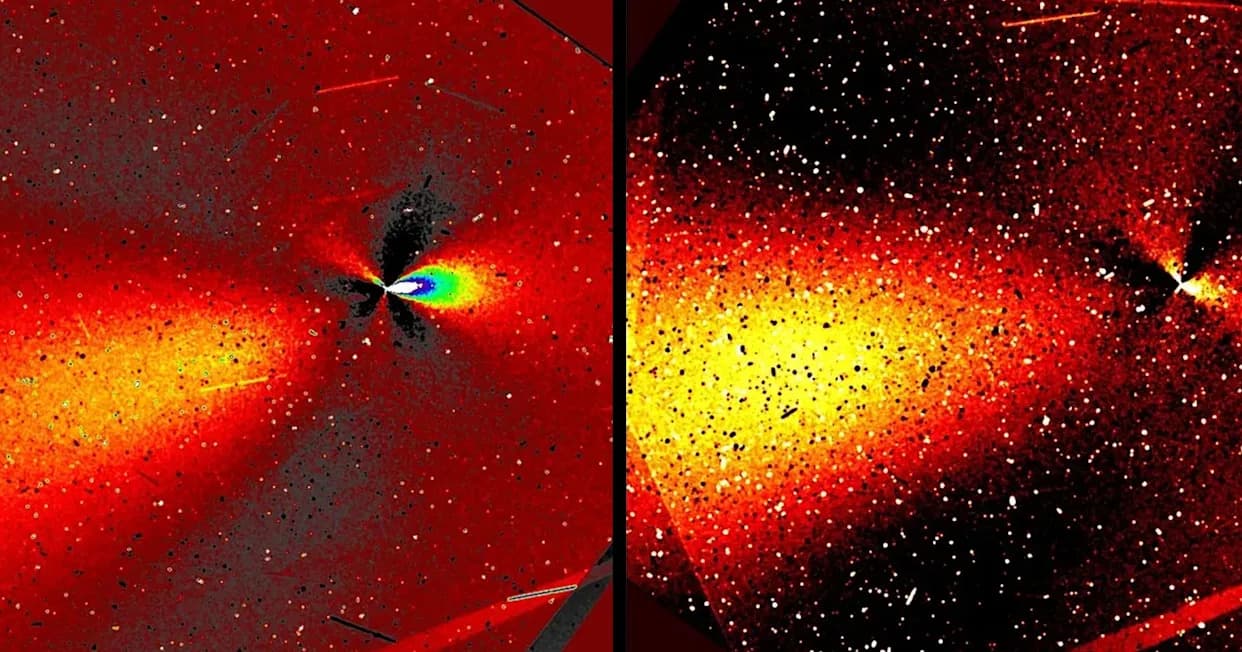
Breakthrough Listen observations with the Green Bank Telescope found no artificial radio emissions from the interstellar object 3I/ATLAS in data taken the day before its closest approach to Earth (~167 million miles). Early analysis reports mostly comet-like features — a visible coma and an unelongated nucleus — and composition consistent with CO2 and water ice. Harvard astronomer Avi Loeb still notes anomalies and rated the object a 4 on his informal "Loeb Scale," but he is awaiting more data before updating that assessment. Given the rarity of interstellar visitors, researchers say continued monitoring is warranted.
Breakthrough Listen Detects No Radio Signals From Interstellar Visitor 3I/ATLAS
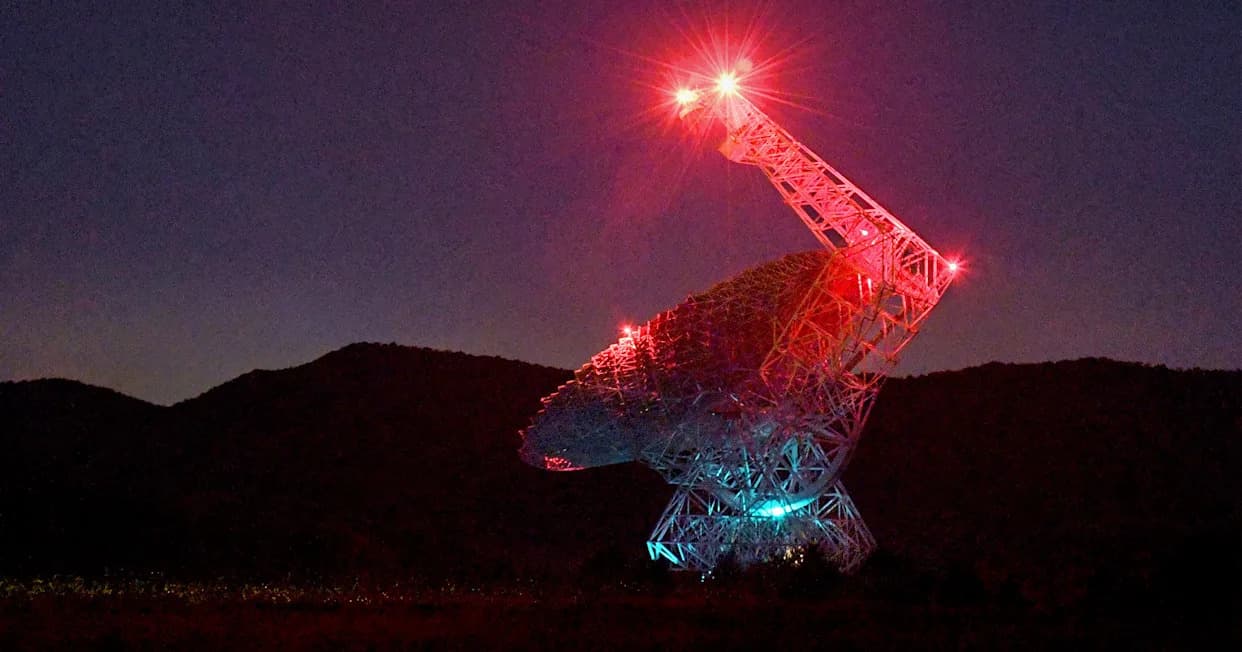
An international team of researchers pointed the largest single-dish radio telescope in the world at 3I/ATLAS.
In July, astronomers using the NASA-funded Asteroid Terrestrial-impact Last Alert System (ATLAS) survey telescope in Chile discovered an extremely rare visitor: an object traveling through the Solar System at a speed too great to be gravitationally bound to the Sun. The object has been designated 3I/ATLAS and is only the third confirmed interstellar object seen in our system.
As 3I/ATLAS made its closest approach to Earth — passing roughly 167 million miles away on December 19 — an international team associated with the Breakthrough Listen initiative pointed the Green Bank Telescope, the world’s largest single-dish radio telescope, at the object to search for artificial radio emissions.
In a paper that is not yet peer reviewed, the team reported that observations taken the day before the flyby produced no credible candidate signals from 3I/ATLAS. "No artificial radio emission localized to 3I/ATLAS was detected," the Search for Extraterrestrial Intelligence Institute (SETI) summarized on its website.
Findings Support a Natural, Cometary Origin
Breakthrough Listen's early analysis finds that 3I/ATLAS displays predominantly comet-like characteristics, including a visible coma and an unelongated nucleus. Several measurements suggest the object's composition is consistent with carbon dioxide and water ice, supporting the interpretation of 3I/ATLAS as a natural interstellar comet rather than an engineered probe.
"There is currently no evidence to suggest that [interstellar objects] are anything other than natural astrophysical objects," the paper states. It adds, however, that because only three such objects are known to date, further study is warranted to rule out rare alternatives.
Why Some Scientists Still Watch Closely
Harvard astronomer Avi Loeb has continued to catalog anomalies he sees in the object's properties, such as its comparatively large inferred size and a trajectory that passes within tens of millions of miles of Mars, Venus and Jupiter. To quantify the plausibility of an artificial origin, Loeb proposed the informal "Loeb Scale," which ranges from 0 (a natural icy body) to 10 (confirmed alien technology). Shortly after discovery, he rated 3I/ATLAS a 4 and has said he will wait for additional data from the period around the closest approach before revising that assessment.
While the null radio result and the growing body of compositional evidence make a technological explanation increasingly unlikely, scientists emphasize the scientific value of continued observations. Interstellar visitors are exceptionally rare — only 'Oumuamua (1I), 2I/Borisov and now 3I/ATLAS have been confirmed — so every dataset helps refine our understanding of how such objects form and travel between stars.
Bottom line: Early Breakthrough Listen observations detected no artificial radio emissions from 3I/ATLAS and the object mostly resembles a cometary body, though astronomers will continue to analyze additional data given the rarity of interstellar visitors.
Help us improve.